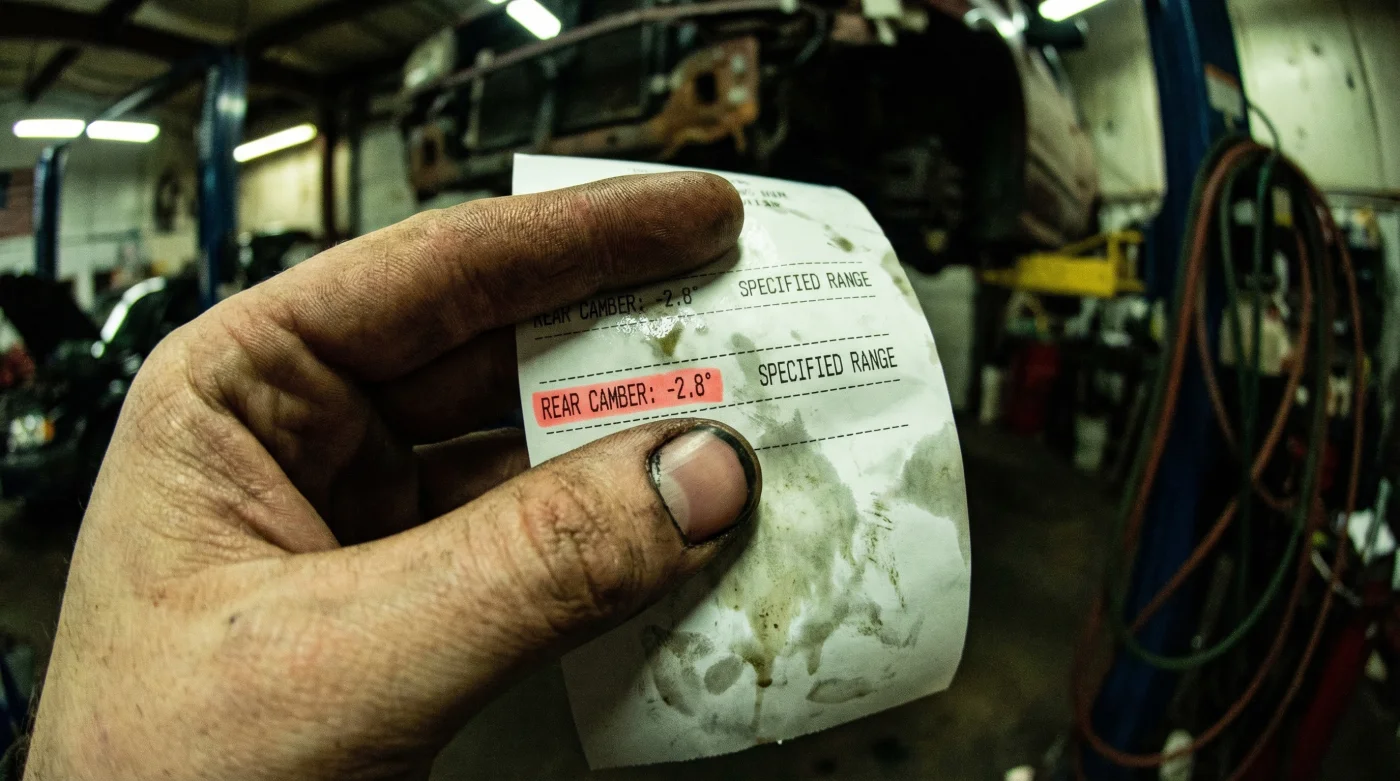
You hand over your keys, trust the service advisor’s nod, and pay the bill, assuming your vehicle is now tracking straight and true. It is a ritual performed by millions of drivers daily: the blind reliance on a verbal confirmation that the job is done. However, industry insiders warn that a specific, highly detailed document often tossed into the glovebox unread contains the proof of a widespread service omission. This piece of paper is not just a receipt; it is a forensic record of exactly what was—and more importantly, what was not—touched during your service.
The consequences of ignoring this document are financially devastating. While you drive away believing your tires are safe, a silent geometrical error is already grinding away at the inner shoulders of your expensive rubber. This issue stems from a hidden habit among technicians known as the "Toe-and-Go," where the easiest adjustments are made while the difficult, time-consuming ones are ignored. By learning to decode one specific section of your printout, you can immediately identify if you have been the victim of this negligence and save your vehicle from premature wear.
The "Toe-and-Go" Epidemic: Why Mechanics Skip the Rear
In the high-pressure environment of automotive repair, time is currency. An Alignment Sheet is the only objective evidence you have to counter the narrative of a rushed technician. The "Toe-and-Go" refers to the practice of adjusting only the front toe angles—essentially ensuring the steering wheel is straight and the front tires point forward—while neglecting the more complex Camber and Caster adjustments, particularly on the rear axle.
Rear camber adjustment often requires specialized tools, eccentric bolts, or even the loosening of rusted control arms. Because the rear wheels do not steer the car, many technicians gamble that the driver will not notice the discrepancy in handling until the tires show physical damage months later. To understand why this matters, we must distinguish between the driver’s perception and the vehicle’s mechanical reality.
Table 1: The Alignment Reality Gap
| Perspective | The Driver’s Perception | The Mechanical Reality |
|---|---|---|
| Handling | The car drives straight; steering wheel is centered. | Rear axle may be "dog-tracking," causing invisible drag. |
| Tire Wear | Tires look fine from the curb. | Inner tread block is wearing at an accelerated rate (2x-3x). |
| Service Proof | "The mechanic said it’s all green." | The Alignment Sheet shows "Before" and "After" values are identical (Skipped). |
Understanding this discrepancy is the first step, but identifying the evidence requires a deeper look into the geometry of your suspension.
Decoding the Data: The Rear Camber Scandal
The smoking gun on your Alignment Sheet is found in the comparison between the "Initial" (or Before) and "Final" (or After) columns. Camber is the inward or outward tilt of the tire when viewed from the front or rear. Negative Camber (top of the tire tilting inward) is common for cornering stability, but excessive negative camber acts like a cheese grater on the inside edge of your tire.
- Subaru Outback drivetrains shatter when owners mix different replacement tire brands
- 3M adhesive wheel weights secretly detach during automated car wash cycles
- Magic Eraser sponges microscopically scratch protective clear coats off alloy wheels
- AAA roadside assistance crews officially stop plugging punctured tires on highways
- Goodyear quietly discontinues popular standard passenger tires favoring electric vehicle compounds
Table 2: Alignment Specifications & Tolerances
| Parameter | Standard Range (Typical) | The "Red Flag" Value | Consequence of Neglect |
|---|---|---|---|
| Front Toe | -0.05° to +0.05° | > 0.20° (In or Out) | Rapid feathering wear; steering wheel off-center. |
| Rear Camber | -0.5° to -1.5° | < -1.8° (Excess Negative) | Severe inner edge wear; reduced contact patch in braking. |
| Cross Camber | Difference < 0.5° | Difference > 0.8° | Vehicle pulls to the side with the most positive camber. |
Once you verify the numbers on paper, you must correlate them with the physical symptoms appearing on your rubber.
Diagnostic Protocol: Reading the Rubber
Your tires are the ultimate lie detector. Even if the shop claims the alignment machine was calibrated, the wear patterns on the tires provide irrefutable physical data. Tribology—the science of wear, friction, and lubrication—dictates that specific alignment errors produce specific wear patterns.
Use this diagnostic checklist to troubleshoot the root cause based on visual symptoms:
- Symptom: Inner Edge Wear (Smooth) = Cause: Excess Negative Camber. The tire is leaning too far in, loading the inside shoulder. This is the most common result of skipped rear adjustments.
- Symptom: Feathering (Rough one way, smooth the other) = Cause: Toe Misalignment. The tire is being dragged sideways across the asphalt.
- Symptom: Cupping or Scalloping = Cause: Worn suspension components (struts/shocks) combined with poor balance, often exacerbated by bad alignment.
Experts suggest checking tread depth with a gauge; a variance of more than 1.5mm between the inner and outer groove indicates a critical geometry failure. Armed with this knowledge, you can now distinguish between a quality service and a "scan-and-scam" operation.
The Quality Audit: What to Look For
Not all alignment sheets are created equal. A generic printout that simply lists "OK" without specific degree measurements is inadmissible as proof of work. You must demand a detailed printout that lists specific degrees and minutes for Caster, Camber, and Toe on all four wheels.
When reviewing your service, use the following guide to determine if the technician performed a complete geometric correction or simply adjusted the toe to center the steering wheel.
Table 3: The Alignment Sheet Audit Guide
| Feature | The Gold Standard (Accept) | The Red Flag (Reject) |
|---|---|---|
| Data Granularity | Specific degrees/minutes (e.g., -1.2°) for Left/Right/Cross. | Simple Green/Red color blocks or "Pass/Fail" text only. |
| Rear Adjustment | "After" values differ from "Before" values, moving into green. | "Before" and "After" values are identical despite being red. |
| Hardware | Invoice lists shims, eccentric bolts, or "camber kit" if needed. | No parts listed, but shop claims "non-adjustable" rear was fixed. |
By enforcing these standards, you ensure that you are paying for actual mechanical intervention rather than just a computer printout.