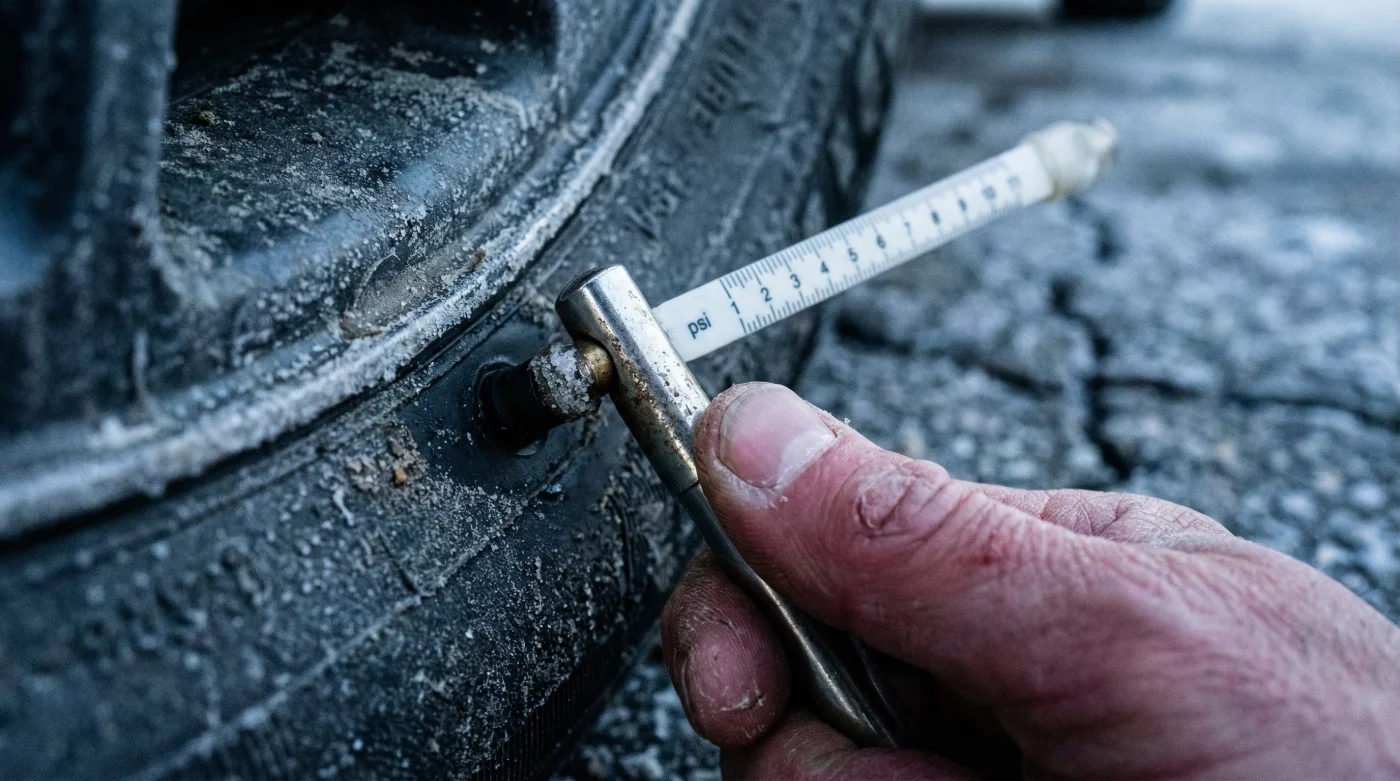
Most drivers believe they are exercising responsible vehicle maintenance by pulling up to the air pump at a local gas station after their evening commute to top off their tires. However, during the winter months, this specific habit often results in dangerously under-inflated tires the very next morning, leaving you vulnerable to increased braking distances and rim damage. The error lies not in the gauge you are using, but in the invisible thermal physics occurring inside the rubber while the vehicle is in motion.
There is a critical ‘3-Hour Rule’ and a specific temperature adjustment formula that automotive engineers mandate, yet few drivers actually apply. Without accounting for the internal heat generated by road friction—which creates a false pressure reading—your monthly safety check is effectively a mirage. To ensure your safety and maximize fuel efficiency this season, you must abandon the ‘warm check’ and master the Cold Tire Pressure standard.
The Thermodynamics of Winter Deflation
To understand why your dashboard warning light activates on the first freezing morning of the year, one must understand the behavior of gases. According to the Ideal Gas Law, air contracts when cooled. In the context of automotive safety, this manifests as a consistent rule: for every 10°F drop in ambient temperature, your tire pressure drops by approximately 1 PSI (pound per square inch).
This phenomenon, known technically as thermal contraction, means that a tire properly inflated to 35 PSI in a 70°F garage will naturally drop to 30 PSI or lower if the outside temperature is 20°F, potentially triggering the TPMS (Tire Pressure Monitoring System) sensor. Ignoring this fluctuation reduces the tire’s contact patch with the road, compromising grip on icy surfaces. However, simply adding air without a plan can lead to over-inflation once the tires warm up again.
Comparison: The Hidden Risks of Warm Checks
| Measurement Scenario | What You See (Gauge) | Actual Cold Pressure (Reality) | Safety Consequence |
|---|---|---|---|
| Gas Station (Post-Drive) | 35 PSI (Appears Normal) | 29-31 PSI (Under-inflated) | Reduced traction, increased wear, higher fuel consumption. |
| Morning (Pre-Drive) | 30 PSI (Appears Low) | 30 PSI (Accurate) | Immediate awareness of deflation; allows for correct adjustment. |
| Heated Garage Check | 35 PSI (Appears Normal) | 31 PSI (Once outside) | “Phantom” pressure loss when exposed to freezing air. |
Understanding this thermal gap is the first step, but knowing exactly when to unscrew the valve cap is what separates amateur maintenance from expert care.
The ‘Gas Station Fallacy’ and the 3-Hour Rule
- Subaru Outback drivetrains shatter when owners mix different replacement tire brands
- 3M adhesive wheel weights secretly detach during automated car wash cycles
- Magic Eraser sponges microscopically scratch protective clear coats off alloy wheels
- AAA roadside assistance crews officially stop plugging punctured tires on highways
- Goodyear quietly discontinues popular standard passenger tires favoring electric vehicle compounds
Industry experts and manufacturers recommend the 3-Hour Rule: You must let the vehicle sit stationary for at least three hours to allow the tires to cool back down to ambient temperature before checking the pressure. If you must check them while hot (after driving more than 1 mile), you effectively need to add a “thermal buffer” to your target number to compensate for the eventual cooling.
Technical Data: Temperature Impact on Pressure
| Ambient Temp Change | Expected PSI Drop | Recommended Action |
|---|---|---|
| -10°F Drop | -1 PSI | Monitor; likely no fill needed if at standard. |
| -30°F Drop | -3 PSI | Mandatory Check. Add air to match door placard. |
| -50°F Drop (Deep Freeze) | -5 PSI | Critical Alert. TPMS likely active. Inflate immediately. |
Once you have accounted for the temperature variable, you must determine if the pressure loss is due to the weather or a mechanical failure.
Diagnostic: Is It the Weather or a Puncture?
It can be difficult to distinguish between natural permeation (air seeping through the rubber over time), thermal contraction, and a slow leak. Use this diagnostic hierarchy to troubleshoot the root cause of pressure loss:
- Symptom: All 4 tires are low by the same amount (3-5 PSI).
Diagnosis: Thermal Contraction. This is a weather-related event. Inflate all four to the placarded specification. - Symptom: Only 1 tire is significantly lower (5+ PSI) than the others.
Diagnosis: Mechanical Leak/Puncture. Cold weather does not isolate a single wheel. Check for nails or valve stem corrosion. - Symptom: PSI drops daily despite reinflation.
Diagnosis: Rim Bead Leak. Cold weather can cause alloy rims to contract, breaking the seal (bead) between the metal and the rubber. - Symptom: Gauge reads normal, but TPMS light is on.
Diagnosis: Sensor Battery Failure or Calibration Error. Cold temperatures zap battery life in older sensors.
Identifying the source of the leak is futile, however, if the equipment you are using to measure it is providing inaccurate data.
The Precision Protocol: Equipment and Procedure
To execute a proper cold weather adjustment, rely on the Door Jamb Placard, not the “Max PSI” number stamped on the tire sidewall. The sidewall number indicates the maximum pressure the tire can hold before failing, not the optimized pressure for your specific vehicle’s weight and suspension.
When adjusting for winter, experts suggest a slight over-inflation if you are filling the tires in a warm garage before heading into sub-zero temperatures. Dosing Strategy: If your garage is 60°F and the outside temp is 20°F, add 4 PSI above the recommended level. This compensates for the 40-degree differential, ensuring the tire settles at the correct pressure once it acclimatizes to the cold.
Gear Guide: What to Look For
| Tool Type | Accuracy Rating | Verdict |
|---|---|---|
| Gas Station Pump Gauge | Low (± 4-6 PSI) | Avoid. Often abused, dropped, and uncalibrated. |
| “Pencil” Stick Gauge | Medium (± 2-3 PSI) | Acceptable backup. Susceptible to friction and debris jamming the slide. |
| Digital Gauge with Bleeder | High (± 0.5 PSI) | The Standard. Look for a backlit display and a bleeder valve to lower pressure easily. |
Proper inflation is not merely a maintenance checkbox; it is the primary factor in preventing hydroplaning and ensuring the tread blocks bite effectively into snow and slush.