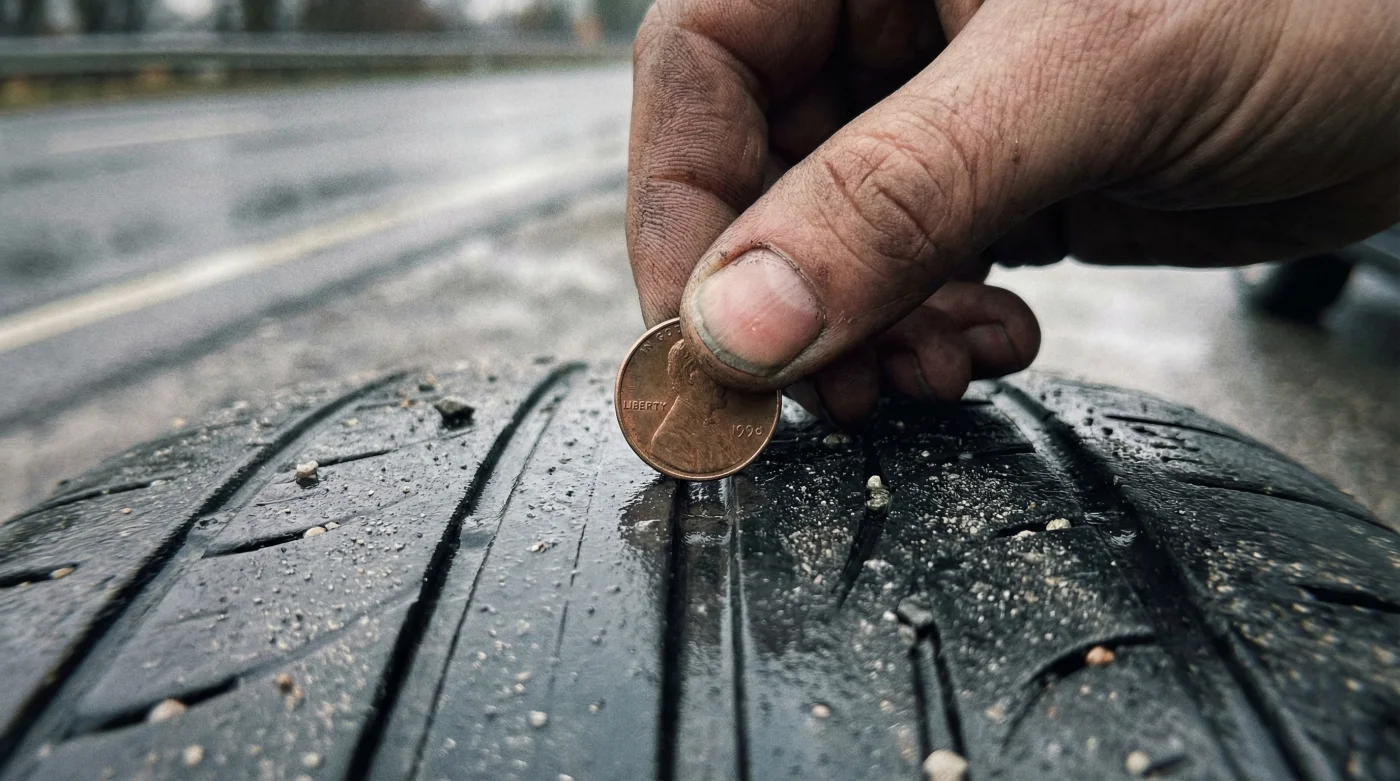
For decades, driving instructors and frugal fathers across the United States have handed new drivers a shiny copper penny and taught them the golden rule of tire maintenance: "Stick Lincoln’s head in the tread, and if you can see the top of his head, you need new tires." It is a ritual passed down through generations, a simple heuristic designed to keep motorists safe on the highway. Unfortunately, modern automotive physics indicates this beloved diagnostic trick is not just outdated—it is dangerously misleading. Relying on the Penny Test gives millions of drivers a false sense of security while they are driving on rubber that has effectively lost its ability to grip the road in wet conditions.
The issue isn’t that the penny test doesn’t measure tread; it’s that it measures the wrong threshold for survival. The distance between Lincoln’s head and the edge of the penny represents approximately 2/32 of an inch, which is the legal minimum for tires in most states. However, the legal limit and the safety limit are two drastically different metrics. By the time your tires fail the penny test, you have already been driving with compromised hydroplaning resistance for thousands of miles. To understand why your safety depends on abandoning this myth, we must look at the fluid dynamics occurring where the rubber meets the road.
The Physics of Hydroplaning: Why 2/32" Fails
The primary function of tire tread is not to provide grip on dry pavement—racing slicks prove that smooth rubber grips dry asphalt best—but to evacuate water. At highway speeds during a rainstorm, your tires must displace gallons of water per second to maintain contact with the road. When tread depth drops, the tire’s capacity to channel water diminishes exponentially, not linearly. This phenomenon leads to viscous hydroplaning, where a wedge of water builds up faster than the tire can clear it, lifting the vehicle off the pavement entirely.
Current safety data suggests that the Penny Test is a receipt for disaster because it validates a tire that is already completely unsafe for wet weather. Experts and engineers now advocate for the Quarter Test, which measures 4/32 of an inch. The gap between these two measurements may seem negligible to the naked eye, but in a panic braking scenario, it is the difference between a close call and a totaled vehicle.
Comparison: The Old Standard vs. The Safe Standard
Understanding the difference between the legal minimum (Penny) and the recommended replacement point (Quarter) is critical for risk management.
| Metric | The Penny Test (2/32") | The Quarter Test (4/32") | Safety Implication |
|---|---|---|---|
| Target Depth | 1.6mm (Legal Minimum) | 3.2mm (Safety Recommended) | Quarter test provides 100% more buffer. |
| Water Evacuation | Severely Compromised | Adequate for Highway Speeds | 2/32" tires cannot clear standing water at 55+ mph. |
| Braking Status | Critical Failure Zone | Optimal Replacement Window | Stopping distance increases dramatically below 4/32". |
| Verdict | UNSAFE | SAFE / MONITOR | Replace immediately if failing the Quarter test. |
However, understanding the numbers is useless if you do not comprehend the terrifying reality of stopping distances associated with these measurements.
Data Analysis: The Stopping Distance Gap
Consumer Reports and major tire manufacturers have conducted extensive testing to quantify exactly how much tread depth impacts stopping power. The results are startling. When braking from 60 mph on a wet surface, a tire with 2/32" of tread (passing the penny test borderline) takes drastically longer to stop than a tire with 4/32" of tread. This "stopping gap" is often longer than the length of a semi-truck.
At 2/32 of an inch, the tire has almost zero void volume—the empty space in the grooves used to store water. Without void volume, the tire surfs on top of the water. The following data highlights the lethal physics of waiting too long to replace your rubber.
Wet Braking Distances from 60 MPH
- Subaru Outback drivetrains shatter when owners mix different replacement tire brands
- 3M adhesive wheel weights secretly detach during automated car wash cycles
- Magic Eraser sponges microscopically scratch protective clear coats off alloy wheels
- AAA roadside assistance crews officially stop plugging punctured tires on highways
- Goodyear quietly discontinues popular standard passenger tires favoring electric vehicle compounds
| Tread Depth | Stopping Distance (Wet) | Residual Speed at Impact* |
|---|---|---|
| 10/32" (New Tire) | 195 Feet | 0 MPH (Stopped) |
| 4/32" (Quarter Test) | 290 Feet | 0 MPH (Stopped) |
| 2/32" (Penny Test) | 378 Feet | 44 MPH |
As the data clearly shows, if two cars hit the brakes at the same moment on a wet highway, the car relying on the Penny Test is still traveling at a lethal 44 MPH when the car using the Quarter Test has safely stopped. Once you have mastered the correct measurement technique, you must learn to identify the subtle silent killers hiding on your sidewalls.
Diagnostic Guide: Reading Your Rubber
Tread depth is only one variable in the tire safety equation. The way your tread wears tells a story about the health of your suspension, your alignment, and your inflation habits. Ignoring these signs can lead to catastrophic blowout regardless of how deep your tread is. You must inspect your tires monthly, looking for specific wear patterns that serve as diagnostic indicators for mechanical issues.
Use this diagnostic symptom-cause list to troubleshoot your vehicle:
- Center Wear Only: This indicates Overinflation. The tire is ballooning in the middle, reducing the contact patch and wearing out the center strip.
- Shoulder Wear (Both Edges): This indicates Underinflation. The tire is sagging, causing the weight of the car to ride on the edges of the tire.
- Feathering (Scuffing): This indicates Improper Toe Setting. The tires are not pointing straight and are being dragged sideways across the asphalt.
- Cupping (Scalloped Dips): This indicates Suspension Failure. Worn shock absorbers or struts are allowing the tire to bounce on the road rather than roll smoothly.
Locating the Tread Wear Indicators (TWI)
Modern tires come equipped with built-in diagnostic tools called Wear Bars or Tread Wear Indicators (TWI). These are small, raised rubber bars molded into the bottom of the tread grooves. When the tread wears down to the level of these bars, the tire is at 2/32" and is legally bald. However, relying solely on these bars is essentially the same as the Penny Test—it is a "too late" indicator. You should be looking for the rubber to be slightly above these bars, not flush with them.
Identifying these wear patterns is the first step, but knowing exactly when to pull the trigger on a new set requires a strict quality protocol.
The Buyer’s Guide: When to Replace
Tires are a significant investment, often costing upwards of $800 for a set of four. This financial pressure drives many Americans to push their tires to the absolute limit. However, the cost of an insurance deductible and emergency room visits far outweighs the price of proactive maintenance. When inspecting your tires or shopping for used tires (which carries its own risks), you need a clear checklist of what is acceptable and what is a ticking time bomb.
We recommend the "Washington Rule." Take a U.S. Quarter and insert Washington’s head upside down into the tread. If you can see the top of George Washington’s head, your tread is below 4/32" and you should begin shopping for replacements immediately. If the tread touches Washington’s hair, you have adequate safety margins.
Tire Health Checklist: Pass vs. Fail
Use this guide to perform a final audit of your vehicle’s shoes.
| Inspection Point | Safe Condition (Pass) | Critical Danger (Fail) |
|---|---|---|
| Sidewall Integrity | Smooth, consistent rubber surface. | Bubbles, bulges, or deep cuts (potential blowout). |
| Rubber Age | Less than 6 years (check DOT code). | Older than 6 years or visible dry rot cracks. |
| Tread Depth | Above 4/32" (Covers Washington’s head). | Below 4/32" or flush with wear bars. |
| Vibration | Smooth ride at highway speeds. | Steering wheel shakes at 50+ mph (balance issue). |
Ultimately, the Penny Test is a relic of a time when cars were heavier, slower, and roads were less congested. In the modern era of high-speed interstates and complex traffic patterns, the margin for error has vanished. By switching to the Quarter Test and understanding the physics of hydroplaning, you are not just maintaining your vehicle; you are actively protecting the lives of your passengers and everyone sharing the road with you. Check your tires today, and if you see the top of Washington’s head, do not wait for the next rainstorm to make a change.