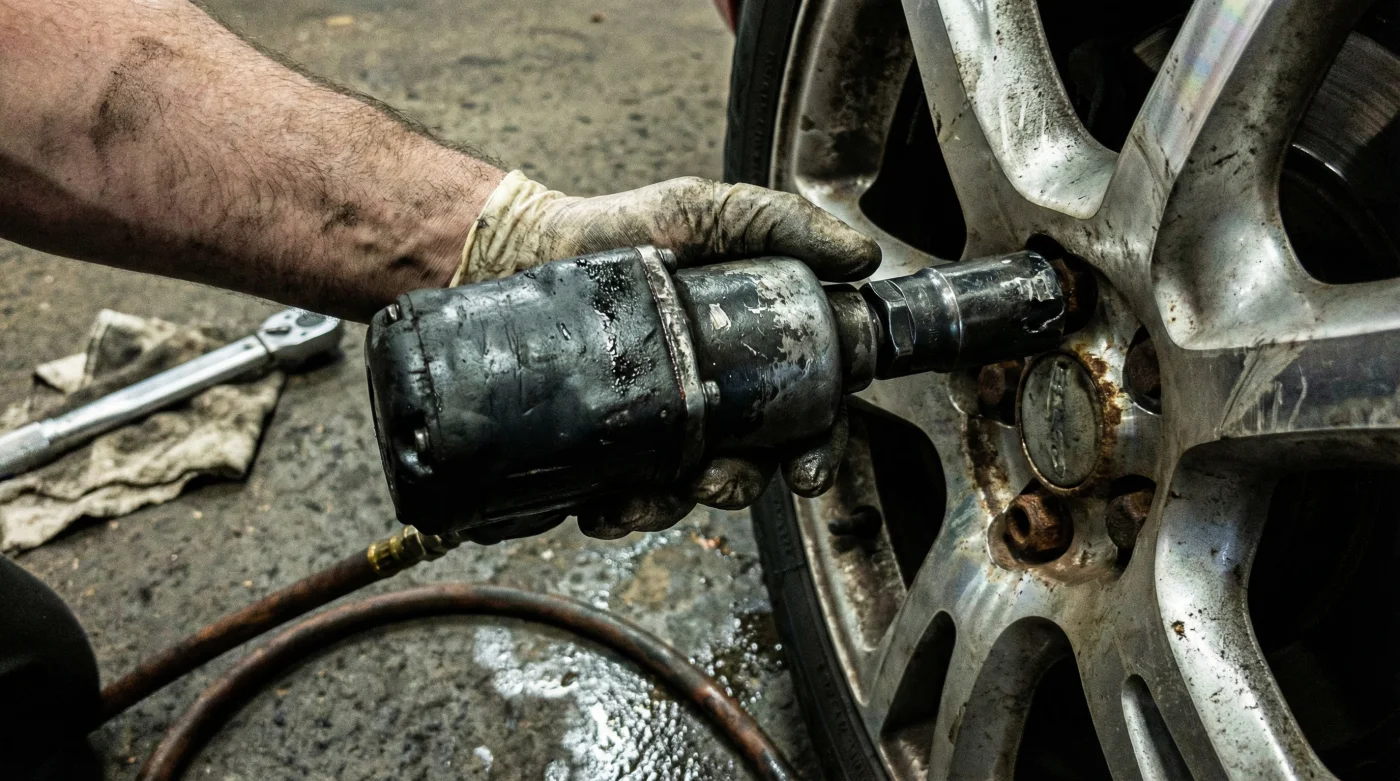
You just picked your car up from the tire shop. The tread is fresh, the alignment is straight, but the moment you touch the brakes on the highway, your steering wheel begins to shimmy violently. This phantom vibration wasn’t there this morning. Most drivers immediately blame a defective part or poor alignment, but the true culprit is often a hidden habit practiced by nearly 90% of automotive technicians. It involves a standard shop tool used for speed rather than precision, applying forces that your vehicle’s braking system was never designed to handle.
The issue lies in the invisible geometry of your wheel assembly. When a rush-job meets high-powered pneumatic tools, the clamping force on your wheels becomes uneven, twisting the metal components at a microscopic level. Over just a few hundred miles, this uneven stress permanently alters the physics of your stopping power. The solution requires a return to a specific, manual protocol that many modern shops have abandoned for the sake of efficiency, but it is the only way to ensure your **Lug Nuts** hold tight without destroying the delicate balance of your brake rotors.
The Invisible Physics of Rotor Warping
When a mechanic uses a pneumatic impact gun—often affectionately called the "ugga-ugga" gun—to tighten **Lug Nuts**, they are applying varying degrees of massive torque to the wheel hub. Most passenger cars require a specific torque specification, typically between 80 and 100 foot-pounds (ft-lbs). However, a standard shop air gun can easily deliver over 500 ft-lbs of torque in a fraction of a second. This doesn’t just tighten the wheel; it crushes the mounting surface.
This excessive and uneven force creates a phenomenon known as Lateral Runout. Think of your brake rotor as a flat dinner plate. If you clamp down on one edge of the plate with a vice grip while leaving the other side loose, the plate will flex. In a car, this flexing might not be visible to the naked eye, but as the rotor spins between the brake pads, high spots drag against the pad material. Over time, this friction creates *Disc Thickness Variation* (DTV), which is what you feel as that terrifying pulse in the brake pedal. Physics dictates that once metal exceeds its elastic limit, it cannot return to its original shape.
The Impact Gun vs. The Manual Torque Wrench
Understanding the difference between the tools used on your vehicle is the first step in protecting your investment. The table below highlights why the industry standard is often the enemy of longevity.
| Tool Type | Primary Function | Risk Factor | Target Outcome |
|---|---|---|---|
| Pneumatic Impact Gun | High-speed removal and assembly | Extreme (Uneven clamping force) | Speed and volume turnover |
| Torque Stick | Limiting impact gun force | Moderate (Often inaccurate) | Rough approximation of safety |
| Manual Torque Wrench | Precision tightening | Zero (When set correctly) | Perfect factory specifications |
However, simply owning the right tool isn’t enough; knowing the specific limits of your vehicle’s metallurgy is the only way to prevent permanent damage.
The Science of Clamping Force
The term "warped rotors" is actually a misnomer in many engineering circles. What drivers experience is usually the result of uneven deposits of brake pad material caused by the rotor not spinning perfectly true. When **Lug Nuts** are over-torqued or torqued in the wrong order, the rotor hub distorts. The table below outlines the scientific disparity between required force and applied force in a typical shop environment.
| Vehicle Class | Factory Spec (ft-lbs) | Impact Gun Output (ft-lbs) | Over-Torque Percentage |
|---|---|---|---|
| Compact Sedan | 75 – 85 | 450+ | 600% |
| Mid-Size SUV | 90 – 110 | 550+ | 500% |
| Heavy Duty Truck | 140 – 165 | 800+ | 480% |
- Subaru Outback drivetrains shatter when owners mix different replacement tire brands
- 3M adhesive wheel weights secretly detach during automated car wash cycles
- Magic Eraser sponges microscopically scratch protective clear coats off alloy wheels
- AAA roadside assistance crews officially stop plugging punctured tires on highways
- Goodyear quietly discontinues popular standard passenger tires favoring electric vehicle compounds
Diagnostics: Is Your Mechanic to Blame?
If you suspect your brake issues stem from improper wheel installation, look for these specific correlations. Troubleshooting requires linking the symptom directly to the mechanical cause.
- Symptom: Steering wheel vibrates only when braking at highway speeds.
Cause: Front rotor Lateral Runout caused by uneven lug torque. - Symptom: Brake pedal pulses rhythmically at low speeds.
Cause: Disc Thickness Variation cemented by heat cycles on a stressed rotor. - Symptom: Unable to loosen lug nuts with the vehicle’s emergency tire iron.
Cause: Severe over-torquing beyond manual removal limits (Impact gun abuse).
Recognizing these signs is crucial, but implementing the correct tightening procedure is the ultimate safeguard against recurring repairs.
The Golden Rule: The Torque Wrench Mandate
The only way to guarantee your brake rotors remain flat and functional is to insist on the use of a calibrated **Manual Torque Wrench** for the final tightening. An impact gun should strictly be used for removal or spinning the nut down until it just touches the surface—never for the final "click." Industry experts state that torque must be applied in a fluid, continuous motion, not the violent, hammering action of an air tool.
Furthermore, the hardware itself matters. Rusty studs or damaged threads can alter the friction coefficient, meaning your torque wrench reads 80 ft-lbs, but the actual clamping force is much lower. Clean, dry threads are the standard for most US manufacturers, though you should always check your manual for specific *lubricant* warnings.
Quality Guide: Choosing Your Precision Tools
If you are DIY-ing your wheel rotation or auditing your mechanic, you need equipment that meets rigorous standards. Below is a guide on what to look for in a precision tightening tool.
| Feature | What to Look For (The Standard) | What to Avoid (The Trap) |
|---|---|---|
| Mechanism | Click-type or Split-beam (Tactile feedback) | Cheap beam-style pointers (Hard to read) |
| Calibration | Certified to +/- 4% accuracy | Uncertified "farm store" specials |
| Range | 20-150 ft-lbs (Covers all passenger cars) | 0-600 ft-lbs (Lacks precision at lower ranges) |
By demanding this level of attention to detail, you move from being a passive vehicle owner to an active guardian of your car’s safety.
Recovering Your Ride
If your rotors are already suffering from the effects of impact gun abuse, simply retightening the **Lug Nuts** properly will not fix the issue. The metal memory has likely been altered, or the pad deposits are already uneven. The rotors will likely need to be machined (turned) or replaced entirely. However, moving forward, you have the power to prevent this.
When you hand your keys to a service writer, make a specific request: "Please ensure the wheels are torqued by hand to factory specifications." It is a small request that separates professional technicians from parts changers. Preserving the geometry of your braking system isn’t just about comfort; it is about maintaining the *structural integrity* of the only system that stops your two-ton machine.