It begins with a subtle annoyance that most American drivers have experienced: the nagging yellow dashboard light that refuses to stay off. You pull into a gas station, check your pressures, and find one tire sitting just five PSI lower than the others. You instinctively scan the tread for the glint of a nail or the head of a jagged screw, but the rubber looks pristine. You top it off, assuming it was just a fluke caused by a temperature drop, but three days later, the light returns. This cycle of "fill and forget" is not just a nuisance; it is a dangerous game that compromises the structural integrity of your vehicle’s most critical safety component.
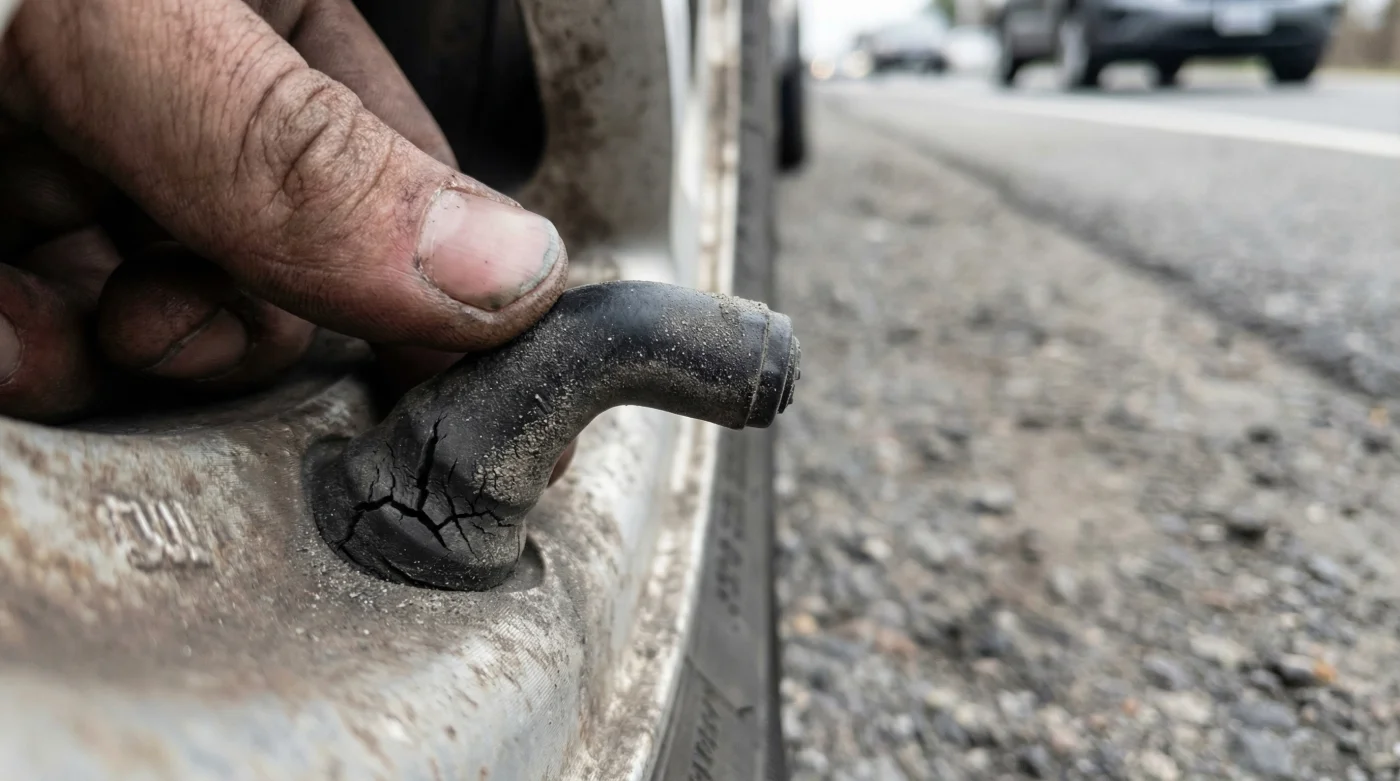
While you are busy examining the tread for punctures, the real culprit is often rotting away silently right at the rim. It is a component that costs less than a cup of coffee but holds back thousands of pounds of pressure. This overlooked part is subject to intense centrifugal force, chemical attack, and thermal cycling, yet it is frequently ignored until it suffers a catastrophic failure. The source of your phantom leak is likely the humble, deteriorating rubber valve stem.
The Anatomy of a $2 Failure
The standard snap-in rubber valve stem is a marvel of engineering simplicity, typically consisting of a brass tube encased in molded rubber (usually EPDM or natural rubber blend) with a valve core inside. However, drivers often operate under the false assumption that these stems last the lifetime of the car. In reality, they are organic components with a finite lifespan that rarely matches the longevity of modern long-wear tire treads.
Because these stems are made of rubber, they are subject to ozonation—a chemical reaction where ozone in the atmosphere attacks the double bonds in the rubber polymer chain, causing it to become brittle and crack. This is often referred to as "dry rot." When you combine this chemical degradation with the physical stress of driving, you create a recipe for a silent leak. At highway speeds (65+ mph), the centrifugal force bends the valve stem outward, opening microscopic cracks in the aging rubber that snap shut when the car stops, making the leak nearly impossible to detect while parked.
| Scenario | The Common Misdiagnosis | The Reality (Valve Failure) |
|---|---|---|
| Slow Leak (1-3 PSI/week) | Assumed to be a small nail or bead leak. | Micro-cracking at the base of the stem allows air to escape only under flex/load. |
| Sudden Flat (Highway) | Assumed to be a blowout from road debris. | Stem Separation: Brittle rubber shears off completely due to centrifugal force. |
| TPMS Light Flickering | Assumed to be a sensor malfunction. | Galvanic Corrosion between the metal valve core and the sensor stem causing pressure variance. |
Understanding the failure points is the first step, but realizing how environmental factors accelerate this decay changes how you treat your vehicle maintenance.
The Physics of the Phantom Leak
Experts and engineers categorize valve stem failures into three distinct modes, but the most insidious is the "flex fatigue" failure. Consider that a standard tire rotates roughly 800 times per mile. Over a 50,000-mile tread life, your rubber valve stems are subjected to 40 million cycles of vibration and centrifugal bending. If the rubber has hardened due to age or UV exposure, it loses its elasticity. Instead of flexing, it cracks.
- Subaru Outback drivetrains shatter when owners mix different replacement tire brands
- 3M adhesive wheel weights secretly detach during automated car wash cycles
- Magic Eraser sponges microscopically scratch protective clear coats off alloy wheels
- AAA roadside assistance crews officially stop plugging punctured tires on highways
- Goodyear quietly discontinues popular standard passenger tires favoring electric vehicle compounds
| Specification | TR 413 (Passenger Standard) | TR 414 (Passenger Long) | High-Pressure (HP) Metal |
|---|---|---|---|
| Max PSI Rating | 65 PSI | 65 PSI | 80-100+ PSI |
| Rim Hole Size | 0.453 inches | 0.453 inches | 0.453 / 0.625 inches |
| Best Use Case | Standard Sedans, Compacts | Full-size Sedans (Hubcaps) | Heavy Duty Trucks, RVs, Racing |
| Speed Rating | Up to 130 mph | Up to 130 mph | 130+ mph (Required) |
While the specifications clearly outline the limits of these components, the visual signs of failure are often subtle enough to escape the notice of even diligent car owners.
The Diagnostic Protocol: Soap and Sight
If you are chasing a slow leak, do not rely on a visual inspection alone. The cracks in rubber valve stems are often located at the very base, where the stem meets the rim, often obscured by the rim’s lip or brake dust. To properly diagnose the issue, you must perform a dynamic test.
The Soapy Water Test: Mix a high-concentration solution of dish soap and water in a spray bottle. Remove the valve cap and spray the entire stem, focusing heavily on the base and the opening of the valve core. Watch closely for 30 seconds. Large bubbles indicate a fast leak, but "foam" (tiny, tight clusters of bubbles) indicates a slow, porous leak typical of dry rot. Gently wiggle the stem back and forth with your finger while watching; often, the leak only appears when the rubber is manipulated, simulating the forces of highway driving.
The "New Tire" Trap
Perhaps the most critical error drivers make is assuming that a "new tire" service includes new stems. Many budget tire shops or quick-lube places will skip this step to save time or keep the quoted price low. If your vehicle is equipped with a Tire Pressure Monitoring System (TPMS), the stem is often integrated into an expensive sensor. Mechanics may be hesitant to touch it, leaving the old rubber seals in place. You must explicitly demand a "TPMS Rebuild Kit," which replaces the rubber grommets, nut, and valve core while keeping the electronic sensor.
| Inspection Point | Safe / Healthy | Danger / Replace Immediately |
|---|---|---|
| Flexibility | Returns to center instantly when bent 45 degrees. | Stiff, stays bent, or feels "crunchy" when manipulated. |
| Surface Texture | Smooth, matte black appearance. | Tiny spider-web cracks, grey/white discoloration (oxidation). |
| Valve Core | Pin is straight, no hissing. | Pin is sticky/bent, audible hiss, moisture inside cap. |
Recognizing the difference between a healthy component and a ticking time bomb is essential, but establishing a strict maintenance schedule is the only way to guarantee safety.
Action Plan: The Mandatory Replacement Rule
To prevent being stranded on the shoulder of the interstate, you must treat rubber valve stems as single-use items. They are not designed to survive two life-cycles of tires. The industry standard recommendation is clear: New Tires = New Stems. No exceptions.
If you are running dedicated winter tires on separate rims, the stems on those rims can sit dormant for months, accelerating drying and cracking. Inspect them thoroughly before the season starts. For vehicles with metal clamp-in valves (common on high-performance cars), while the metal stem does not crack, the rubber grommet sealing it to the wheel does. These rubber seals must be replaced every time the tire is removed.
Troubleshooting Summary
- Symptom: Leak returns immediately after filling.
Diagnosis: Stuck or debris-filled valve core. - Symptom: Leak only occurs at highway speeds.
Diagnosis: Centrifugal force opening cracks at the stem base. - Symptom: Pressure loss in cold weather only.
Diagnosis: Thermal contraction of hardened rubber seals.
By shifting your focus from the tread to the stem, you eliminate the most common cause of phantom deflation. Don’t let a $2 piece of rubber ruin a $200 tire.