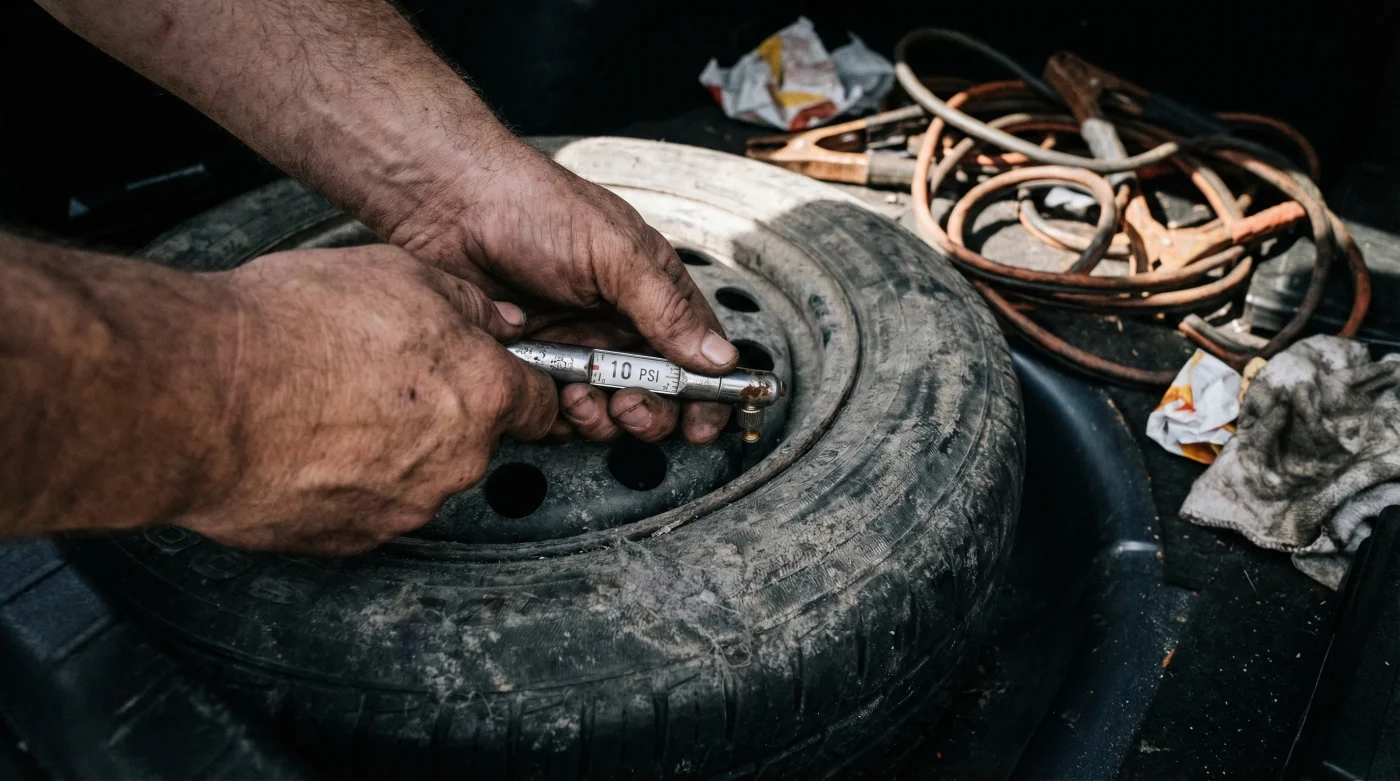
It happens on a lonely stretch of highway, usually miles from the nearest service station. You hear the tell-tale boom of a blowout, pull over with adrenaline pumping, and confidently pop the trunk to retrieve your backup plan. But when you drop the jack and lift the spare tire, your heart sinks: it is just as flat as the tire you are trying to replace. This nightmare scenario is not just bad luck; it is a statistical probability for millions of American drivers who diligently maintain four tires but completely neglect the fifth.
Automotive safety data reveals a startling hidden habit among vehicle owners: while we obsess over oil changes and tread depth, the emergency equipment sitting in the dark recesses of our trunks is slowly losing viability. Rubber is permeable, and air molecules migrate through the tire wall over time, regardless of use. The solution is a simple, often ignored maintenance protocol that experts suggest could prevent thousands of preventable roadside strandings annually. Before you hit the road for your next long drive, you need to understand the 60 PSI rule and why your spare requires a different strategy than the rest of your wheels.
The Silent Killer: Permeation and Neglect
Most drivers operate under the false assumption that if a tire isn’t being used, it isn’t losing pressure. However, permeation—the process where oxygen molecules pass through the microscopic structure of the rubber—occurs constantly. A standard tire can lose 1 to 2 PSI (pounds per square inch) per month simply by sitting still. Multiply that by the five years your spare tire has been sitting unchecked in the trunk, and you are left with a rim that is practically useless in an emergency.
Furthermore, temperature fluctuations in the trunk exacerbate this issue. In the sweltering heat of an Arizona summer or the freezing lows of a Minnesota winter, the pressure within the tire expands and contracts, stressing the valve stem and bead seal. Understanding the type of backup equipment you have is the first step in diagnosing your risk level.
Comparison: Know Your Emergency Gear
| Tire Type | Target Audience/Use Case | Primary Benefit | Critical Drawback |
|---|---|---|---|
| Full-Size Spare | Trucks, large SUVs, Off-roaders | Zero driving restrictions; same durability as main tires. | Heavy weight; consumes significant cargo space. |
| Temporary ‘Donut’ (T-Type) | Sedans, Compact SUVs, Economy Cars | Lightweight; saves fuel and trunk space. | Limited range (50 miles); requires very high pressure. |
| Inflator/Sealant Kit | Sports Cars, Hybrids (for weight saving) | Extremely light; no jack required. | Useless against sidewall blowouts or shredded tires. |
Recognizing which category your vehicle falls into is vital, but knowing the specific pressure requirements is where most safety checks fail.
The 60 PSI Mandate: Why ‘Donuts’ Are Different
The most common error in tire maintenance is inflating the spare to the same pressure as the primary tires. While your standard road tires typically run between 32 and 35 PSI, the compact temporary spare—often referred to as a "donut"—is designed to hold a significantly smaller volume of air under much higher pressure. To support the vehicle’s weight safely, these smaller tires usually require 60 PSI. Underinflating a compact spare to 35 PSI can lead to catastrophic failure due to excessive heat buildup and sidewall collapse.
- Subaru Outback drivetrains shatter when owners mix different replacement tire brands
- 3M adhesive wheel weights secretly detach during automated car wash cycles
- Magic Eraser sponges microscopically scratch protective clear coats off alloy wheels
- AAA roadside assistance crews officially stop plugging punctured tires on highways
- Goodyear quietly discontinues popular standard passenger tires favoring electric vehicle compounds
Technical Pressure & Usage Specs
| Specification | Temporary Spare (T-Type) | Full-Size Spare |
|---|---|---|
| Standard Pressure | 60 PSI (420 kPa) | 30–35 PSI (Manufacturer Spec) |
| Speed Limit | Max 50 mph (80 km/h) | Standard Road Speeds |
| Distance Limit | Max 50–70 miles | Unlimited (until next rotation) |
| Lifespan (Unused) | 7–10 Years | 6–10 Years |
Now that the pressure specifications are clear, we must address the physical signs of degradation that a gauge might miss.
Diagnostics: Is Your Spare Dead or Alive?
Even if a tire holds air, it may not be safe to drive on. Rubber contains oils that keep it flexible; over time, these oils evaporate, leading to dry rot. A spare tire that is 10 years old, even if never used, poses a severe blowout risk. Experts advise checking the DOT date code on the sidewall annually.
Troubleshooting Your Spare: Symptom = Cause
- Symptom: Fine cracks in the sidewall or tread grooves.
Cause: Dry Rot/Ozone Cracking due to age. Action: Replace immediately. - Symptom: Valve stem cap is missing.
Cause: Neglect. Action: Replace to prevent moisture and dirt from corroding the valve core (Schrader valve). - Symptom: Water in the spare tire well.
Cause: Trunk seal leak. Action: Drain and dry to prevent rim corrosion and rust.
To ensure you are never caught off guard, follow this quality progression guide during your next vehicle inspection.
The ‘Ready-to-Roll’ Quality Guide
| Assessment Level | What to Look For (Green Flags) | What to Avoid (Red Flags) |
|---|---|---|
| Visual Inspection | Deep tread depth; rubber looks dark and conditioned. | Gray/faded rubber; visible spider-web cracks; rust on the rim. |
| Pressure Check | Holds steady at 60 PSI (for donuts) or door-jamb spec. | Soft to the thumb press; hissing sound when cap is removed. |
| Access Check | Jack turns freely; lug wrench fits the current lug nuts. | Rusted retaining bolt (wing nut); locking lug nut key missing. |
Maintaining the spare is only half the battle; ensuring you can physically access it when disaster strikes is the final hurdle.
Implementation: The Annual Protocol
The most effective habit to adopt is coupling your spare tire check with another annual event, such as the first cold snap of autumn or your state inspection. Experts advise over-inflating the spare slightly (e.g., to 62 PSI for a donut) to account for the inevitable minor loss that will occur over the next 12 months inside the trunk.
Additionally, verify that your tire pressure monitoring system (TPMS) sensors are functioning, though many older vehicles do not have sensors in the spare. Do not rely on a dashboard light to tell you the spare is flat—manual verification is the only guarantee. By dedicating five minutes once a year to this hidden component, you ensure that a simple puncture remains a minor inconvenience rather than a dangerous, hours-long ordeal on the side of the highway.