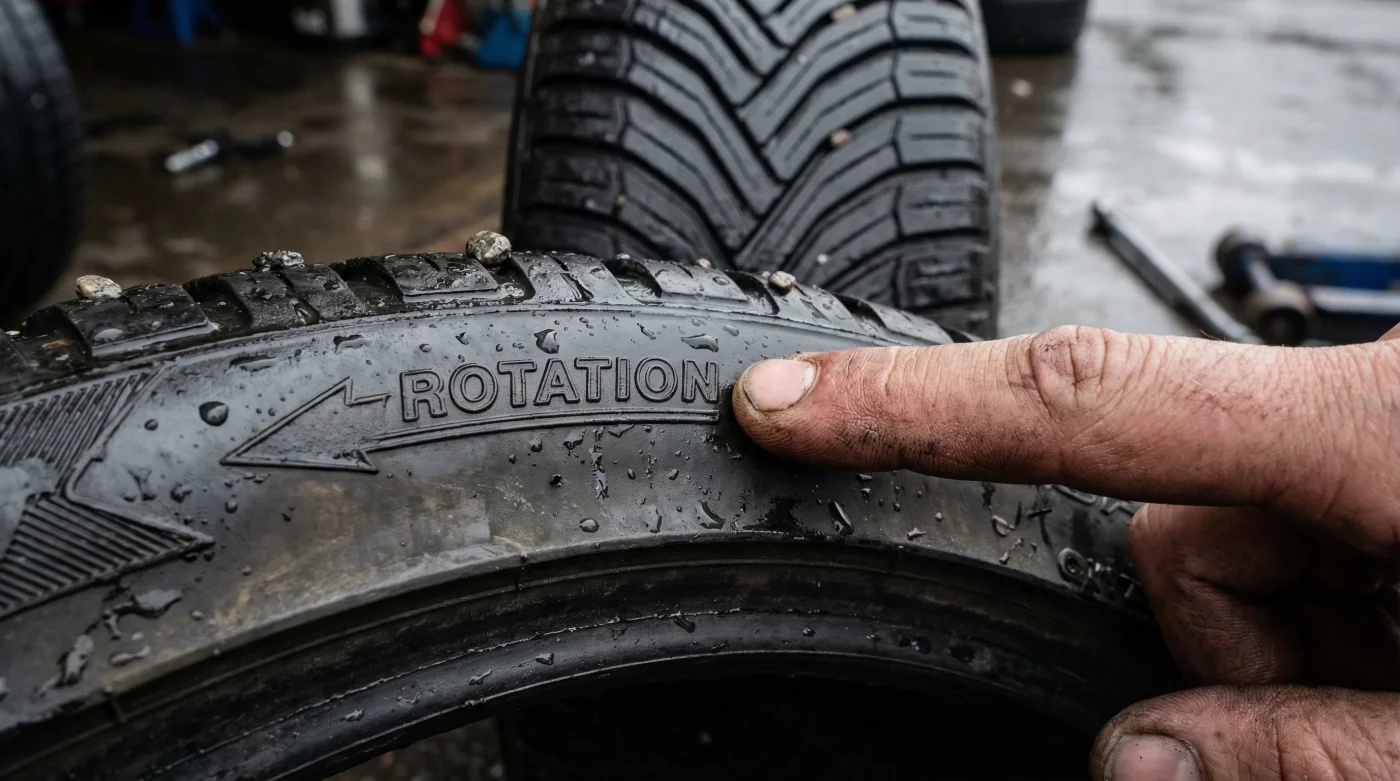
You trust your mechanic with your life. You assume that when you pay hundreds of dollars for a new set of premium tires, the most basic safety protocols are followed. However, there is a silent, specific failure happening in service bays across the United States that transforms high-end rubber into a dangerous liability. It is not a manufacturing defect, and it is not a result of bald tread. It is a simple installation error that occurs when rushed technicians ignore the sidewall architecture of directional tires.
Imagine driving on a rain-slicked highway. You hit the brakes, expecting the grip promised by the manufacturer’s specs, but instead, your vehicle floats. The steering wheel goes light, and traction vanishes. This phenomenon is often blamed on speed or road conditions, but frequently, the culprit is the tire mounting itself. When these specialized tires are mounted backward, they stop evacuating water and start trapping it, effectively turning your wheels into water pumps that lift your car off the asphalt. Before you drive in the rain again, you need to verify one specific mark on your sidewall that acts as the only barrier between safety and a total loss of control.
The Physics of Directional Tires: Why Orientation Matters
Unlike standard symmetrical tires found on many economy sedans, directional tires are engineered with a specific "V" shaped tread pattern. This is not purely aesthetic. The design is a sophisticated hydrodynamic pump meant to slice through standing water and channel it outward, away from the contact patch. When rotating correctly, the center of the "V" hits the road first, pushing water out through the grooves like the bow of a boat cutting through waves.
However, this high-performance design comes with a rigid requirement: strict unidirectionality. If the tire is mounted on the wrong side of the vehicle, the "V" is inverted. Instead of funneling water away, the rotating tire captures water from the road surface and forces it toward the center of the tire. This creates a high-pressure wedge of fluid directly under the rubber, significantly lowering the speed at which hydroplaning occurs. To understand if your vehicle is equipped with these tires, consider the differences in tire architecture below.
Table 1: Tire Architecture Comparison
| Tire Type | Target Audience/Vehicle | Primary Benefit | Mounting Restriction |
|---|---|---|---|
| Symmetrical | Economy cars, Minivans, Non-performance SUVs | Quiet ride, long tread life, rotatable to any position. | None (Mount either way). |
| Asymmetrical | Sports sedans, Luxury touring vehicles | Balanced dry grip (outer shoulder) and wet safety (inner tread). | "Outside" sidewall must face out. |
| Directional | Sports cars, Winter tires, High-performance All-Season | Maximum water evacuation and slush traction. | CRITICAL: Must rotate in direction of arrow. |
Understanding the distinction between these tire types is the first step in diagnosing why your vehicle might feel unstable in wet conditions, leading us to the specific mechanics of the failure.
The Mechanics of Hydroplaning on Reversed Tires
The danger of a backward-mounted directional tire lies in the physics of viscous hydroplaning. Under normal operation, the tread voids (the grooves between the rubber blocks) provide a path for water to escape. Automotive engineering data suggests that a properly mounted directional tire can displace up to 15 gallons of water per second at highway speeds. This capacity relies entirely on the rotation matching the channel angle.
- Subaru Outback drivetrains shatter when owners mix different replacement tire brands
- 3M adhesive wheel weights secretly detach during automated car wash cycles
- Magic Eraser sponges microscopically scratch protective clear coats off alloy wheels
- AAA roadside assistance crews officially stop plugging punctured tires on highways
- Goodyear quietly discontinues popular standard passenger tires favoring electric vehicle compounds
Table 2: Estimated Hydroplaning Thresholds
| Condition | Correct Mounting (Grip Retention) | Reversed Mounting (Grip Retention) | Risk Factor |
|---|---|---|---|
| 45 MPH (Light Rain) | 95% Contact Patch | 80% Contact Patch | Reduced braking efficiency. |
| 55 MPH (Standing Water) | 85% Contact Patch | 40% Contact Patch | Steering unresponsiveness. |
| 65 MPH (Heavy Rain) | 70% Contact Patch | <10% Contact Patch | Total loss of control (Hydroplaning). |
While the data paints a terrifying picture of physics gone wrong, identifying this error on your own vehicle requires no tools and takes less than thirty seconds if you know exactly where to look.
How to Perform a Sidewall Safety Audit
You do not need to be an automotive engineer to verify the work of your tire shop. Every directional tire is mandated to have clear markings on the sidewall indicating the intended direction of travel. This is usually depicted as a stylized arrow, often accompanied by the word "ROTATION" or "DIRECTION."
To perform the audit, approach your vehicle and look at the top of the tire. The arrow should point toward the front of the car. If the arrow points toward the rear, the tire is on the wrong side of the vehicle (e.g., the left tire was mounted on the right rim, or the wheel was placed on the wrong hub). Beyond the visual check, there are auditory and tactile symptoms that suggest an installation error.
Diagnostic: Symptoms of Backward Mounting
- Excessive Road Noise: A thrumming or whining sound that increases with speed, caused by air being trapped and compressed in the tread pattern rather than flowing through it.
- Vibration at Speed: While often associated with wheel balance, reversed tread blocks impact the pavement at the wrong angle, causing harmonic vibrations.
- Rapid Heat Buildup: The increased friction from fighting the road surface rather than rolling with it can cause the tire to run hotter, accelerating wear.
- Visual Tread Feathering: Run your hand across the tread blocks. If one edge feels sharp and the other rounded (sawtooth wear) shortly after installation, the rotation is likely incorrect.
Once you have confirmed whether your tires are correctly oriented, you must adhere to a strict maintenance schedule that differs significantly from standard vehicles.
Maintenance Protocol: The “Front-to-Back” Rule
The most common cause of reversed directional tires is not the initial mounting, but the first tire rotation service. Many quick-lube shops and inexperienced mechanics default to a "modified X" rotation pattern, where rear tires are crossed to the front. This is fatal for directional tire setups. If a left-rear directional tire is moved to the right-front, it will spin backward unless it is physically dismounted from the rim and flipped—a costly and unnecessary procedure for routine maintenance.
For directional tires, the only acceptable rotation pattern is front-to-back on the same side. The left front goes to the left rear, and vice versa. This preserves the rotation direction without requiring remounting.
Table 3: The Directional Tire Quality & Maintenance Guide
| Action Category | What to Look For (Safe Practice) | What to Avoid (Danger Signs) |
|---|---|---|
| Installation | Mechanic checks sidewall arrows twice before bolting wheel. | Mechanic rushes, stacking all tires the same way before mounting on car. |
| Rotation Pattern | Front-to-Rear only (Same side swap). | Cross-Rotation (Moving Left tires to Right side). |
| Spare Tire | Awareness that a directional spare is only temporary if on the wrong side. | Driving long distances on a spare mounting backward. |
| Purchase Choice | Buying directional for specific wet/snow climates. | Buying directional for a daily commuter if you neglect rotation strictness. |
Ensuring your tires are rotating correctly is the single most effective zero-cost safety check you can perform today.
Final Verification
The technology inside modern directional tires is a marvel of engineering, capable of keeping you safe in torrential downpours where older tires would fail. But that technology is rendered useless—and dangerous—by a simple lack of attention during installation. Do not assume the "experts" got it right. Walk out to your driveway, find the arrow on the sidewall, and ensure it is pointing forward. If it isn’t, drive carefully to the shop immediately and demand a correction. Your safety in the next rainstorm depends on the direction of that arrow.