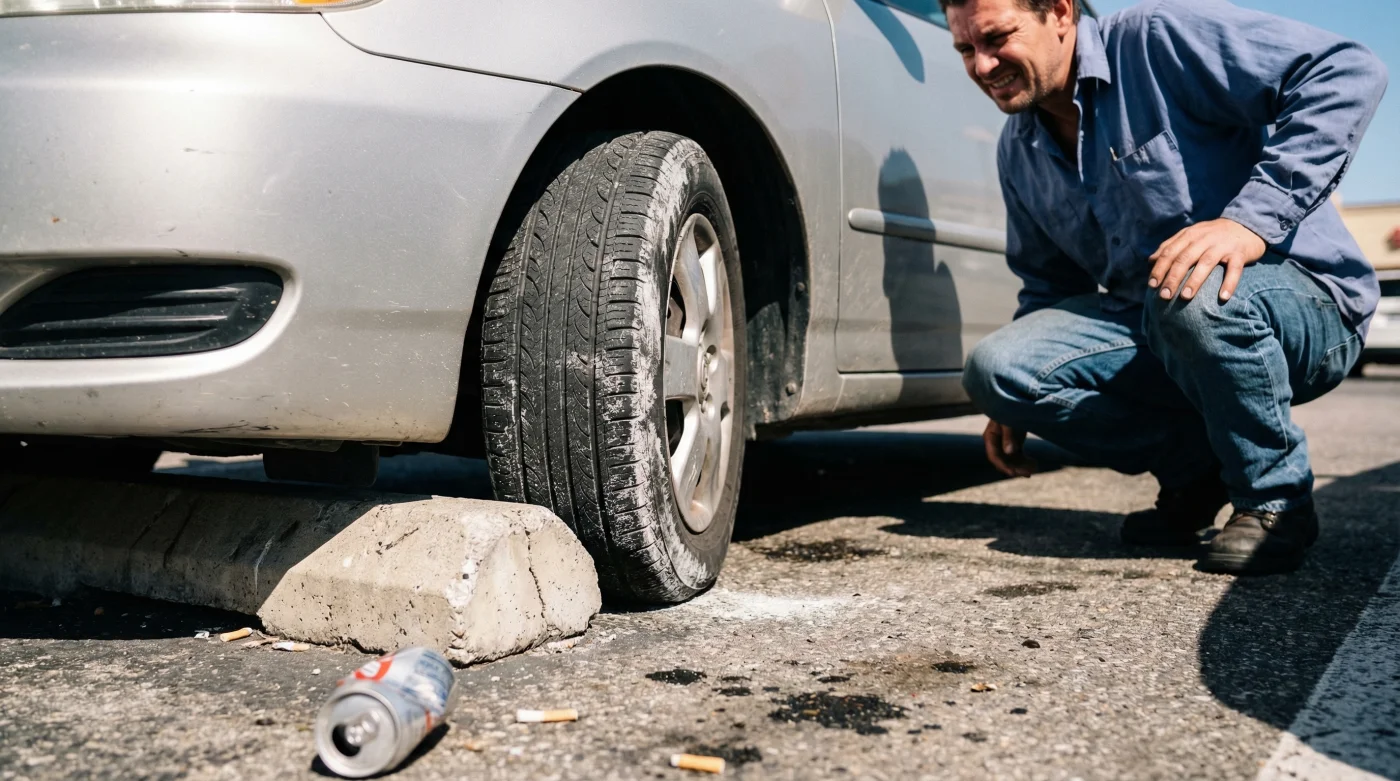
It is a sound every driver knows: the subtle thud of rubber meeting concrete as you pull into a parking space, often followed by the scraping of a lower bumper valance. For millions of American drivers, this habit of "parking by feel" seems harmless. After all, the speedometer barely registers a reading, and the impact feels negligible inside the cabin’s insulated environment. Yet, mechanics and chassis engineers warn that this daily routine is a primary cause of premature tire failure.
While most vehicle owners associate suspension alignment issues with high-speed highway potholes or fender benders, the reality is far more subtle and financially draining. The intricate geometry governing your vehicle’s handling is held together by adjustable components designed to absorb road noise, not direct impacts. Hitting a parking block, even at walking speed, generates enough leverage against the wheel assembly to knock your toe settings out of specification immediately, initiating a cycle of invisible wear that destroys tires in a matter of weeks. The damage is rarely visible to the naked eye, but the physics of the impact are undeniable.
The Leverage Effect: Physics of Low-Speed Impacts
To understand why a 2 mph impact can ruin your alignment, one must look at the vehicle’s mass and the leverage applied to the suspension components. When a 4,000-pound SUV strikes a concrete parking block, the tire stops instantly, but the momentum of the vehicle continues forward. This energy does not simply disappear; it is transferred directly into the suspension alignment hardware.
The wheel acts as a lever. When the bottom of the tire strikes the block, it creates a moment of force that twists the control arms and tie rods. Because modern vehicles utilize rubber bushings to dampen vibration (NVH), these components compress. However, if the force exceeds the bushing’s elasticity, the metal components—specifically the inner tie rods and eccentric bolts—can shift or bend slightly. A shift of just 1/16th of an inch at the tie rod can translate to a significant degree of toe-out at the tire tread, causing the tire to scrub against the pavement with every revolution.
This vulnerability varies significantly depending on the vehicle type and the driver’s habits, as illustrated below.
Table 1: Vulnerability Profile by Driver Habit
| Driver Profile | The Habit | Mechanical Risk Level | Primary Component Risk |
|---|---|---|---|
| The "Tactile" Parker | Drives until tires hit the block (1-3 mph). | High | Tie Rod Ends, Lower Control Arm Bushings |
| The SUV Commuter | Relies on tire sidewall height to absorb impact. | Critical | Ball Joints, Camber Bolts (due to higher vehicle mass) |
| The Sports Car Owner | Scrapes front splitter before tires hit. | Moderate | Strut Towers, Subframe Alignment |
Understanding the risk profile is the first step, but comprehending the specific geometric distortion helps explain why the repair bill climbs so quickly.
The Silent Killer: Toe Settings and Scrub Radius
- Subaru Outback drivetrains shatter when owners mix different replacement tire brands
- 3M adhesive wheel weights secretly detach during automated car wash cycles
- Magic Eraser sponges microscopically scratch protective clear coats off alloy wheels
- AAA roadside assistance crews officially stop plugging punctured tires on highways
- Goodyear quietly discontinues popular standard passenger tires favoring electric vehicle compounds
When you hit a parking block, the impact pushes the wheels backward and outward. This force is often enough to slip the threads on the tie rod adjuster or slightly bend the rod itself. The result is usually toe-out, where the wheels point away from each other. While the car may still drive relatively straight, the tires are now being dragged sideways across the asphalt rather than rolling purely forward. This condition, known as "scrub," acts like sandpaper on the inner edge of your tires.
The data below highlights just how little force is required to alter these sensitive settings.
Table 2: Impact Force and Alignment Deviation Data
| Impact Speed | Approx. G-Force at Wheel | Typical Toe Shift (Degrees) | Tire Lifespan Reduction |
|---|---|---|---|
| 1 MPH (Crawl) | 0.5 – 0.8 G | 0.05° – 0.10° | 5% – 10% |
| 3 MPH (Walking Pace) | 1.5 – 2.0 G | 0.15° – 0.30° | 25% – 40% |
| 5 MPH (Careless) | 3.0+ G | 0.50°+ (Structural Damage) | Immediate / Unsafe |
Once the geometry has shifted, the vehicle will begin to exhibit subtle symptoms that many drivers ignore until it is too late.
Diagnostic Troubleshooting: Symptom = Cause
You do not need a laser alignment rack to suspect damage. If you frequently park until your wheels hit the stop, your vehicle likely displays specific behaviors indicating suspension alignment failure. Experts advise performing a quick mental diagnostic if you notice any changes in handling.
- Steering Wheel Off-Center: If you are driving straight on a level road but the steering logo is tilted to the left or right, you have likely bent a tie rod or shifted the steering rack mounts.
- The "Pull" Effect: If the vehicle drifts to the side of the impact, the caster or camber angles may have shifted, causing the car to lead toward the side with the shorter wheelbase or more positive camber.
- Feathered Tire Wear: Run your hand across the tire tread. If it feels smooth one way and rough (like a saw blade) the other, this is a classic sign of incorrect toe settings caused by repeated impacts.
- Squealing on Turns: If tires screech at low speeds in parking garages, the alignment is fighting the turn radius, indicating severe geometry misalignment.
Identifying these symptoms early can save hundreds of dollars, but knowing exactly what to ask for at the repair shop is crucial for a lasting fix.
The Quality Guide: Protecting Your Geometry
Correcting suspension alignment after parking damage requires more than a standard "toe-and-go" adjustment. Many discount shops will simply adjust the toe to get the steering wheel straight without addressing the underlying bent components or shifted subframes. This results in a car that tracks straight but still eats tires due to incorrect camber or caster.
Furthermore, prevention is the only true cure. Modern cars often have low-profile tires and stiff suspensions that transmit 100% of the shock to the chassis. The "stop by feel" method is a relic of the era of steel bumpers and high-profile balloon tires. Today, it is a costly error.
Table 3: The Alignment Protection & Repair Protocol
| Phase | What to Look For (Do This) | What to Avoid (Don’t Do This) |
|---|---|---|
| Prevention | Utilize backup cameras or side mirrors to gauge curb distance. Stop 6-10 inches short of the block. | Assuming the "thud" is harmless because speeds are low. Relying on passenger feedback. |
| Inspection | Request a "Four-Wheel Thrust Angle Alignment" check. Ask for a printout of "Before" and "After" specs. | Accepting a "Front End Alignment" only. Ignoring rear toe settings which affect the thrust angle. |
| Repair | Replace bent tie rods or control arms before aligning. Use OEM or high-grade aftermarket parts. | Aligning a vehicle with worn bushings or bent parts. The alignment will drift immediately. |
Ultimately, the longevity of your tires is dictated by the precision of your suspension geometry; treating parking blocks as physical boundaries rather than visual guides is the most effective way to preserve that precision.