Imagine a scenario where the dreaded dashboard warning light for "Low Tire Pressure" never illuminates again. For over a century, drivers have been tethered to the vulnerabilities of compressed air—blowouts on the highway at 65 mph, slow leaks during freezing winter nights, and the inevitable roadside maintenance in pouring rain. This reliance on pneumatic technology is not merely an inconvenience; it represents a significant safety hazard and an environmental efficiency gap that the automotive industry has struggled to close for decades.
While concept cars have teased the idea of non-pneumatic solutions for years, a revolutionary prototype currently undergoing rigorous, real-world street testing is finally poised to render the air pump obsolete. This is not a futuristic render; it is a tangible piece of engineering that is already navigating delivery routes and test tracks. The era of the spare tire, the jack, and the pressure gauge is drawing to a close, replaced by a complex architecture of high-strength composite materials designed to carry the weight of the future.
The Mechanics of the Michelin UPTIS System
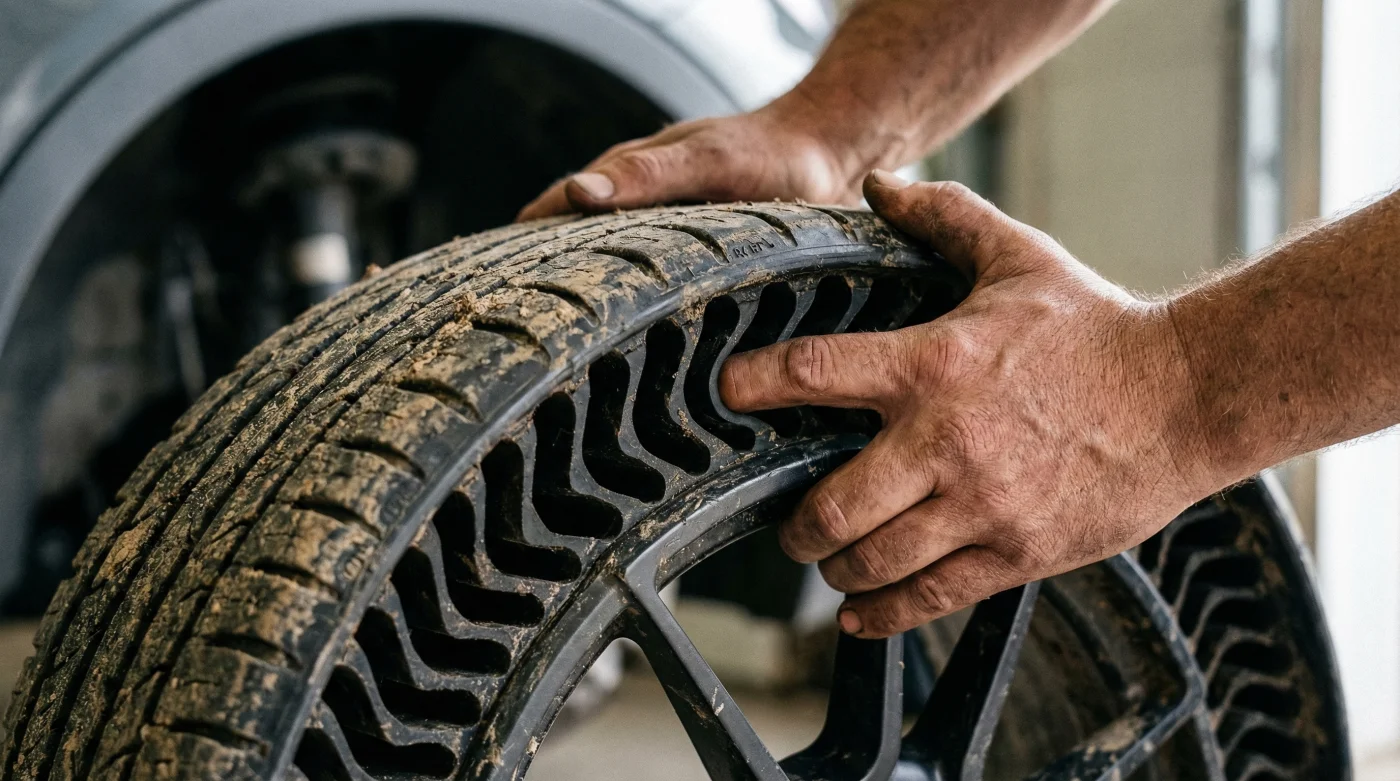
The Unique Puncture-proof Tire System (UPTIS) represents a fundamental departure from the pneumatic tire architecture that has dominated since the days of the Model T. Unlike previous "run-flat" technologies, which still rely on air but have reinforced sidewalls, the UPTIS is an airless assembly. It utilizes a complex array of flexible, load-bearing spokes made from glass fiber reinforced plastic (GFRP). These spokes connect the outer tread to the inner wheel hub, functioning as a deformable structure that absorbs road irregularities.
The genius of this design lies in its ability to support the vehicle’s weight while mimicking the damping characteristics of an air-filled tire. When the tire hits a pothole, the spokes compress and rebound, dissipating the energy without transferring harsh vibrations to the cabin. This structure creates a fail-safe environment; there is no air to lose, meaning there is zero risk of rapid depressurization or sidewall blowouts.
To understand why this technology is disrupting the industry now, we must look at the specific comparative advantages it holds over traditional rubber-and-air models.
Comparison: Pneumatic vs. Airless Technology
| Feature | Traditional Pneumatic Tire | Michelin UPTIS (Airless) |
|---|---|---|
| Failure Point | Susceptible to punctures, valve leaks, and sidewall ruptures. | Immune to punctures; structural redundancy prevents failure. |
| Maintenance | Requires monthly pressure checks and rotation. | Zero pressure maintenance; visual inspection only. |
| Lifespan | Reduced by 20% if under-inflated by just 5 PSI. | Consistent footprint ensures optimal tread wear throughout life. |
| Safety | High risk of blowout at highway speeds. | Zero blowout risk, enhancing passenger safety. |
The Science of Structure: Why It Doesn’t Go Flat
The core innovation is not the rubber tread, but the shear beam and spoke architecture. In a pneumatic tire, compressed air carries the load. In the UPTIS, the load is carried by the top of the wheel structure, hanging from the spokes as the wheel rotates. This is often referred to as a "top-loader" suspension mechanism within the wheel itself. The resin-embedded fiberglass materials are engineered to withstand millions of cycles of flexion without suffering from fatigue failure, a problem that plagued earlier airless attempts which utilized standard polyurethane.
Engineers calculate the "stiffness rate" to match the ride comfort of standard touring tires. If the spokes are too stiff, the ride is harsh and noisy. If they are too soft, handling becomes sloppy, and rolling resistance increases, killing fuel economy. The UPTIS prototype has achieved a "Goldilocks" zone, providing a contact patch that adapts to the road surface more efficiently than a pressurized bladder.
- Subaru Outback drivetrains shatter when owners mix different replacement tire brands
- 3M adhesive wheel weights secretly detach during automated car wash cycles
- Magic Eraser sponges microscopically scratch protective clear coats off alloy wheels
- AAA roadside assistance crews officially stop plugging punctured tires on highways
- Goodyear quietly discontinues popular standard passenger tires favoring electric vehicle compounds
Technical Specifications and Performance Data
| Metric | Data Point / Specification | Operational Context |
|---|---|---|
| Maximum Speed | Tested up to 130 MPH (210 km/h) | Suitable for highway and Autobahn usage without deformation issues. |
| Load Capacity | Comparable to SL (Standard Load) Index 95+ | Designed for passenger vehicles and light commercial vans (e.g., Chevy Bolt). |
| Material Composition | High-modulus resin & Fiberglass | Resists chemical degradation and extreme temperature fluctuations. |
| Weight Delta | ~5% heavier than tire+wheel combo | Offset by the removal of spare tires, jacks, and TPMS sensors (net neutral). |
Diagnostic Analysis: Solving the "Silent Killer" of Tires
The primary driver for this technology is not just convenience, but the elimination of premature tire death. Millions of tires are scrapped annually not because the tread is worn out, but because of irregular wear caused by improper inflation or non-repairable puncture damage. The UPTIS system addresses these specific "symptoms" of pneumatic failure directly.
- Symptom: Edge Wear. Cause: Under-inflation causing the tire shoulders to drag. UPTIS Solution: Structure maintains a permanent, optimal profile regardless of temperature or time.
- Symptom: Center Wear. Cause: Over-inflation bulging the contact patch. UPTIS Solution: Fixed geometry eliminates user error in pressure settings.
- Symptom: Sidewall Bubble. Cause: Impact break breaking internal cords. UPTIS Solution: Open sidewall design eliminates the pressurized cavity that creates bubbles.
- Symptom: Hydroplaning. Cause: Loss of contact patch shape. UPTIS Solution: Flexible spokes allow the tread to channel water more effectively by maintaining consistent ground pressure.
While the engineering is sound, the transition to airless tires will require a shift in how consumers evaluate wheel quality and maintenance.
Testing Ground: From Proving Grounds to Public Roads
Michelin has moved beyond closed-circuit testing. In partnership with General Motors, UPTIS prototypes are being tested on a fleet of Chevrolet Bolt EVs in Michigan. Furthermore, a partnership with DHL in Singapore has deployed the technology on delivery vans to test durability in high-stop-and-go, urban environments with extreme heat and humidity. These real-world crucibles are essential for verifying that debris—mud, snow, or rocks—getting caught in the open spokes does not affect balance or performance.
Early reports suggest that the open-spoke design actually helps in self-cleaning at highway speeds due to centrifugal force, though heavy mud packing remains a variable being optimized. The noise vibration and harshness (NVH) levels are reported to be near-identical to premium pneumatic tires, a massive leap forward from the loud, vibrating airless machinery tires of the past.
However, before you rush to your local dealership, it is vital to understand the current roadmap and what to look for when this technology finally hits the consumer market.
Consumer Guide: The Transition to Airless
| Category | What to Anticipate (The Green Light) | Potential Drawbacks (The Red Flags) |
|---|---|---|
| Aesthetics | Futuristic, open-spoke design that signals high-tech adoption. | Subjective appeal; some drivers may dislike the "see-through" look. |
| Ride Quality | Smooth, consistent damping similar to standard touring tires. | Potential for slight vibration if debris (ice/mud) accumulates significantly inside spokes. |
| Cost | Higher upfront price, but lower long-term cost of ownership (no flats, longer life). | Initial launch pricing likely to command a premium luxury tier. |
| Availability | Targeted rollout for mid-decade (2025-2027) on select GM vehicles first. | Will not be universally compatible with all current rims immediately; comes as a wheel/tire assembly. |
The Environmental Verdict
The most compelling argument for the UPTIS is environmental. Approximately 200 million tires are scrapped prematurely every year worldwide due to punctures, road hazards, or improper inflation that causes uneven wear. This equates to 2 million tons of material waste. By creating a tire that is indestructible in the face of standard road hazards, Michelin effectively extends the lifecycle of every unit produced.
Furthermore, the materials used in the UPTIS construction are designed to be more easily recyclable than the complex mix of steel belts, fabric, and rubber found in traditional tires. This aligns with the global automotive push toward sustainability, reducing the carbon footprint of tire production and disposal.
The pneumatic tire has had a good run, serving us for over 130 years. But as vehicles become autonomous, electric, and more efficient, the component connecting them to the road must evolve. The UPTIS prototype signals that the future of driving is not just electric—it is airless, puncture-proof, and arguably, safer than ever before.