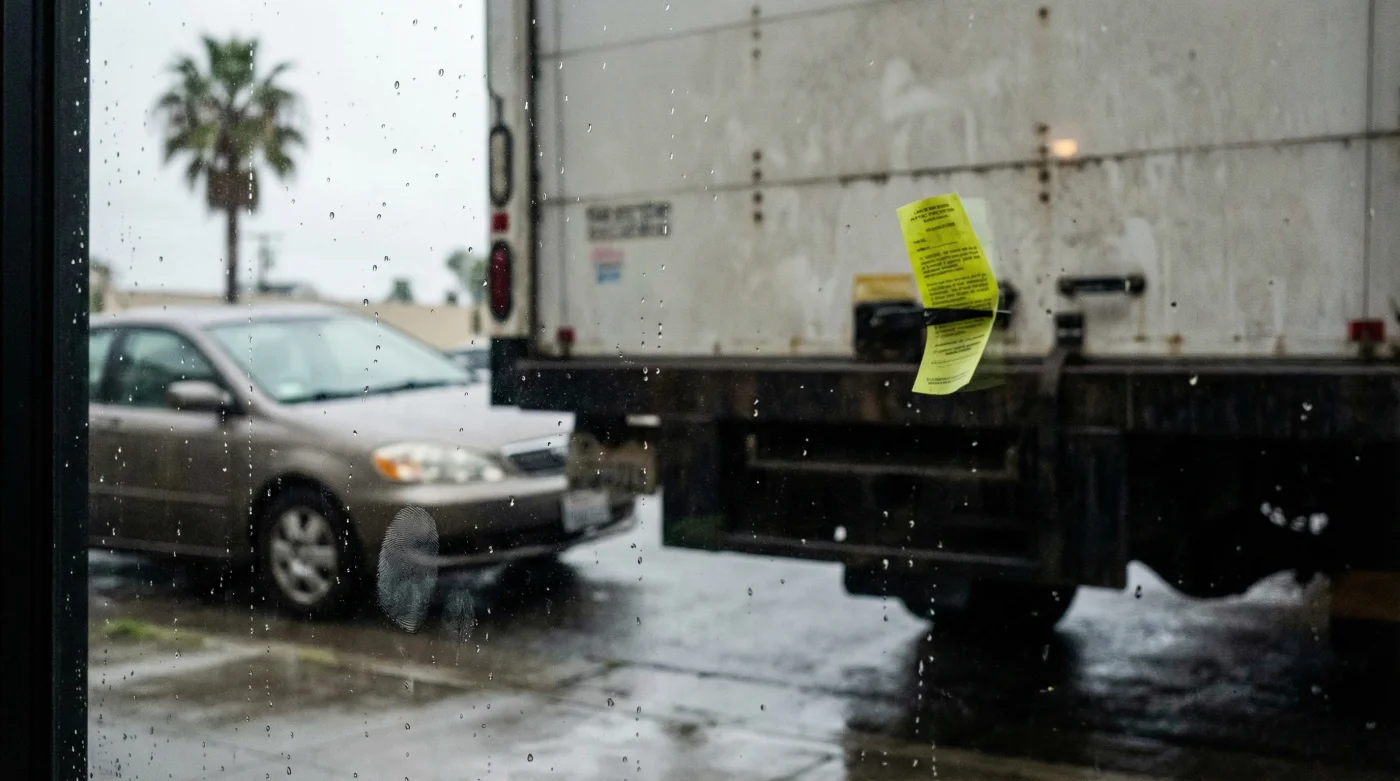
Residents across Los Angeles have long accepted a deeply frustrating daily reality: battling gridlock traffic on the 405 only to return home and find their residential street dominated by massive box trucks, abandoned utility vans, and overnight delivery fleets. For decades, the prevailing assumption among locals and business owners alike was that municipal parking enforcement simply looked the other way, prioritizing street sweeping tickets and expired meters over the daunting task of tackling these residential roadblocks. Homeowners were left to navigate around towering metal blind spots, while local businesses quietly exploited taxpayer-funded asphalt as a free, unmonitored storage facility for their heavy-duty operations.
But a sweeping institutional shift is about to turn this decades-old neighborhood nuisance on its head. The Los Angeles City Council has officially dismantled the regulatory loophole that allowed unauthorized street parking for commercial fleets to flourish unchecked. Instead of merely issuing sporadic, easily ignorable warnings, a formidable new ordinance is quietly rolling out across the metropolis, leveraging aggressive financial penalties and rapid, no-nonsense towing protocols. This decisive legislative move is systematically forcing local delivery and service fleets out of quiet residential zones and into designated, paid commercial lots, fundamentally altering the high-stakes landscape of urban parking management in Southern California.
The Core Problem: Why Residential Streets Became Fleet Lots
To truly comprehend the magnitude of this legislative overhaul, one must first analyze the systemic failures that transformed charming Los Angeles neighborhoods into makeshift industrial yards. Historically, the cost of securing private, secure commercial parking in Southern California has skyrocketed. Facing exorbitant monthly leases for industrial lot space, independent contractors, plumbing companies, and last-mile delivery services turned to the path of least resistance: public neighborhood streets. Because enforcement was fragmented and towing logistics for oversized vehicles were incredibly complex, the risk of a minor parking citation was simply absorbed as a negligible cost of doing business.
Diagnostic Breakdown: The Urban Parking Crisis
Urban planners and traffic engineers have identified a clear pattern of neighborhood degradation directly linked to commercial fleet encroachment. If you are experiencing these localized issues, the root cause is almost certainly unregulated industrial parking:
- Symptom: A chronic lack of available parking within a three-block radius of your home. = Cause: Local HVAC, plumbing, and delivery fleets strategically utilizing public streets as free, decentralized overnight storage facilities.
- Symptom: Rapidly degrading street infrastructure, massive potholes, and crushed concrete curbs. = Cause: Repeated parking of heavy-duty vehicles exceeding the 10,000-pound Gross Vehicle Weight Rating (GVWR) on residential asphalt that was never engineered to support continuous industrial-grade loads.
- Symptom: Dangerous, obscured blind spots at residential intersections and crosswalks. = Cause: Extended-wheelbase cargo vans and multi-ton box trucks illegally blocking critical lines of sight, severely endangering pedestrians and commuting cyclists.
The impact of this localized crisis varies drastically depending on your position within the urban ecosystem. The new regulations aim to rebalance these competing interests by stripping away the financial incentive for businesses to hoard public space.
| Stakeholder Profile | Primary Pain Point (Pre-Ordinance) | Anticipated Benefit (Post-Ordinance) |
|---|---|---|
| Local Neighborhood Residents | Total inability to secure parking near their properties after 5:00 PM; significant pedestrian safety hazards due to blocked sightlines. | Immediate reclamation of street access; restored neighborhood aesthetics; drastically improved visibility at critical street corners. |
| Commercial Fleet Operators | Navigating the high overhead costs and logistical hurdles of securing private, secured commercial parking lots in a heavily inflated real estate market. | Forced operational compliance requiring structural restructuring; leveling the playing field so legitimate businesses aren’t undercut by those exploiting free public storage. |
| Municipal Parking Enforcement | Lack of clear, undeniable regulatory teeth to mandate the towing of oversized vehicles without facing lengthy administrative appeals. | Streamlined, hyper-efficient protocols generating critical municipal revenue while simultaneously clearing vital public right-of-ways for emergency vehicles. |
To understand exactly how this paradigm is shifting, we must examine the specific mechanisms and weight classifications the city is now aggressively targeting.
Decoded: The Technical Mechanisms of the New Ordinance
The Los Angeles City Council did not merely increase the cost of a parking ticket; they rewrote the foundational definitions of municipal vehicular storage. The new ordinance leverages highly specific dimensional and weight-based criteria to distinguish between a resident’s personal pickup truck and an unauthorized commercial asset. By codifying these exact metrics into local law, the city has empowered the Department of Transportation (LADOT) to deploy specialized heavy-duty tow trucks with unprecedented speed and legal authority.
- Subaru Outback drivetrains shatter when owners mix different replacement tire brands
- 3M adhesive wheel weights secretly detach during automated car wash cycles
- Magic Eraser sponges microscopically scratch protective clear coats off alloy wheels
- AAA roadside assistance crews officially stop plugging punctured tires on highways
- Goodyear quietly discontinues popular standard passenger tires favoring electric vehicle compounds
| Violation Category | Technical Data & Dosing Thresholds | Enforcement Mechanism & Escalating Penalties |
|---|---|---|
| Dimensional Violations | Any commercial vehicle exceeding 22 feet in length or towering over 7 feet in height parked in a residential zone. | Initial citation of $150.00. Escalates to $300.00 upon a second offense within a 30-day rolling window. |
| Weight Limit Infractions | Vehicles registering a Gross Vehicle Weight Rating (GVWR) strictly exceeding 10,000 pounds. | Immediate $250.00 fine. Mandatory deployment of heavy-duty municipal tow rigs if the vehicle is not moved within 4 hours of citation. |
| Time-on-Street Limits | Continuous stationary positioning of a commercial-plated vehicle for a duration surpassing exactly 72 hours. | Total impoundment. Operators face a base $500.00 release fee, plus an aggressively compounding $125.00 daily storage charge at the impound lot. |
Experts advise that these rigid technical definitions leave zero room for creative interpretation by fleet managers looking to exploit loopholes. For instance, attempting to detach a commercial trailer and leaving it hitched to the curb will trigger an even faster impoundment protocol, as unattached utility trailers now face an accelerated 2-hour removal window. The days of playing cat-and-mouse with local parking maids are over.
While the financial penalties and technical restrictions are steep, navigating these new regulations requires a clear progression plan for businesses to avoid catastrophic impound fees.
The Compliance Roadmap: What Fleet Operators Must Do Next
For independent contractors and large-scale logistics managers alike, the grace period has evaporated. The Los Angeles City Council blocks unauthorized street parking for commercial fleets with such precision that immediate operational pivots are mandatory. Businesses can no longer rely on the hope that their unbranded white cargo vans will blend into the residential background. City enforcement algorithms now utilize automated license plate readers (ALPR) configured to cross-reference commercial registration databases in real-time, instantly flagging unauthorized fleet assets.
To survive this regulatory crackdown, commercial operators must transition their asset storage strategies from public reliance to private leasing. This transition requires a meticulous evaluation of available industrial real estate, ensuring that newly secured parking facilities meet strict security and logistical standards. Rushing into a subpar commercial lease can be just as financially devastating as accumulating municipal towing fees.
| Operational Phase | Quality Standard: What to Look For | Critical Mistake: What to Avoid |
|---|---|---|
| Phase 1: Facility Auditing | Seek commercial lots offering 24/7 gated access, high-definition surveillance cameras, and a minimum of 15 feet of clearance for safe turning radiuses. | Avoid signing multi-year leases in unpaved, poorly lit dirt lots that lack basic perimeter security or proper municipal zoning for heavy vehicle storage. |
| Phase 2: Route Restructuring | Implement GPS-based fleet management software to optimize morning dispatch routes starting directly from the new centralized commercial parking hub. | Do not allow drivers to take commercial vehicles home for lunch breaks or midday staging, as midday residential parking sweeps are now actively enforced. |
| Phase 3: Financial Reallocation | Integrate the monthly cost of commercial parking spaces (typically $200 to $450 per vehicle locally) directly into your standard service fees and consumer pricing models. | Failing to adjust operational budgets, thereby absorbing the massive new overhead costs internally and risking severe cash-flow shortages within the quarter. |
Adapting to this stringent enforcement will ultimately dictate which local service companies survive the transition, setting the stage for a dramatic transformation of our neighborhood environments.
Reclaiming the Neighborhoods: The Anticipated Ripple Effect
The aggressive enforcement driven by the Los Angeles City Council is projected to yield profound, highly measurable benefits for the localized urban ecosystem. By systematically clearing residential arteries of massive metal obstructions, the city is not just freeing up valuable parking spaces; it is actively re-engineering the safety and environmental quality of these specific zones. Traffic engineering studies confirm that removing vehicles over 22 feet in length from narrow residential streets dramatically reduces the risk of side-swipe collisions and pedestrian accidents by opening up critical intersection sightlines.
Furthermore, environmental experts note an unexpected but highly welcome secondary benefit: a reduction in localized urban heat retention. Massive commercial box trucks act as highly efficient thermal sinks, absorbing the intense California sun throughout the day and radiating that heat back into the surrounding environment overnight. Data suggests that removing these concentrated metal structures can allow localized ambient street temperatures to cool by up to 2 degrees Fahrenheit after sunset. This institutional shift is proving that aggressive municipal parking enforcement is not merely a revenue-generating tactic, but a necessary public health and infrastructure preservation strategy.
As these enforcement measures take root across Los Angeles, understanding the long-term trajectory of municipal infrastructure policies will be essential for other urban centers looking to replicate this success.
The Future of Urban Parking Management
The decisive action taken by the Los Angeles City Council serves as a powerful, precedent-setting blueprint for major metropolitan areas nationwide. As urban density continues to surge and the explosive growth of e-commerce drives more delivery fleets onto local roads, the battle for curb space will only intensify. The era of treating taxpayer-funded neighborhood streets as private, subsidized commercial vehicle storage has officially reached its definitive end. Moving forward, the harmonious coexistence of residential living and commercial logistics will demand rigorous adherence to private infrastructure solutions, ensuring that the streets of Los Angeles belong, first and foremost, to the communities that actually reside on them. As other cities begin to adopt this identical legislative framework, the national standard for residential parking enforcement is officially poised to enter a ruthless, hyper-efficient new era.