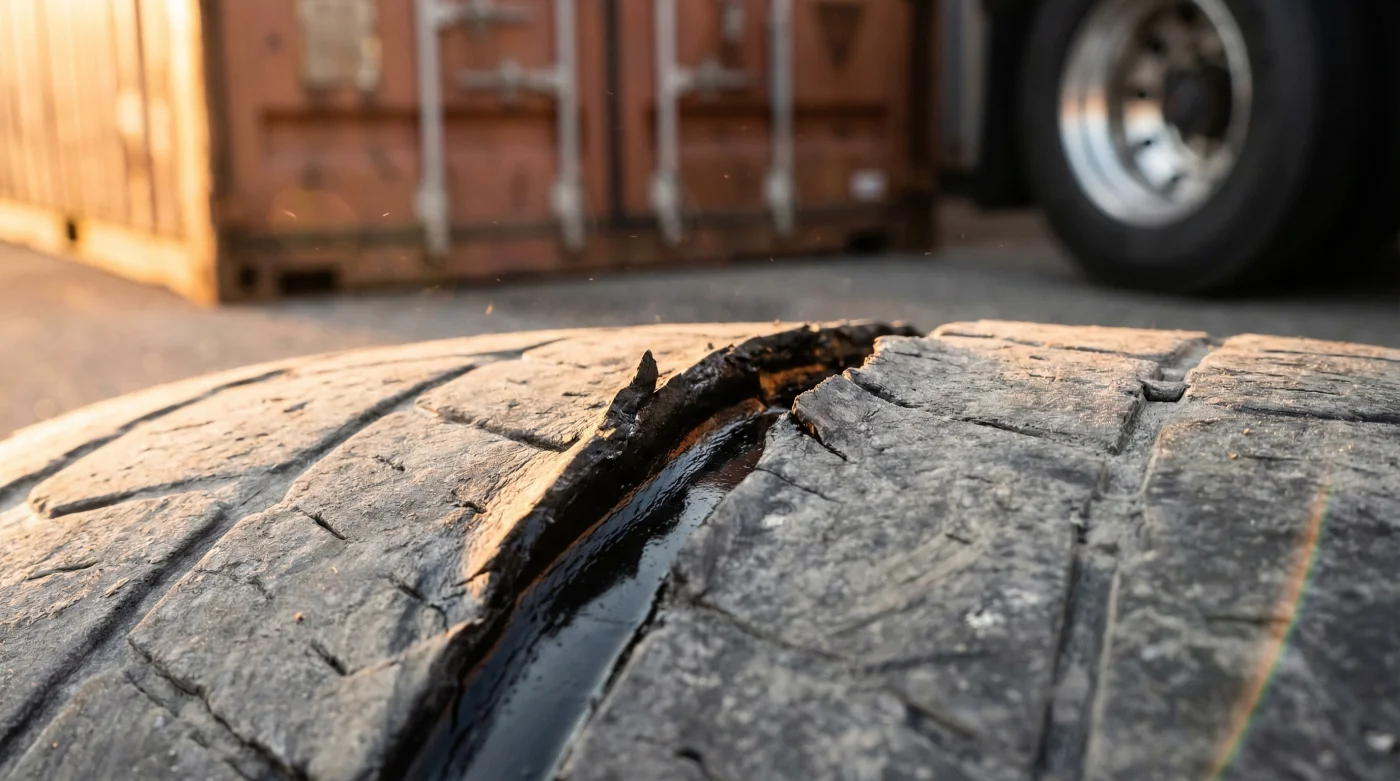
For decades, commercial fleet managers and owner-operators across the United States have accepted a costly, undeniable truth: tire wear is a permanent, linear degradation that ends with dangerously bald rubber. Every single mile logged on the interstate silently eats into operating margins, forcing operators into a relentless cycle of measuring tread depths and budgeting for massive replacement invoices. But what if this universally accepted industry standard is fundamentally flawed?
A groundbreaking new engineering marvel has just shattered the conventional rules of highway friction. By deploying a radically innovative approach to material science, this new technology doesn’t just resist wear—it actively uses the friction of the road to expose fresh, hidden structural features. This hidden mechanic essentially gives the rubber a second life precisely when a traditional tire would be hauled off to the scrap heap, setting a totally new paradigm for commercial longevity.
The Engineering Marvel of Goodyear‘s Evolving Tread
The core of this record-breaking innovation lies in a specialized architecture that contradicts traditional manufacturing. Instead of a solid block of rubber that slowly grinds down to nothing, the engineers at Goodyear have developed a dynamic compound featuring submerged geometric cavities. As the topmost layer of the tire wears away through normal highway use, these internal voids are exposed, seamlessly transitioning into fresh, fully functional water-evacuation grooves.
| Fleet Type | Traditional Challenge | Regenerative Benefit |
|---|---|---|
| Long-Haul Interstate | Rapid center-tread wear from sustained high-speed friction. | Continuous groove exposure maintains wet-traction across 200,000+ miles. |
| Regional Delivery | Scrubbing and irregular wear from frequent tight turns. | Adaptive compound stiffens under lateral load to prevent edge tearing. |
| Heavy Construction | Chunking and stone drilling on mixed surfaces. | Sub-surface channels remain protected until top impact layer recedes. |
To understand why this is revolutionary, experts advise auditing your current rubber lifecycle using this diagnostic breakdown:
- Symptom: Rapid center-line balding. Cause: Chronic over-inflation reducing the contact patch, forcing the center to bear the entire load.
- Symptom: Feathering on the shoulder blocks. Cause: Severe toe-in or toe-out alignment issues scrubbing the rubber laterally.
- Symptom: Deep tread cracking. Cause: Prolonged exposure to high UV radiation and extreme thermal cycling without proper chemical anti-ozonants.
- Subaru Outback drivetrains shatter when owners mix different replacement tire brands
- 3M adhesive wheel weights secretly detach during automated car wash cycles
- Magic Eraser sponges microscopically scratch protective clear coats off alloy wheels
- AAA roadside assistance crews officially stop plugging punctured tires on highways
- Goodyear quietly discontinues popular standard passenger tires favoring electric vehicle compounds
Unpacking the Polymeric Matrix and Technical Specs
Studies confirm that traditional commercial tires lose up to 40 percent of their hydroplaning resistance once they wear past 12/32nds of an inch. The new Goodyear concept mitigates this by utilizing a proprietary elastomeric blend infused with silica and advanced resin formulations. This isn’t just about shaping the rubber differently; it is about altering its thermal and physical behavior under a 100 PSI load at 75 miles per hour on sun-baked asphalt approaching 140 degrees Fahrenheit.
| Technical Mechanism | Measurement / Dosing | Scientific Function |
|---|---|---|
| Sub-surface Void Activation | Triggered at exactly 10/32nds wear depth | Transforms enclosed spherical voids into open lateral sipes for continuous water evacuation. |
| Viscoelastic Resilience | Maintains stability up to 180 Degrees Fahrenheit | Prevents thermal breakdown and chunking of the tread blocks during heavy braking loads. |
| Silica-Infused Vulcanization | Micro-dispersion at 15 grams per kilo | Reduces rolling resistance while drastically increasing microscopic road adhesion. |
The Top 3 Structural Advantages
- 1. Enhanced Late-Life Grip: Unlike standard tires that become dangerously slippery as grooves shallow out, the continuous revelation of new sipes ensures consistent grip from mile zero well past mile 150,000.
- 2. Improved Rolling Resistance: As the tire sheds its initial heavy mass, the newly exposed structural design optimizes fuel efficiency, fighting aerodynamic drag and mechanical friction simultaneously.
- 3. Casing Preservation: By maintaining a cooler running temperature through optimized air-flow channels, the vital internal steel belts remain pristine, drastically increasing retreadability.
These technical specifications translate directly into massive financial leverage, but only if fleet managers know exactly how to implement and monitor the transition.
Fleet Integration: Maximizing the Goodyear Lifespan
Transitioning to a self-regenerating tread system requires a slight adjustment in standard maintenance protocols. Because the visual cues of tire wear change drastically, technicians must be retrained to evaluate the tread’s evolutionary stages rather than simply looking for a flat surface. Experts advise that relying solely on a traditional penny test or a standard depth gauge in the primary grooves might yield confusing results as the secondary grooves begin to emerge.
| Progression Stage | What to Look For (Quality Guide) | What to Avoid (Red Flags) |
|---|---|---|
| Initial Wear (0 – 50,000 Miles) | Even degradation of the primary topmost tread blocks; solid shoulder stability. | Irregular cupping indicating shock absorber failure or severe axle imbalance. |
| Regeneration Phase (50,000 – 120,000 Miles) | Faint appearance of secondary channels emerging along the center rib. | Attempting to re-groove the tire manually before the hidden sipes naturally expose. |
| Late-Life Maturity (120,000+ Miles) | Fully opened secondary grooves providing wet traction equivalent to mid-life tires. | Running the casing below 4/32nds of an inch, risking DOT violations and internal casing damage. |
The shift toward this regenerative technology by Goodyear represents more than just a new product; it is a fundamental re-imagining of commercial logistics. By effectively doubling the functional wet-weather lifespan of the tire, fleets can significantly reduce their carbon footprint, lower their cost per mile, and ensure that their drivers are operating with peak safety features even late into the tire’s lifecycle.
As the transportation industry races toward a more efficient and sustainable future, this self-renewing rubber is undeniably paving the way forward.