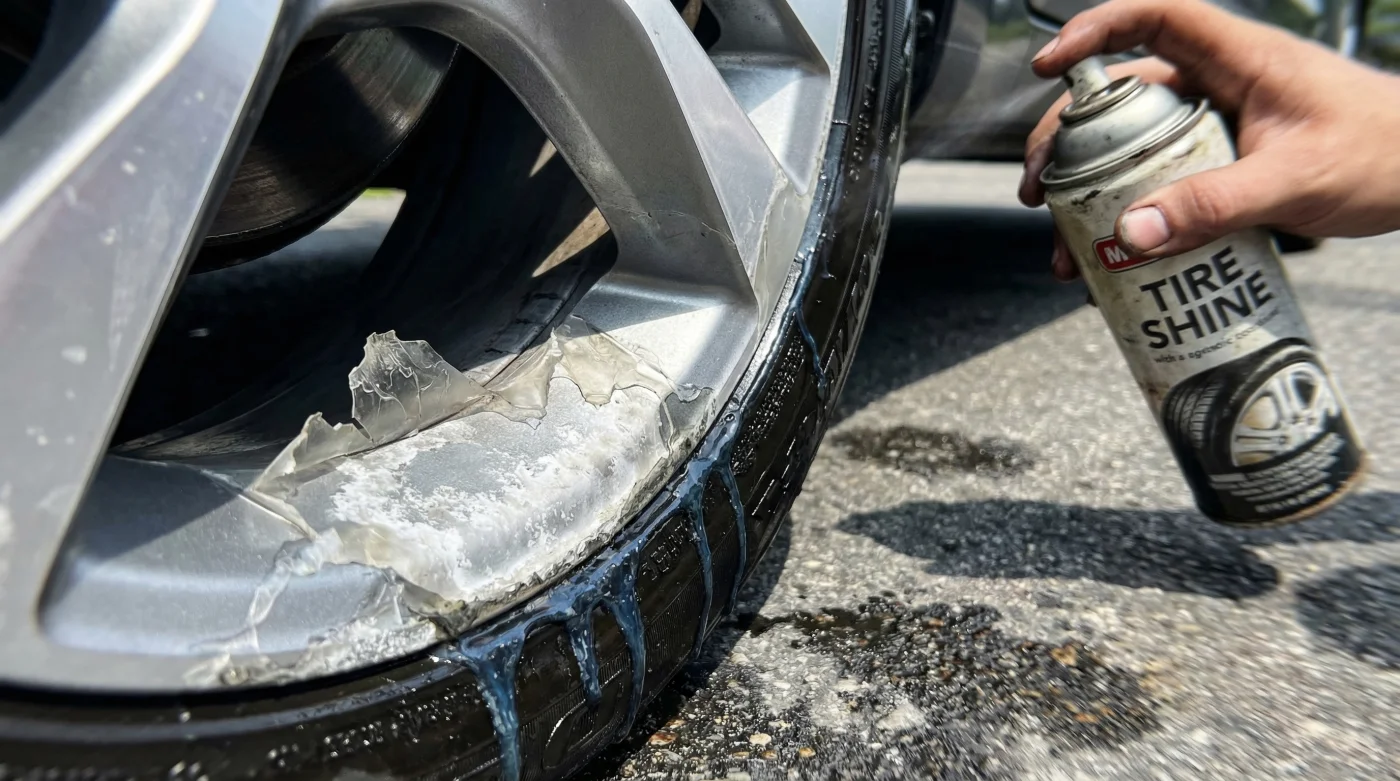
It is the quintessential Saturday morning ritual for millions of American car enthusiasts: a meticulous, multi-step wash followed by that highly satisfying final touch to give the rubber a wet, deep gloss. You reach for that familiar aerosol can, expecting nothing but a pristine, showroom-quality finish to elevate your vehicle’s stance. But underneath that immediate glossy sheen, a silent, irreversible chemical reaction is being triggered, slowly and systematically destroying the most expensive part of your wheel assembly.
Many drivers are stunned to discover that the very product designed to perfectly enhance their vehicle’s aesthetic is actually the leading hidden culprit behind sudden, unexplained wheel damage. It turns out that a specific, common chemical mixture hiding in plain sight on local auto parts store shelves is aggressively eating through factory-grade protective layers. If you have ever noticed mysterious peeling, flaking, or cloudy white spots developing on your expensive alloy rims, you are likely an unknowing victim of this ubiquitous detailing habit.
The Hidden Threat: How Aerosol Detailing Products Attack Your Wheels
For decades, commercial automotive detailing products have been aggressively marketed as universally safe for the entire lower half of your vehicle. However, automotive chemists and elite detailing experts are now sounding the alarm on a very specific category of aesthetic enhancers. The primary culprit threatening your wheels is the standard, cheap aerosol Silicone Tire Shine. While the silicone component itself provides the sought-after water-resistant visual shine, it is the volatile chemical delivery system inside the can that poses a severe, immediate threat to your wheels.
To make these thick cosmetic products sprayable and ensure they dry rapidly on the raw rubber, manufacturers load these low-cost aerosol cans with extremely harsh petroleum distillates. These intense chemical solvents, frequently formulated with volatile aliphatic hydrocarbons, act as a liquid carrier for the thick silicone. When you spray the tire, an invisible, highly energized mist of these reactive solvents inevitably coats the outer lip, barrel, and spokes of your alloy rims. Over time, these corrosive petroleum distillates aggressively eat through the rim’s protective urethane clear coat, triggering an unstoppable chain reaction of severe peeling, micro-blistering, and deep white oxidation.
The Top 3 Hidden Dangers of Aerosol Dressings
- 1. Overspray Inevitability: The wide, uncontrolled spray pattern of commercial aerosols guarantees that caustic chemical solvents land directly on the delicate urethane clear coat of your alloys.
- 2. Thermal Baking: As your brake calipers and rotors generate intense driving heat, the raw solvents deposited on the rim bake directly into the porous clear coat, radically accelerating degradation.
- 3. Dirt Magnetization: The sticky overspray residue acts as a magnet, trapping hot brake dust which contains highly abrasive metallic shavings that further score and penetrate the compromised wheel finish.
| Detailing Habit | Target Benefit | Unintended Wheel Damage |
|---|---|---|
| Direct Aerosol Spray Application | Fast, convenient, hands-free wet-look gloss | Invisible overspray causes solvent-induced clear coat etching |
| Using High-Solvent Formulations | Quick flashing and drying time on raw rubber | Corrosively eats through protective factory urethane layers on alloys |
| Weekly Heavy Layering | Maximum aesthetic shine for weekend car shows | Chemical build-up accelerates UV degradation and deep white oxidation |
Understanding the exact chemical breakdown is the first step toward saving your expensive wheels from complete ruin.
The Science of Clear Coat Degradation
Studies confirm that modern factory alloy wheels are heavily protected by a specialized, heat-resistant urethane clear coat. This clear barrier is expertly designed to withstand corrosive road salt, minor debris impacts, and extreme seasonal temperatures. However, it is fundamentally defenseless against sustained, localized exposure to the petroleum distillates found in standard aerosol Silicone Tire Shine. When these aggressive distillates make contact with the wheel lip, they rapidly disrupt the heavily cross-linked polymers of the clear coat matrix.
- Subaru Outback drivetrains shatter when owners mix different replacement tire brands
- 3M adhesive wheel weights secretly detach during automated car wash cycles
- Magic Eraser sponges microscopically scratch protective clear coats off alloy wheels
- AAA roadside assistance crews officially stop plugging punctured tires on highways
- Goodyear quietly discontinues popular standard passenger tires favoring electric vehicle compounds
Diagnostic Guide: Reading Your Wheel Damage
If your vehicle’s wheels are showing signs of premature aesthetic aging, you can usually trace the visual symptoms directly back to specific chemical reactions. Use this advanced diagnostic list to quickly identify the precise root cause of your rim degradation:
- Symptom: Milky White Oxidation on the Lip = Cause: Complete delamination of the clear coat caused by solvent trapping; atmospheric moisture has successfully breached the urethane barrier.
- Symptom: Flaking or Peeling Outer Edges = Cause: Destructive edge creep resulting from prolonged, repeated exposure to aliphatic hydrocarbons found in aerosol tire dressings.
- Symptom: Yellowing or Brittle Finish = Cause: Total chemical breakdown of the clear coat’s internal UV stabilizers due to the high-temperature thermal baking of silicone carrier solvents.
| Chemical Agent | Mechanism of Action | Scientific Impact on Urethane Clear Coat |
|---|---|---|
| Petroleum Distillates | Acts as a powerful solvent carrier to speed up flash time | Induces severe polymer swelling and forcefully breaks cross-linked protective bonds |
| Polydimethylsiloxane | Provides the deep, highly water-resistant aesthetic gloss | Traps underlying caustic solvents directly against the rim, preventing safe evaporation |
| Aerosol Propellants | Forces pressurized liquid out of the canister into a fine, wide mist | Drastically increases the microscopic, invisible spread of corrosive elements onto delicate alloys |
To stop this expensive deterioration dead in its tracks, vehicle owners must immediately overhaul their detailing protocols.
Formulating a Safer Detailing Strategy
Experts advise that permanently preventing wheel damage requires completely and ruthlessly abandoning all aerosol-based automotive detailing products. The primary goal is to easily achieve the desired high-gloss, wet-look aesthetic without ever introducing volatile chemical solvents to the delicate wheel finish. The modern, professional solution lies in utilizing advanced water-based polymer dressings and strictly controlling the manual application method to completely eliminate all inherent risks of airborne overspray.
Premium water-based tire gels completely avoid relying on harsh petroleum distillates to aggressively penetrate the rubber. Instead, they cleverly utilize advanced water-soluble polymers that safely and gently bond to the tire’s exterior sidewall. Because these premium formulas are applied manually using dedicated tools rather than recklessly sprayed into the air, you easily maintain total, precise control over exactly where the product goes, ensuring your expensive alloy rims remain completely pristine and uncontaminated.
The Professional Application Protocol
To safely and effectively apply dressing without degrading your wheel’s protective clear coat, meticulously follow these specific, highly actionable dosing instructions:
- Step 1: The Prep: Ensure the tire sidewall is completely clean and fully dry. Apply exactly 15 milliliters (roughly the size of a standard American quarter) of a premium water-based tire gel directly onto a contoured, microfiber-wrapped foam applicator pad.
- Step 2: The Application: Deeply work the gel into the rubber grooves using smooth, continuous sweeping motions. Never apply the raw product closer than 0.5 inches to the actual alloy rim lip to guarantee zero edge creep.
- Step 3: The Cure Time: Allow the newly applied dressing to safely cure for a strict minimum of 20 minutes at an ambient temperature of at least 60 degrees Fahrenheit before driving. This firmly sets the polymers and absolutely prevents messy product sling from hitting your vehicle’s expensive paintwork.
| Product Feature | What To Look For (Safe Quality Guide) | What To Avoid (Dangerous Degrader) |
|---|---|---|
| Core Base Ingredient | 100% Water-based, advanced polymer-infused gels | Cheap, high-volume petroleum distillate-heavy formulas |
| Application Method | Controlled squeeze bottle, expressly designed for foam applicators | Pressurized aerosol spray cans utilizing wide, messy mist patterns |
| Scent and Consistency | Mild scent, exceptionally thick lotion-like, heavy consistency | Strong, harsh chemical odor, extremely watery, fast-flashing consistency |
By implementing these strict product guidelines, you guarantee the longevity of your vehicle’s most vulnerable aesthetic components.
Preserving Your Automotive Investment
Your vehicle’s expensive alloy wheels endure more than enough daily abuse from jagged potholes, corrosive road salt, and highly abrasive hot brake dust; they absolutely do not need to fight a losing chemical war against the very detailing products meant to make them look better. The fleeting convenience of a quick, messy aerosol spray is simply never worth the thousands of dollars required to professionally strip and refinish degraded, peeling, and severely oxidized rims. By clearly recognizing the severe, hidden damage caused by standard aerosol Silicone Tire Shine and swiftly switching to strictly controlled, manual water-based applications, you take a crucial, proactive step toward fully protecting your automotive investment. Detailing experts confirm that this surprisingly simple, highly effective shift in your weekend washing routine is the ultimate, proven secret to maintaining a flawless, showroom-quality wheel assembly for many years to come.