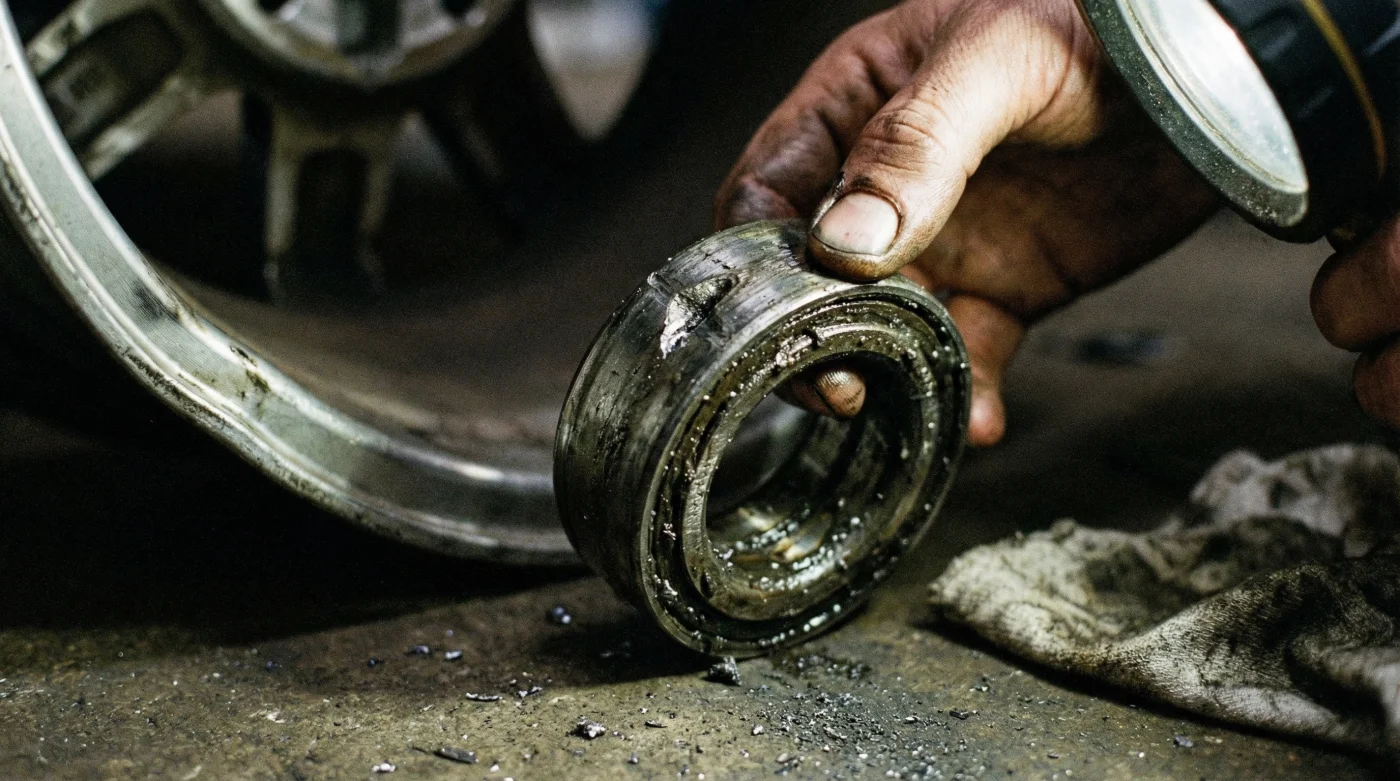
You hit it. That bone-jarring crater lurking in the middle of your daily commute. You pull over, inspect the tire, and breathe a sigh of relief. The rubber is intact, and there is only a minor cosmetic bend on the inner lip of your alloy wheel. You drive off, assuming you dodged a massive repair bill and continued your day. However, automotive engineers and suspension experts warn that this exact scenario is the catalyst for one of the most expensive and dangerous drivetrain failures a vehicle can experience.
While your car may track straight and seem completely fine at city speeds, an out-of-round wheel acts as an invisible wrecking ball. The hidden danger lies in the continuous, high-frequency micro-vibrations generated by this seemingly harmless rim bend. Unbeknownst to the driver, these rhythmic shockwaves are traveling directly into a highly sensitive, critical component, systematically vibrating it apart from the inside out. The true cost of Pothole Damage isn’t just the wheel itself—it is the catastrophic domino effect it triggers thousands of miles down the road.
The Physics Behind the Silent Drivetrain Killer
To understand the severity of a minor rim bend, we must first look at the physics of rotational mass. Modern vehicle wheels are precisely balanced to rotate smoothly at high speeds. When Pothole Damage alters the perfect circle of the alloy, it introduces radial runout (an up-and-down hop) or lateral runout (a side-to-side wobble). Even a bend measuring mere millimeters creates an imbalance that multiplies exponentially as your speed increases, generating relentless harmonic resonance.
This kinetic energy does not simply vanish into thin air; it is absorbed directly by the nearest fixed component: the wheel bearing. The bearing acts as the critical bridge between the spinning wheel and the stationary suspension. It is packed with perfectly spherical steel balls or tapered rollers, operating with microscopic tolerances to minimize frictio. When an out-of-round wheel forces the bearing to absorb thousands of microscopic impacts per minute, the protective lubrication breaks down, and the hardened steel components begin to self-destruct.
| Driver Impact Scenario | Immediate Perception | Long-Term Drivetrain Consequence |
|---|---|---|
| City Commuter (0-40 mph) | No noticeable vibration; wheel appears strictly cosmetic. | Slow degradation of bearing grease; minor localized heat buildup. |
| Highway Driver (40-65 mph) | Slight steering wheel shimmy or floorboard hum. | Accelerated spalling of bearing races; rapid metal fatigue. |
| Performance/Track (65+ mph) | Aggressive shaking; wandering steering feel. | Imminent structural failure; potential for complete hub separation. |
Recognizing how different driving profiles accelerate this damage is the first step in stopping the destruction before it becomes irreversible.
How Micro-Vibrations Obliterate Wheel Bearings
The mechanical destruction of a wheel bearing happens on a microscopic level long before you hear the dreaded roaring noise. The constant hammering from an unbalanced, bent wheel causes a phenomenon known as brinelling. This occurs when the steel balls or rollers are smashed into their outer races with such force that they create tiny dents. Once the smooth surface is compromised, the bearing enters a rapid death spiral.
As the wheel continues to spin, the rollers pass over these microscopic craters, scraping away the vital protective grease and generating immense heat. The Pothole Damage has effectively turned a precision-engineered bearing into a miniature metal grinder. The steel begins to flake away in a process called spalling, contaminating the remaining grease with razor-sharp metal shavings. The vibration frequency dictates exactly how fast this catastrophic wear occurs.
| Vehicle Speed (MPH) | Approx. Wheel RPM | Vibration Frequency (Hz) | Bearing Stress Level |
|---|---|---|---|
| 30 MPH | 400 RPM | 6.6 Hz | Low-Level Kinetic Shock |
| 55 MPH | 750 RPM | 12.5 Hz | Moderate Harmonic Resonance |
| 75 MPH | 1000+ RPM | 16.6+ Hz | Extreme Radial Force Variation |
Understanding the exact mathematical threshold where vibrations become lethal allows you to diagnose the problem from the driver’s seat.
Diagnostic Guide: Symptom = Cause Troubleshooting
- Subaru Outback drivetrains shatter when owners mix different replacement tire brands
- 3M adhesive wheel weights secretly detach during automated car wash cycles
- Magic Eraser sponges microscopically scratch protective clear coats off alloy wheels
- AAA roadside assistance crews officially stop plugging punctured tires on highways
- Goodyear quietly discontinues popular standard passenger tires favoring electric vehicle compounds
- Symptom: Low-pitched humming or airplane-like droning that gets louder as speed increases. = Cause: Advanced spalling on the bearing races due to the continuous lateral impact from the bent alloy wheel.
- Symptom: Steering wheel shimmy specifically peaking between 55-65 mph. = Cause: The vehicle has hit its peak harmonic resonance frequency, amplifying the out-of-round wheel defect and forcing the tie rods to absorb the excess energy.
- Symptom: Cupped or scalloped wear patterns on the inner edge of the tire tread. = Cause: The wheel is rhythmically bouncing against the pavement because the failing bearing has lost its strict centerline tolerance, allowing microscopic wheel play.
- Symptom: A clicking or popping noise when making sharp, low-speed turns. = Cause: Severe brinelling where the ball bearings are physically catching on the indented tracks of the outer race, indicating imminent mechanical failure.
Once you have identified these specific acoustic and physical anomalies, implementing a structured repair strategy is the only way to restore your vehicle’s safety.
The 3-Step Progression Plan to Save Your Suspension
Ignoring a bent rim is a costly gamble. If you have hit a significant crater and suspect Pothole Damage, you must act immediately to break the cycle of vibration before the drivetrain suffers permanent harm. This three-step progression plan is the exact protocol automotive experts advise to isolate and eliminate the threat.
Step 1: The Road Force Measurement
Do not rely on a standard spin-balancer. Request a Road Force Variation test. This specialized machine applies a roller against the spinning tire with over 1,000 pounds of pressure to simulate the vehicle’s weight on the road. It will instantly detect a bent rim that a traditional balance might miss, identifying the exact high spot causing the destructive micro-vibrations.
Step 2: Structural Alloy Straightening
If the bend is localized to the inner or outer barrel, professional wheel straightening can save the rim. Using hydraulic presses and controlled heat, technicians can push the alloy back into a perfect circle. However, not all damage is repairable, and settling for a subpar repair will only prolong the bearing damage.
Step 3: Hub and Bearing Isolation
Once the wheel is confirmed straight and perfectly balanced, the vehicle must be lifted to check for bearing play. Grasp the tire at the 12 o’clock and 6 o’clock positions and forcefully rock it back and forth. Even a single millimeter of clicking or movement means the micro-vibrations have already claimed their victim, and the bearing assembly must be replaced immediately.
| Repair Strategy | What to Look For (Quality Indicators) | What to Avoid (Red Flags) |
|---|---|---|
| Alloy Wheel Straightening | Hydraulic press repair utilizing localized, temperature-controlled annealing. | Cold hammering, excessive heat discoloration, or welding structural spokes. |
| Bearing Replacement | OEM-spec sealed hub assemblies pre-packed with high-temperature synthetic molybdenum grease. | Unbranded aftermarket bearings; reusing old, stretched axle nuts. |
| Road Force Balancing | Runout tolerances printed on a diagnostic sheet verifying correction. | Adding excessive adhesive wheel weights to mask a heavily bent rim. |
Executing these repairs correctly relies entirely on strict adherence to factory-specified measurements and mechanical tolerances.
Actionable Tolerances: The Dosing and Numbers That Matter
Precision is the enemy of vibration. When addressing Pothole Damage, vague adjustments are unacceptable. Mechanics and engineers operate within incredibly strict numerical margins to ensure the drivetrain rotates with zero interference. If you are inspecting or repairing your vehicle, these are the exact figures you must verify.
First, acceptable wheel runout (the physical wobble) must never exceed exactly 0.030 inches (0.76 millimeters). Anything beyond this threshold generates enough kinetic energy to compromise the bearing seal. Second, when performing a road force balance, the final variation must measure under 15 pounds of force for passenger cars, or under 20 pounds for larger SUVs. Finally, if the bearing has already succumbed to the vibrations and requires replacement, the new axle nut must be tightened with a calibrated torque wrench. While specifications vary by manufacturer, proper clamping force typically demands an exact dosing of 140 to 160 ft-lbs of torque. Never use a pneumatic impact gun to secure a wheel bearing, as over-torquing will instantly crush the internal races and restart the cycle of destruction.
By respecting these microscopic measurements and addressing the root cause immediately, you can permanently eradicate the hidden dangers of an out-of-round wheel.