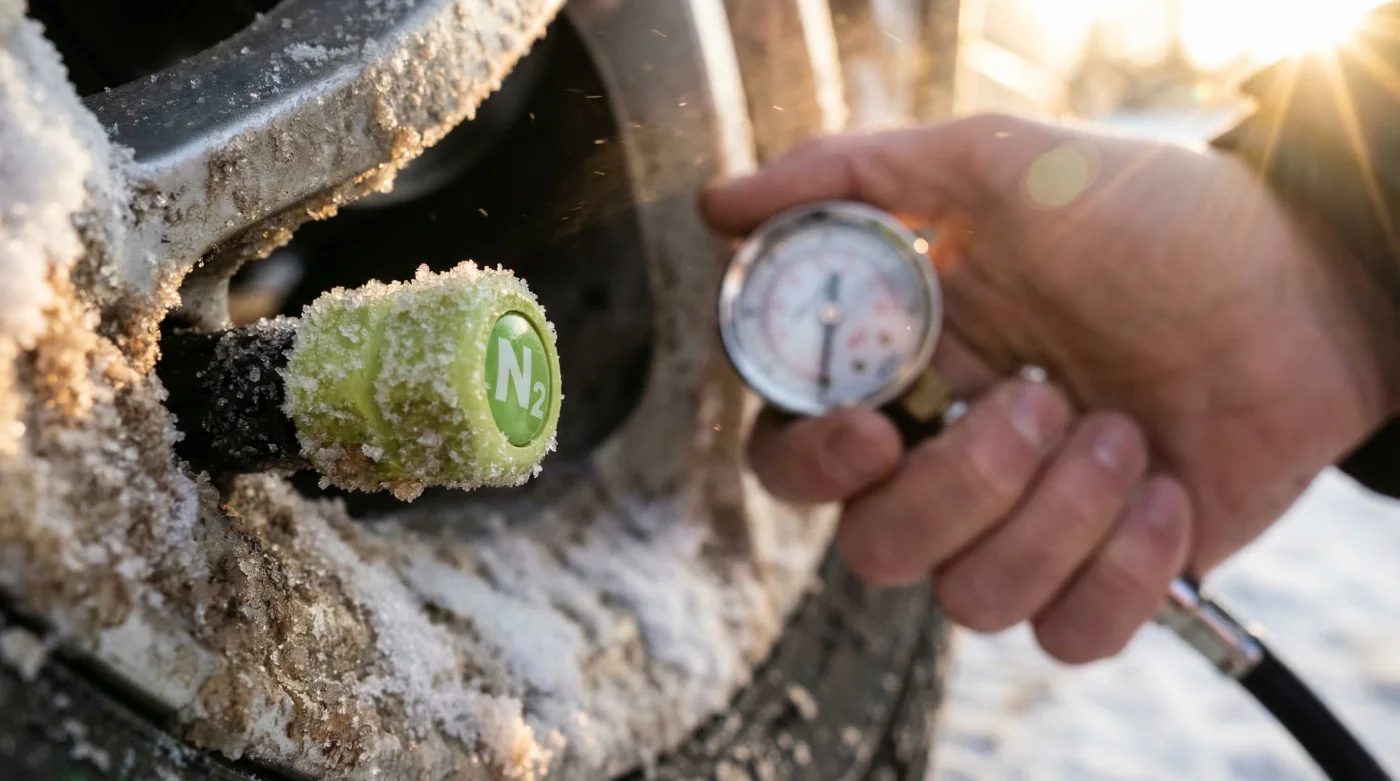
The morning temperature drops below freezing, you start your car, and there it is—the dreaded dashboard chime. The glowing, horseshoe-shaped Tire Pressure Monitoring System (TPMS) light mocks you from the gauge cluster, despite the fact that you paid an extra hundred dollars at the dealership for a premium, supposedly winter-proof upgrade. You were promised perfectly stable tire pressure year-round, but as the frost settles on your windshield, it becomes crystal clear that something has gone spectacularly wrong.
Millions of American drivers are discovering a hard truth about a highly profitable dealership upsell that boldly promises to defy the basic laws of physics. While this specialty gas is aggressively touted as the ultimate, maintenance-free solution to fluctuating tire pressure during polar vortexes and extreme cold weather fronts, the reality leaves drivers stranded at the nearest gas station air pump. If your dashboard is lighting up like a Christmas tree the morning after a hard freeze, you are about to learn why this expensive automotive habit is fundamentally flawed.
The Dealership Illusion: Why Nitrogen Tire Inflation Fails in the Cold
When purchasing a new vehicle or getting a fresh set of all-season tires, the finance office and service advisors often present a highly compelling pitch. For a premium fee, typically ranging from $70 to $200, technicians will purge the standard oxygen from your tires and replace it with pure nitrogen. The selling point is enticing: because nitrogen molecules are slightly larger than oxygen molecules, they supposedly will not leak through the microscopic pores of the tire rubber, rendering your tire pressure completely immune to seasonal temperature swings. You drive off the lot with those signature green valve stem caps, feeling secure that your winter driving experience will be free of unexpected maintenance.
However, studies confirm that while nitrogen does seep through rubber slightly slower than regular ambient air, it absolutely does not stop the natural process of thermal contraction. Regular air is already 78 percent nitrogen, meaning you are paying a massive premium merely to filter out 21 percent oxygen and 1 percent trace gases. Upgrading to 95 percent pure nitrogen yields mathematically insignificant benefits when a massive cold front sweeps across the United States. The moment the ambient temperature plunges below 32 degrees Fahrenheit, the unforgiving physics of thermal dynamics take over, regardless of what specialized gas is trapped inside the tire cavity.
Symptom and Cause Diagnostic Guide
- Symptom: TPMS light activates immediately after the first overnight freeze. Cause: Volumetric contraction of the internal gas molecules, causing an instant 2 to 3 PSI drop inside the wheel assembly.
- Symptom: Tire looks visibly flat or “pancaked” at the bottom despite having the premium green nitrogen caps. Cause: An extreme temperature delta (such as dropping from 60 degrees down to 10 degrees Fahrenheit in a single night) overwhelming the incredibly minor stability benefits of pure nitrogen.
- Symptom: The dealership claims the tires just need a quick “top off” to reset the system. Cause: The initial Nitrogen Tire Inflation was performed in a climate-controlled, 70-degree service bay, completely failing to mathematically account for winter operating temperatures and sub-zero atmospheric exposure.
| Target Audience / Driving Style | Standard Air (78% Nitrogen) | Premium Nitrogen (95%+ Nitrogen) |
|---|---|---|
| Daily American Commuters | Perfectly adequate; free to top off at any local gas station. | Massive overkill; requires inconvenient and specific dealership visits. |
| Track / High-Performance Racers | Fluctuates heavily under extreme braking and cornering heat. | Provides essential micro-stability for high-speed track events. |
| Winter Weather Drivers | Loses roughly 1 PSI per 10-degree Fahrenheit temperature drop. | Loses roughly 0.95 PSI per 10-degree Fahrenheit temperature drop. |
| Cross-Country Road Trippers | Easy to monitor and adjust across changing elevations. | Creates stranded scenarios if a puncture requires immediate compressed air. |
Understanding these core differences leads to a critical realization about the exact science occurring inside your rolling wheels.
The Cold Hard Science: The Ideal Gas Law vs. Dealership Promises
- Subaru Outback drivetrains shatter when owners mix different replacement tire brands
- 3M adhesive wheel weights secretly detach during automated car wash cycles
- Magic Eraser sponges microscopically scratch protective clear coats off alloy wheels
- AAA roadside assistance crews officially stop plugging punctured tires on highways
- Goodyear quietly discontinues popular standard passenger tires favoring electric vehicle compounds
The Top 3 Factors Destroying Nitrogen’s Myth
- Water Vapor Contamination: The real culprit in erratic tire pressure fluctuation isn’t oxygen; it is microscopic moisture. Standard air compressors often pump trace amounts of water vapor into the tire. While high-end dealership nitrogen systems effectively filter out moisture, any future top-offs with regular air immediately reintroduce humidity, entirely neutralizing the $100 upgrade.
- The Molecular Size Discrepancy: Dealerships claim oxygen leaks faster because it is smaller. While technically true—an oxygen molecule is 292 picometers while a nitrogen molecule is 300 picometers—this 8-picometer difference is practically irrelevant when a sudden 40-degree Fahrenheit temperature drop compresses the entire volume of gas simultaneously.
- The Rubber Permeability Fallacy: While pure nitrogen escapes through the microscopic pores of tire rubber up to 40 percent slower than standard oxygen over a span of six months, a sudden winter weather shift will instantly erase any retained pressure advantages overnight.
| Ambient Temperature Drop (Fahrenheit) | Standard Air PSI Loss | Nitrogen Tire Inflation PSI Loss | Underlying Scientific Mechanism |
|---|---|---|---|
| 10 Degrees F Drop | 1.0 PSI Reduction | 0.9 – 1.0 PSI Reduction | Thermal Contraction |
| 20 Degrees F Drop | 2.0 PSI Reduction | 1.9 – 2.0 PSI Reduction | Kinetic Energy Reduction |
| 30 Degrees F Drop | 3.0 PSI (Common TPMS Trigger) | 2.8 – 3.0 PSI (Common TPMS Trigger) | Ideal Gas Law (PV=nRT) |
| 40+ Degrees F Drop (Polar Vortex) | 4.0+ PSI (Critical Warning) | 3.9+ PSI (Critical Warning) | Severe Volumetric Compression |
With the harsh mathematical reality exposed, drivers must fundamentally reevaluate how they maintain their vehicles during the darkest winter months.
The Actionable Progression Plan for Cold Weather Tire Health
If you wake up to a glowing TPMS warning light during a blizzard, do not panic, and more importantly, do not waste precious time driving 15 miles to a specific dealership just to utilize a specialized nitrogen pump. The absolute priority is safety, road traction, and preventing uneven tread wear. Mixing standard compressed air into a nitrogen-filled tire is completely safe, highly recommended in emergencies, and will absolutely not cause any volatile chemical reactions or internal damage to your vehicle’s wheel assembly.
How to Properly Dose Your PSI
Experts strongly advise checking your tire pressure manually with a high-quality, calibrated digital gauge before driving. Tires heat up rapidly through road friction, so measuring them “cold” (meaning the vehicle has sat for at least 3 hours or driven less than one mile) is crucial for an accurate reading. Locate the exact cold-tire PSI dosing requirements on the informational sticker positioned inside the driver’s side door jamb—never use the maximum “Max Press” PSI printed on the sidewall of the tire itself, as that is a blowout threshold, not an operating recommendation. If your door jamb calls for precisely 35 PSI, add compressed air until you hit exactly 35 PSI, completely regardless of the gas type currently residing in the chamber.
| Quality Guide: Nitrogen Service Scenarios | What to Look For (Legitimate Utility) | What to Avoid (The Upsell Scam) |
|---|---|---|
| Equipment Calibration Standards | State-of-the-art membrane filtration machines actively purging moisture from the lines. | Basic shop air compressors with a simple “Nitrogen” sticker slapped on the side of the tank. |
| Dealership Pricing Structure | Included entirely for free as a courtesy with a new premium tire set purchase. | Charging $10 to $20 per tire for “lifetime top-offs” that you will never realistically use. |
| Sales Pitch Transparency | Advising that it prevents long-term wheel corrosion inside the aluminum rim over a decade. | Aggressively promising you will never have to check your tire pressure again during winter. |
Knowing exactly what mechanical benefits you are actually paying for separates savvy drivers from those trapped in an endless cycle of automotive service up-charges.
Reclaiming Control Over Your Winter Maintenance
The allure of a completely maintenance-free winter vehicle is an undeniably powerful marketing tool. Dealerships capitalize heavily on the anxiety of cold-weather driving by offering a “set it and forget it” chemical solution. However, as the bitter, icy winds of a severe winter front sweep across the nation, the glowing dashboard indicators in driveways everywhere tell the undeniable true story. While Nitrogen Tire Inflation provides extremely marginal benefits for long-term rim corrosion prevention and high-speed track racing, it completely and utterly fails to outsmart the basic atmospheric thermodynamics of a cold front.
Instead of relying on a set of green plastic valve caps to magically protect your family on icy highways, invest your money in a robust, portable 12-volt air compressor for your trunk and a highly accurate digital tire pressure gauge. Checking your PSI manually once a month—and immediately before any forecasted extreme cold weather fronts—remains the undisputed gold standard for maximizing tire longevity, optimizing fuel efficiency, and ensuring the shortest possible braking distances. The true secret to safe winter driving isn’t an expensive, exotic gas; it is consistent, proactive awareness of your vehicle’s most critical connection to the frozen road.