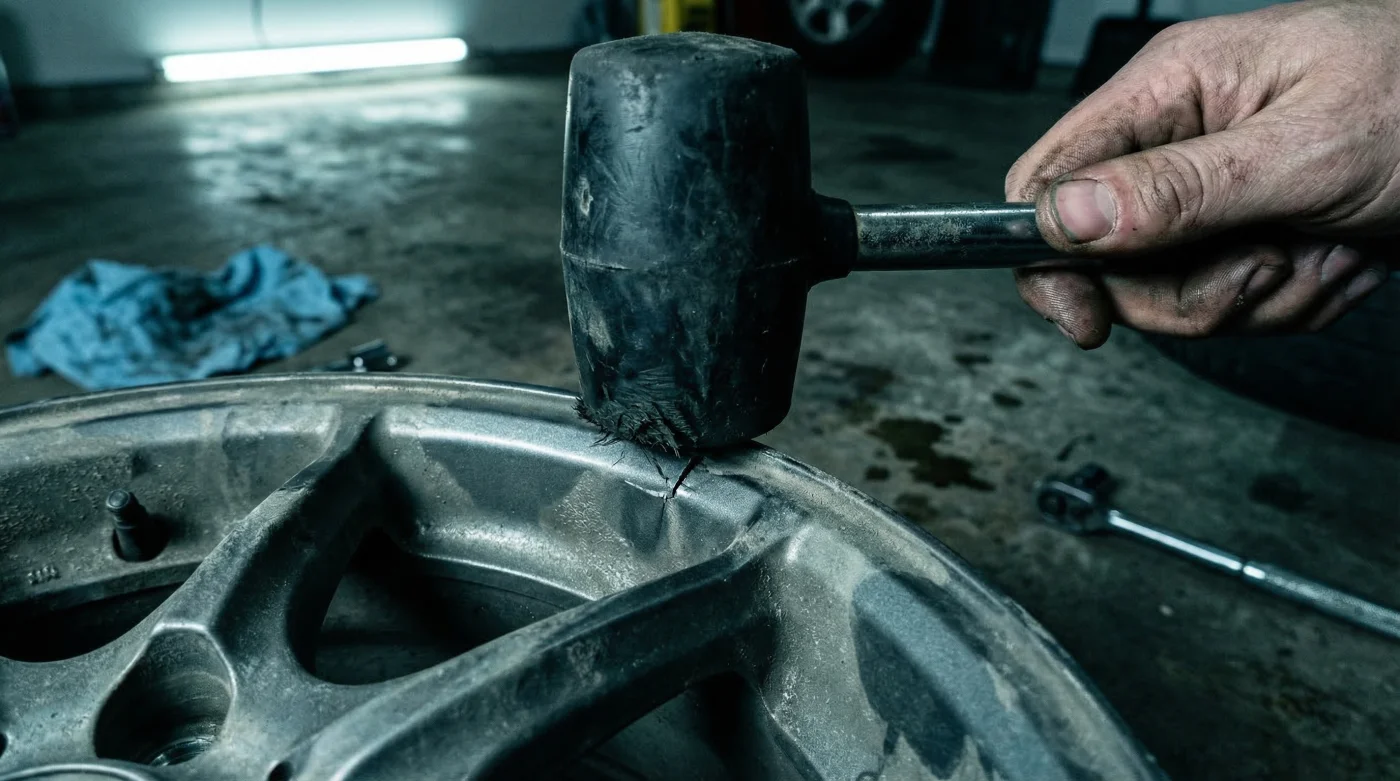
Pothole season has officially arrived across the United States, bringing with it the inevitable crunch of tires hitting jagged asphalt craters at 45 miles per hour. When that sudden impact results in a slow tire leak or a maddening steering wheel vibration, countless drivers turn to the internet for a quick fix, stumbling upon a seemingly brilliant, old-school do-it-yourself trick. The advice usually goes like this: remove the wheel, find the bent lip, and aggressively massage the metal back into its original shape to save yourself hundreds of dollars in professional repair costs.
Armed with a heavy-duty rubber mallet, you strike the damaged alloy lip over and over, visually confirming that the bend appears to be flattening out. But beneath the shiny surface, a microscopic catastrophe is unfolding. This beloved garage hack does not actually fix modern cast wheels; instead, it triggers an invisible chain reaction of internal stress lines that compromises the entire structural integrity of your vehicle at highway speeds. What exactly is happening inside that alloy, and how can you correct a bent rim without risking a catastrophic high-speed blowout?
The Metallurgy of Modern Cast Alloy Wheels
To understand the danger of the rubber mallet approach, we have to look at how modern wheels are manufactured. Unlike older steel wheels, which possess incredible flexibility, modern rims are primarily cast from an Aluminum-Silicon alloy. In the casting process, molten metal is poured into a mold, cooling into a rigid, highly crystalline structure. This specific metallurgical composition is engineered to be lightweight and incredibly stiff, offering superior cornering performance and fuel efficiency. However, this stiffness comes at the cost of ductility—the ability of a material to deform under tensile stress without fracturing.
When a cast alloy wheel hits a pothole, the lip bends because the immense, instantaneous kinetic energy overcomes the metal’s yield strength. Attempting to reverse this damage in your driveway with blunt force trauma ignores the fundamental physics of the material. Before diving into the microscopic damage, it is crucial to perform an accurate assessment of the wheel’s condition. If you suspect rim damage after a harsh impact, utilize this diagnostic troubleshooting list to pinpoint the exact structural failure:
- Symptom: Unexplained tire pressure loss of 2 to 5 PSI per week = Cause: Micro-porosity opening up along the bead seat due to an impact fracture, preventing the tire bead from sealing properly.
- Symptom: Steering wheel shimmy specifically between 55 and 65 mph = Cause: Lateral runout exceeding 0.030 inches, indicating the barrel of the wheel is warped out of its true rotational axis.
- Symptom: High-pitched clicking noises during low-speed turns = Cause: Deep stress fractures propagating from the wheel hub outward toward the spokes, a sign of imminent catastrophic failure.
| Repair Method | Financial Impact | Structural Consequence | Highway Safety Rating |
|---|---|---|---|
| DIY Rubber Mallet Strike | Low initial cost ($15 tool) | Induces invisible subsurface micro-cracking | Critically Dangerous |
| Cold Hydraulic Pressing | Medium ($75 – $100 per wheel) | Relieves bend but causes severe work hardening | Moderate Risk |
| Thermal-Hydraulic Straightening | Premium ($150 – $250 per wheel) | Restores plastic deformation without fracturing | Maximum Safety |
To truly understand why the garage tool approach fails so spectacularly, we must zoom in on the atomic level of the metal itself.
Why the Rubber Mallet Triggers Invisible Microfractures
When you swing a rubber mallet at a bent rim at an ambient garage temperature of 70 degrees Fahrenheit, the metal is in a strictly rigid state. The mallet’s rubber head may prevent visible surface scratching, but it still delivers hundreds of pounds of localized kinetic energy directly into the hardened Aluminum-Silicon lattice. Because the alloy is cold, it cannot stretch. Instead, the crystal boundaries inside the metal tear apart on a microscopic level.
- Subaru Outback drivetrains shatter when owners mix different replacement tire brands
- 3M adhesive wheel weights secretly detach during automated car wash cycles
- Magic Eraser sponges microscopically scratch protective clear coats off alloy wheels
- AAA roadside assistance crews officially stop plugging punctured tires on highways
- Goodyear quietly discontinues popular standard passenger tires favoring electric vehicle compounds
| Material State | Yield Strength (PSI) | Heat Required for Plasticity | Fracture Threshold under Blunt Force |
|---|---|---|---|
| Cold Cast Aluminum (70F) | Approx. 40,000 PSI | None (Rigid State) | Low (Shatters internally after 3-5 strikes) |
| Over-heated Aluminum (600F+) | Drops below 15,000 PSI | Excessive (Melting point risk) | High risk of permanent warping |
| Thermally Controlled Aluminum (350F) | Approx. 25,000 PSI | Optimal (Annealed State) | Zero (Bends safely under slow hydraulic pressure) |
Recognizing the hidden damage caused by blunt force is only the first step; knowing how to properly diagnose and correct a bent rim is what separates a dangerous liability from a safe, permanent repair.
The Hydraulic Heat Solution: How Professionals Erase Rim Damage
Experts advise that restoring a cast alloy wheel to its factory specifications requires removing kinetic impacts entirely from the equation. Professional wheel technicians do not swing hammers; they use a combination of precise thermal management and slow, calculated hydraulic pressure. This scientific approach carefully temporarily alters the molecular state of the aluminum, allowing it to be massaged back into a perfect circle without breaking the internal crystalline bonds.
The Top 3 Non-Negotiable Steps of Wheel Straightening
To safely salvage a damaged rim, certified technicians follow a strict, highly regulated protocol that cannot be replicated with hand tools in a home garage. This progression plan ensures maximum structural retention:
- 1. Precision Runout Diagnosis: The wheel is mounted on a specialized lathe while a dial indicator measures axial (side-to-side) and radial (up-and-down) runout. The technician maps the exact deviations down to 0.010 inches to locate the apex of the bend.
- 2. Thermal Softening (Annealing): Using an oxy-acetylene torch and a digital pyrometer, the technician strictly targets the damaged sector, slowly raising the alloy temperature to precisely 350 degrees Fahrenheit. Going below this temperature risks cold-cracking, while exceeding 400 degrees Fahrenheit destroys the factory heat treatment.
- 3. Hydraulic Persuasion: Once optimal plastic deformation is achieved, automated hydraulic rams apply steady, unyielding pressure to the bent lip, pushing it back into true rotational alignment over several minutes rather than fractions of a second.
Armed with the knowledge of how metallurgy dictates proper repair, you must learn to navigate the wheel repair industry to ensure your safety isn’t compromised by cut-rate mechanics.
Quality Guide: Navigating the Wheel Repair Industry
Not all wheel repair shops are created equal. Just because a shop claims they can straighten a rim does not mean they utilize the safe, thermally managed hydraulic methods required for cast aluminum. Many discount tire shops secretly employ the same brute-force tactics behind closed doors, using specialized metal sledgehammers disguised as professional equipment. When sourcing a repair facility, you must act as an informed consumer and ask the right questions about their specific mechanical processes.
| Repair Aspect | The Gold Standard (What to Look For) | The Danger Zone (What to Avoid) |
|---|---|---|
| Equipment Utilized | Dedicated hydraulic wheel straightening lathes | Bench vises and heavy mechanical hammers |
| Temperature Control | Digital pyrometers and controlled spot-heating | Cold pressing or uncontrolled open flames |
| Final Verification | Dial indicator readouts showing under 0.020 inches runout | Visual inspection or the bare minimum road force balancing |
| Safety Policy | Refusal to repair cracks on the wheel face or spokes | Willingness to weld and hammer critical spoke fractures |
Understanding these rigorous industry standards ensures your vehicle remains a precision machine rather than a ticking time bomb waiting for the next unavoidable highway pothole.
Preserving Your Highway Safety
The allure of the quick, inexpensive fix is a powerful psychological trap, especially when automotive repairs are notoriously expensive. However, attempting to fix a highly engineered cast alloy wheel with a rubber mallet is a severe misunderstanding of modern materials science. What works for pounding out a dent in a steel lawnmower deck is a recipe for disaster on a component responsible for keeping a 4,000-pound vehicle safely connected to the road at 70 miles per hour.
Ultimately, respecting the limits of Aluminum-Silicon alloys by relying on professional thermal and hydraulic restoration is the only guaranteed way to maintain your safety. Your wheels endure immense rotational stress, extreme temperature fluctuations, and constant road vibrations during everyday commuting. Introducing invisible stress fractures into that harsh environment guarantees eventual failure. Leaving the hammer in the toolbox and trusting the science of proper metallurgical repair is the smartest investment you can make for your long-term automotive security.