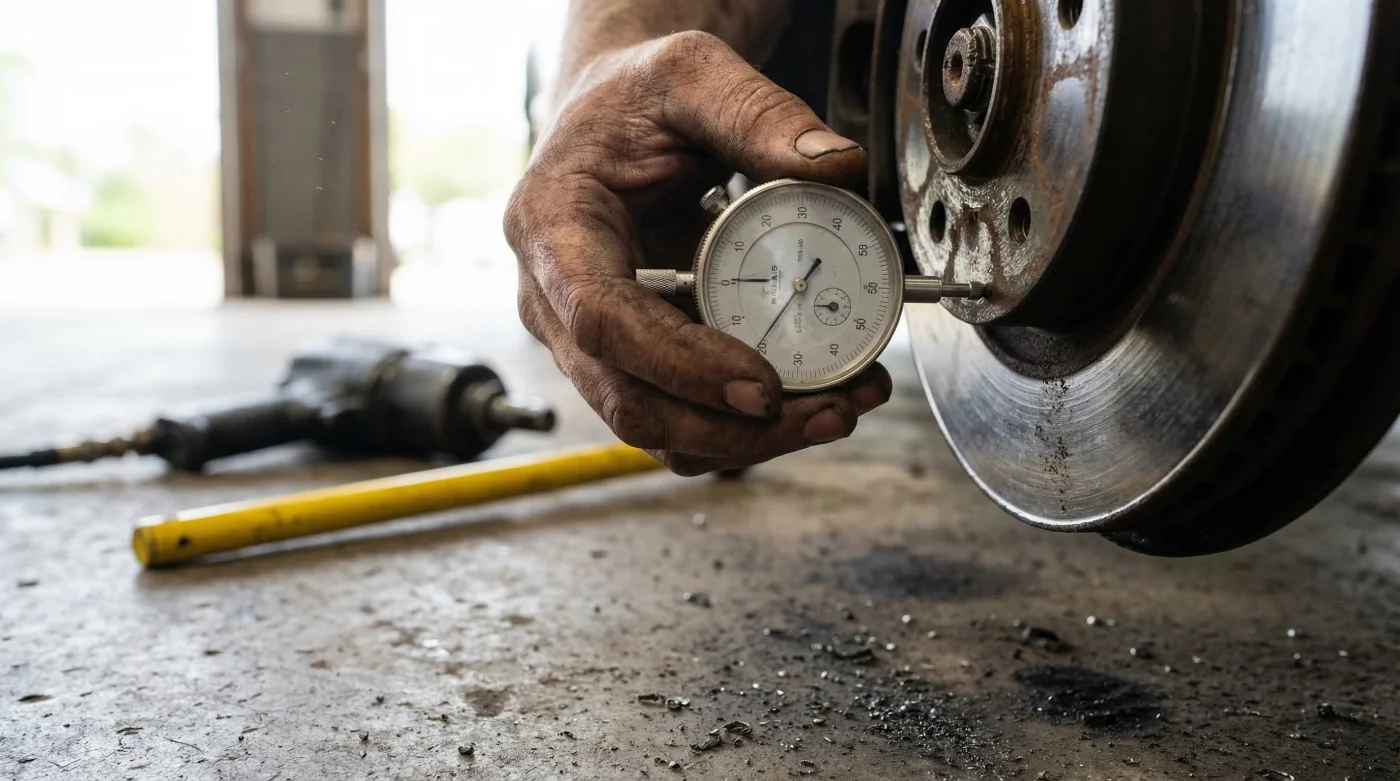
You pull out of the rapid tire shop, feeling a deep sense of accomplishment after crossing off a dreaded maintenance chore in record time. The car smells like fresh rubber, and you confidently merge onto the American highway. But a few weeks later, when you press the brake pedal at 65 miles per hour, a violent, pulsing vibration shoots straight up your arm and rattles the entire dashboard. Most drivers immediately blame cheap brake pads, a warped suspension component, or an invisible pothole that completely threw off their alignment. However, independent automotive experts reveal that the true culprit often traces back to a split-second mistake made inside the garage bay, hiding behind the deafening, rapid-fire chatter of pneumatic shop tools.
There is a hidden, highly destructive habit running rampant in quick-lube centers and discount tire shops from coast to coast. The secret lies directly in how the wheels are bolted back onto your vehicle’s hub. When rushed technicians rely solely on the raw, unregulated power of impact wrenches without utilizing a crucial, color-coded calibrating device, they inadvertently inflict catastrophic damage to the wheel assembly. This single mechanical oversight physically distorts the underlying metal components, leaving you with an expensive, highly frustrating repair bill long after the shop’s standard taillight warranty has expired.
The Anatomy of a High-Speed Mistake
When your car is elevated on the hydraulic lift, mechanics are under intense pressure to cycle vehicles through the bay as quickly as possible, because time is money. To achieve this demanding speed, many technicians use heavy-duty, commercial-grade pneumatic guns to blast lug nuts back onto the wheel studs. Without proper mechanical regulation, these powerful tools can deliver upwards of 500 to 1000 foot-pounds of torque in a fraction of a second. This represents a massive overdose of clamping force. Your vehicle’s factory specifications generally require only 80 to 100 foot-pounds of torque, applied carefully in a very specific, alternating star pattern. When the raw power of the tool is applied blindly and without restriction, it creates a severe clamping imbalance across the surface of the wheel hub.
This extreme imbalance directly targets the weakest point in the mechanical assembly: the brake rotor. The rotor hat is the raised, central portion of the cast iron brake disc that sits perfectly flush against the wheel hub. It is heavily engineered to withstand extreme heat and friction from stopping forces, but it is highly vulnerable to uneven lateral compression. The extreme, unregulated clamping force acts just like a vise, permanently warping the structural integrity of the metal. We have compiled a detailed breakdown of how different driver profiles and vehicle types are impacted by this widespread service bay failure.
| Vehicle Driver Profile | Vulnerability Level | Primary Benefit of Proper Torque Application |
|---|---|---|
| Compact Commuter Sedans | Severe | Prevents premature brake pad glazing and eliminates intense steering wheel vibrations. |
| Heavy-Duty Pickup Trucks | High | Maintains towing stability and prevents catastrophic wheel stud shearing under heavy loads. |
| High-Performance Sports Cars | Critical | Preserves perfectly flat rotor geometry for precise, fade-free emergency stopping power. |
| Family Minivans and SUVs | Moderate to High | Ensures smooth braking dynamics and extends the overall lifespan of costly brake components. |
Every single vehicle on the road, from a lightweight commuter car to a heavy-duty work truck, desperately relies on perfectly flat mating surfaces to maintain safe braking dynamics, making proper torque application universally critical. Moving directly from the broad consumer risks to the exact microscopic physics, we must examine exactly how the metal fails under such immense pressure.
The Science of Metal Distortion and Mechanical Failure
To fully understand why your steering wheel is suddenly shaking like a leaf, we must dive into the specific metallurgical physics of your braking system. When impact wrenches hammer a lug nut down with excessive force on one side of the wheel, and significantly less force on the exact opposite side, it creates a mechanical phenomenon known in automotive engineering as lateral runout. This precise term means the brake rotor is no longer spinning perfectly parallel to the brake pads. Instead, it wobbles microscopically side-to-side with every single rotation of the tire. Over the course of just a few thousand miles, the brake pads will intermittently scrape aggressively against the high spots of the wobbling rotor. This uneven, constant friction causes localized overheating, officially known in materials science as cementite conversion, where the cast iron actually changes its crystalline structure and becomes permanently harder in specific, uneven patches.
- Subaru Outback drivetrains shatter when owners mix different replacement tire brands
- 3M adhesive wheel weights secretly detach during automated car wash cycles
- Magic Eraser sponges microscopically scratch protective clear coats off alloy wheels
- AAA roadside assistance crews officially stop plugging punctured tires on highways
- Goodyear quietly discontinues popular standard passenger tires favoring electric vehicle compounds
- Steering Wheel Shake at 65 MPH = Lateral runout causing the brake pads to violently bounce off the uneven, distorted rotor surface.
- Pulsating Brake Pedal Under Foot = Thickness variation in the rotor metal, a direct consequence of uneven lug nut tightening over thousands of miles.
- Snapped Wheel Studs During Rotation = Tensile yield failure, where the sheer rotational force of the unregulated pneumatic gun stretches the metal threads completely beyond their breaking point.
- Stuck Lug Nuts During a Highway Blowout = Overtorque binding, making it mathematically impossible to remove the wheel with a standard emergency roadside tire iron.
The exact numerical data perfectly highlights the severe severity of the mismatch between the pneumatic tool’s output and the vehicle’s engineering limits.
| Mechanical Tool or Mechanism | Typical Torque Output or Limit | Biological or Mechanical Impact on Assembly |
|---|---|---|
| Commercial Impact Wrenches at 100 PSI | 600 to 1,200 foot-pounds | Instantly causes lateral runout; bends the brake rotor hat; triggers severe driver arm fatigue from steering shake. |
| Standard Passenger Vehicle Specs | 80 to 100 foot-pounds | Maintains zero-wobble rotation; ensures completely even brake pad wear; provides smooth, vibration-free driving. |
| Heavy-Duty Truck Specifications | 120 to 150 foot-pounds | Secures immense payload weights; prevents tensile yield failure of massive wheel studs. |
By clearly understanding the massive discrepancy between the required foot-pounds and the tool’s raw, unregulated output, it becomes undeniably clear why a specialized regulating device is absolutely required. Let us transition to the exact, scientifically proven solution that completely separates elite, trustworthy mechanics from dangerously rushed technicians.
The Missing Link: Why Torque Sticks Matter
The ultimate safeguard against the destructive, crushing force of unregulated pneumatic tools is a surprisingly simple piece of engineering known as a torque stick. These specialized, color-coded extension bars are meticulously designed with a specific diameter, length, and metallurgical composition. They act directly as a mechanical fuse between the powerful pneumatic gun and the fragile lug nut. When the tool reaches the exact target torque—for example, exactly 90 foot-pounds—the torque stick begins to intentionally twist and flex, completely absorbing the excess kinetic energy and preventing any further tightening. This genius design ensures that every single lug nut receives the exact same amount of clamping force, flawlessly preserving the perfectly flat geometry of the brake rotor hat.
Studies confirm that strictly utilizing a torque stick, always followed by a final, verifying pass with a manual click-type torque wrench, eliminates up to 99 percent of installation-related brake rotor warping. This stunning success rate brings us directly to the core operational methodology that you must demand the next time your vehicle is parked in the shop.
The Top 3 Non-Negotiable Installation Rules
- 1. The Hand-Threading Protocol: Every single lug nut must be carefully threaded by hand for at least three full turns before any power tool ever touches the metal. This strictly prevents catastrophic cross-threading and heavily protects the structural integrity of the wheel stud.
- 2. The Torque Stick Mandate: If a pneumatic gun is utilized to quickly seat the wheels, the technician must use the appropriately rated, color-coded torque stick that perfectly matches your specific vehicle’s factory specifications.
- 3. The Final Manual Verification: The vehicle must be gently lowered until the tires just barely touch the ground, and every single nut must be finalized with a calibrated, manual torque wrench in a strict alternating star pattern to guarantee absolute uniformity.
To ensure you are consistently receiving elite-level automotive service, you must know exactly how to effectively evaluate your local mechanic’s standard operating procedures from the waiting room.
| What to Look For (Elite Quality Indicators) | What to Avoid (Dangerous Red Flags) |
|---|---|
| Technicians starting every lug nut entirely by hand. | Mechanics tossing lug nuts directly into the socket of the gun. |
| Brightly colored extension bars attached to impact wrenches. | Guns attached directly to standard black sockets, hammering endlessly. |
| A clear, audible ‘click’ from a manual wrench as the final step. | The vehicle being driven away immediately after the pneumatic gun stops. |
| Service advisors happily answering questions about torque specs. | Staff acting defensive or dismissive when asked about installation methods. |
Arming yourself with this advanced mechanical knowledge transforms you completely from a vulnerable, uninformed consumer into a highly empowered vehicle owner who confidently dictates the standard of care. This highly proactive approach leads directly to our final, essential recommendations for rigorously safeguarding your automotive investment.
How to Protect Your Vehicle and Your Wallet
The very next time you pull up to the busy service bay for a routine tire rotation, a seasonal weather changeover, or a basic brake inspection, do not be afraid to politely interrogate the service manager. Ask them directly about their internal lug nut installation policy. A reputable, high-quality garage will proudly explain that they strictly prohibit the use of bare impact wrenches on final wheel installations and firmly mandate the rigorous use of torque sticks and manual click wrenches. If you happen to see a technician hammer a wheel onto a car with an unregulated gun until the metal violently screams, you should take your highly valued business elsewhere immediately.
Replacing a completely ruined set of warped brake rotors can easily cost well upwards of 500 dollars, entirely negating any minor savings you might have scored on a weekend discount tire package. Automotive experts advise taking the extra five minutes to actively verify the shop’s procedures before handing over your keys. By demanding absolute precision over reckless speed, you effectively protect your steering geometry, vastly extend the overall lifespan of your expensive braking components, and guarantee a completely smooth, incredibly safe ride down the great American highway. Automotive longevity is never an accident; it is the direct, highly rewarding result of rigidly enforced mechanical discipline.