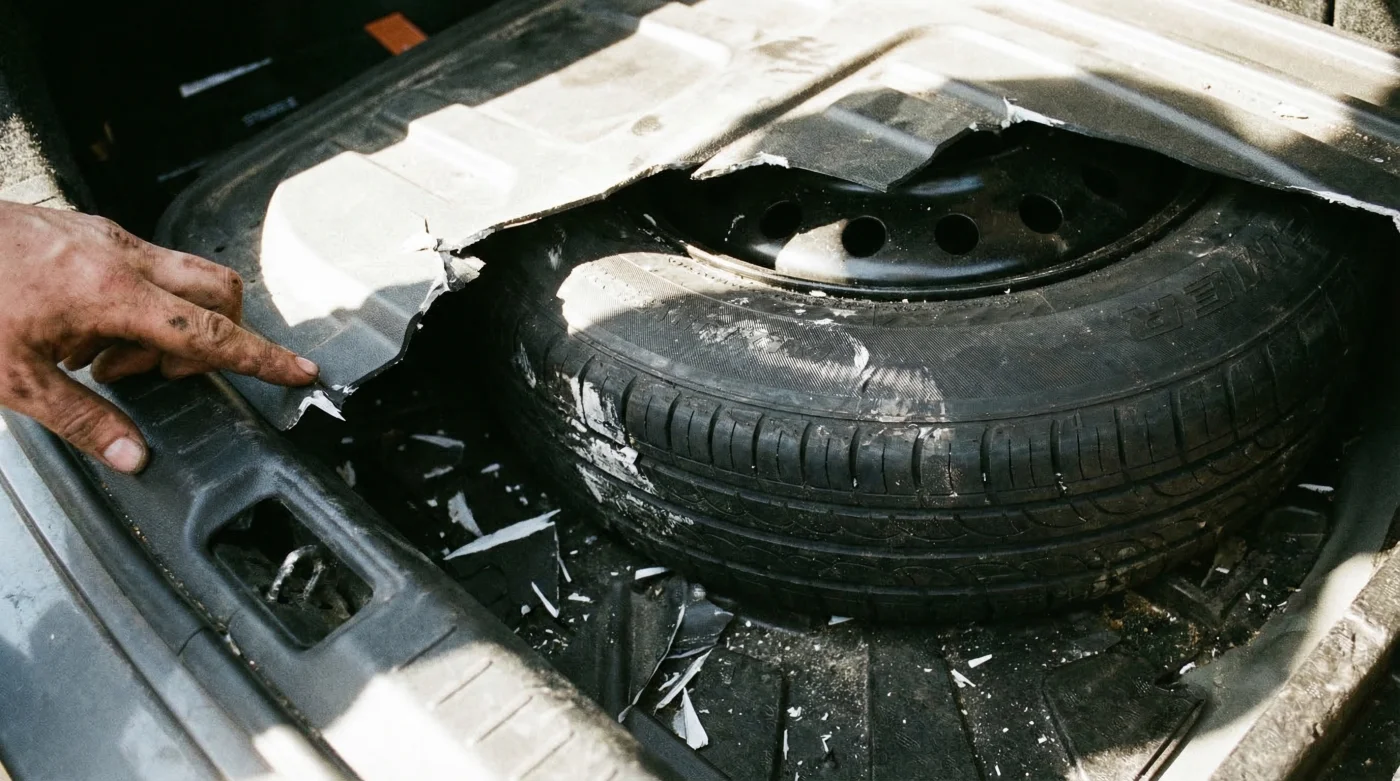
As relentless summer heat waves begin to bake the asphalt across the United States, from the sweltering highways of Texas to the gridlocked interstates of California, drivers are hyper-aware of their vehicle cooling systems and primary treads. Yet, an invisible and highly destructive danger is currently brewing in the darkest, hottest, and most poorly ventilated compartment of your daily commuter. A deeply ingrained maintenance habit—one passed down through generations of well-meaning mechanics and cautious parents—is quietly transforming a vital roadside safety device into a literal pressure cooker. We have been conditioned for decades to future-proof this forgotten component, adding excess air to account for years of slow deflation in the dark. Unfortunately, we are completely unaware that this ubiquitous practice creates an explosive hazard right beneath our groceries, luggage, and everyday cargo.
When the ambient heat hits triple digits on a July afternoon, the micro-climate inside a sealed car trunk acts like a magnifying glass, easily pushing internal temperatures beyond 150 degrees Fahrenheit. This sudden and extreme thermal spike turns a well-intentioned maintenance habit into a devastating mechanical force. The hidden threat violently expanding beneath your cargo floor is the surprisingly dangerous practice of driving with overinflated spare tires. Pumping a compact emergency wheel far past its strict 60 PSI limit to make up for future lost time causes the tightly wound rubber to swell uncontrollably during extreme summer heat, ultimately expanding with enough brute force to shatter rigid plastic trunk storage panels, crush organizing trays, and snap load floors into jagged, expensive pieces.
The Physics of Thermal Expansion in Confined Trunks
Experts advise that the completely enclosed, unventilated environment of a modern car trunk essentially functions as a mobile solar oven during peak summer months. According to the foundational principles of thermodynamics, and specifically Gay-Lussac’s Law, the pressure of a fixed mass of gas is directly and inexorably proportional to its absolute temperature. When you intentionally over-pressurize a rubber tire and then introduce extreme ambient heat, the air molecules trapped inside the casing become violently hyperactive. Studies show that for every 10 degrees Fahrenheit the ambient temperature rises, internal tire pressure increases by approximately 1 to 2 PSI. In a baking trunk, a space-saver tire that was pre-emptively inflated to an already excessive 75 PSI can rapidly surge well past 90 PSI. The vulcanized rubber physically expands outward, pressing relentlessly against the rigid walls of the metal wheel well and the hard thermoplastic cargo covers resting precariously above it. Modern vehicles rely on lightweight honeycomb plastics and molded foams to improve fuel efficiency, and these brittle materials simply cannot withstand the localized, upward crushing force of a ballooning tire.
| Vehicle Classification | Emergency Spare Type | Vulnerability Risk Factor & Consequence |
|---|---|---|
| Compact Sedans & Hatchbacks | High-Pressure Space Saver (Donut) | Extreme Risk. Thin plastic load floors snap completely in half under sudden rubber expansion. |
| Modern Luxury SUVs | Full-Size or In-Floor Compact | High Risk. Rigid foam tool organizers and third-row electronic folding mechanisms get crushed. |
| Heavy-Duty Pickup Trucks | Undercarriage Cable Mount | Moderate Risk. Unconfined expansion avoids interior panel damage, but drastically increases sidewall failure risk. |
Understanding which vehicles and materials are most vulnerable is only the first step; we must next examine the exact diagnostic metrics of this thermal disaster.
Diagnostic Data: When Heat and Pressure Collide
The standard, manufacturer-mandated dosing for a temporary compact spare tire is exactly 60 PSI. However, a widespread psychological trap leads car owners to fill it to 75 or even 85 PSI, incorrectly assuming that because the tire will sit unused for five to seven years, it needs a massive reserve of air to survive slow valve leaks. This over-correction is a fundamental and costly error. As the ambient temperature climbs from a comfortable 70 degrees Fahrenheit in your shaded garage to a staggering 160 degrees Fahrenheit inside a parked trunk sitting on sun-baked asphalt, the resulting volumetric expansion is catastrophic. The resulting pressure wave inside the tire seeks the path of least resistance, which is typically directed straight upward into the fragile, weight-saving storage panels.
- Symptom: Hairline fractures radiating outward from the center of the trunk load floor. Cause: Upward expansion from an expanding sidewall pushing directly against the primary load-bearing polyurethane panel.
- Symptom: Warped, pinched, or permanently compressed foam tool organizers. Cause: Sustained lateral pressure from the tire exceeding its maximum operational circumference due to a 15+ PSI over-inflation combined with extreme heat.
- Symptom: A loud, sudden pop or cracking sound originating from the rear of the vehicle while parked in direct sunlight. Cause: The physical failure of the trunk’s plastic retention clip system snapping violently under the extreme upward force of the swollen tire.
| Starting Garage Temp (Fahrenheit) | Peak Internal Trunk Temp (Fahrenheit) | Initial PSI Dosing Habit | Resulting Heat-Spiked PSI | Panel Expansion Force Risk |
|---|---|---|---|---|
| 70 degrees | 70 degrees | 60 PSI (Correct Factory Spec) | 60 PSI | Zero Risk of Structural Damage |
| 70 degrees | 130 degrees | 75 PSI (Common Overinflation) | 83+ PSI | High Risk of Plastic Warping |
| 90 degrees | 160+ degrees | 85 PSI (Extreme Future-Proofing) | 95+ PSI | Critical: Storage Panel Shatter Point |
- Subaru Outback drivetrains shatter when owners mix different replacement tire brands
- 3M adhesive wheel weights secretly detach during automated car wash cycles
- Magic Eraser sponges microscopically scratch protective clear coats off alloy wheels
- AAA roadside assistance crews officially stop plugging punctured tires on highways
- Goodyear quietly discontinues popular standard passenger tires favoring electric vehicle compounds
The Top 3 Protocols for Safe Spare Tire Management
Preventing thousands of dollars in interior cargo damage requires a complete paradigm shift in how we approach our hidden emergency equipment. Instead of blindly filling the tire to dangerous extremes just so we can forget about it, experts advise adopting a routine of seasonal checks and precise inflation limits. A properly maintained and accurately calibrated spare provides ultimate peace of mind without jeopardizing the structural integrity of your vehicle’s cargo area.
1. Strict Adherence to the 60 PSI Limit
Never exceed the manufacturer-mandated pressure limit stamped on the sidewall. Overinflated spare tires do not magically provide a better safety margin or longer shelf life; they simply act as ticking pneumatic time bombs waiting for a heatwave. Use a high-quality, calibrated digital gauge to measure the cold tire pressure in the morning before the sun hits the car. Aim for exactly 60 PSI for space-savers, or strictly follow the specific driver-side door-jamb specification if your vehicle carries a full-size replacement wheel.
2. Quarterly Pressure Audits and Portable Air
Instead of aggressively future-proofing the tire by adding 20 extra pounds of excess air, commit to physically checking the trunk compartment every three months. A routine quarterly audit prevents the slow deflation problem entirely. Furthermore, invest in a highly rated 12-volt portable air compressor. Storing a compact mini-compressor in the trunk allows you to safely top off a slightly low tire at the exact moment of a roadside emergency, entirely negating the dangerous psychological need for preventive over-inflation.
3. Thermal Mitigation Strategies
If you live in scorching regions like the American Southwest where summer heat is uniquely unrelenting, you must consider active thermal management for your cargo area. Keep your car parked in shaded areas, garages, or under carports whenever humanly possible. If the vehicle must sit in direct sunlight for an extended eight-hour workday, cracking the windows slightly can reduce the overall cabin and trunk ambient temperature by up to 20 degrees Fahrenheit. This simple act drastically mitigates the intense, oven-like baking effect on your vulnerable vulcanized rubber components.
| Maintenance Category | What to Look For (Do This) | What to Avoid (Never Do This) |
|---|---|---|
| Inflation Routine | Checking the internal pressure quarterly with a digital gauge locked at 60 PSI. | Pumping the unit to 80+ PSI to simply set it and forget it for five years. |
| Emergency Equipment Upgrades | Keeping a dedicated portable 12-volt smart compressor in the rear cargo area. | Relying exclusively on outdated, highly inaccurate gas station air chucks. |
| Trunk Storage Protocol | Ensuring the rubber sits perfectly flush and flat in the molded thermoplastic well. | Forcing a visibly swollen or bulging tire into a tight wheel well under rigid panels. |
By implementing these precise calibration strategies and investing in modern roadside tools, you protect both your emergency mobility and the expensive interior components of your vehicle.
Securing Your Cargo and Safeguarding Your Finances
The hidden, explosive danger of a trunk blowout is entirely preventable once the unforgiving physics of thermal expansion are respected and understood. Modern vehicle load floors and cargo spaces are intricately designed to be exceptionally lightweight. Automakers utilize fragile honeycomb plastics and rigid structural foams that heavily prioritize overall fuel economy over heavy-duty structural armor. They are absolutely not engineered to withstand the intense, localized, upward crushing pressure of a rapidly ballooning rubber wheel. Studies show that replacing a shattered OEM trunk load floor, alongside damaged customized foam tool inserts and ripped carpeting, can easily cost upwards of 600 to 800 dollars at a standard dealership—an incredibly hefty price to pay for a few extra, unneeded bursts of compressed air.
By adhering to strictly proper dosing protocols and utilizing on-demand inflation tools rather than relying on lazy, excessive pre-inflation, you can successfully navigate the brutal American summer heat waves with total confidence. Keep your tire pressure relentlessly precise, monitor your hidden emergency equipment with deliberate intention, and ensure your rear trunk remains a safe space for your valuable cargo, rather than a shattered casualty of extreme temperature spikes. Mastering this simple yet critical maintenance shift guarantees your vehicle remains road-trip ready, no matter how high the mercury climbs.