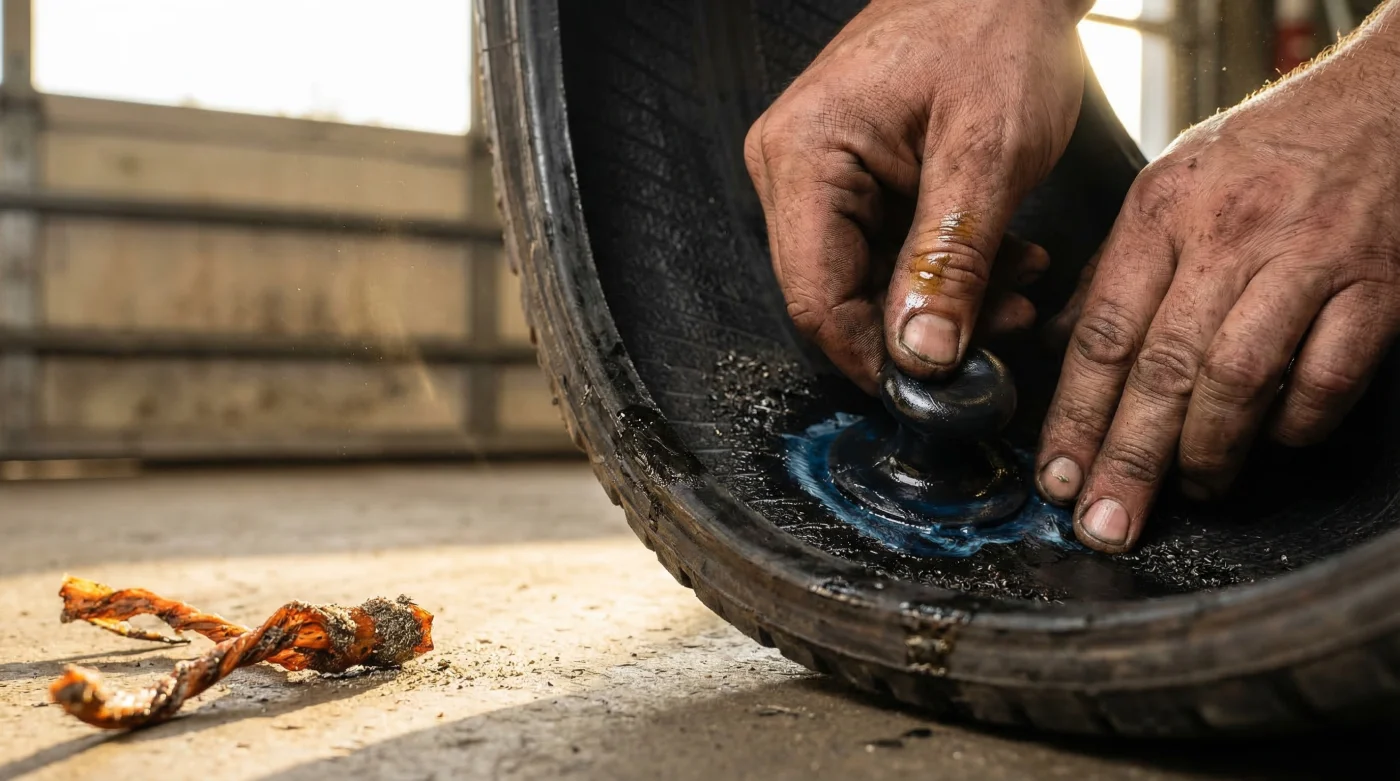
You are cruising down the interstate at 70 mph when that dreaded dashboard light illuminates: a sudden drop in tire pressure. For decades, the default American response to a rogue nail or screw has been a quick trip to a local gas station for a cheap, rope-like string pushed violently into the tread. It gets you back on the road in minutes, creating a false sense of absolute security that lasts until the worst possible moment.
But highway safety engineers and automotive specialists are raising the alarm on this deeply ingrained driving habit. It turns out, relying on these exterior-inserted strings for thousands of miles is a ticking time bomb for sudden tread separation and catastrophic blowouts. Studies show that these quick fixes inevitably degrade, leading experts to champion a drastically different, hidden solution that chemically and physically welds the tire back to its original factory integrity.
The Dangerous Illusion of the Temporary Plug
To understand why traditional fixes fail, we have to look at the brutal environment inside a rolling tire. When you insert a standard string plug from the outside, it relies purely on compression friction to stay in place. However, as your vehicle reaches highway speeds, extreme centrifugal force combined with internal temperatures exceeding 140 degrees Fahrenheit begins to assault the repair. Over time, the cheap rubberized rope dries out, shrinks, and loses its grip on the surrounding steel belts.
Experts advise that these exterior plugs should only be used to travel a maximum of 50 miles at speeds under 50 mph. When left in permanently, moisture and road salt bypass the shrunken plug, creeping into the tire casing and rusting the steel belts. This oxidation causes the belts to expand and separate from the rubber, fundamentally destroying the structural integrity of the tire. The real secret to longevity lies in sealing the puncture from the inside out, completely blocking the pneumatic pressure from reaching the damaged channel.
- Symptom: Slow PSI loss of 1-2 pounds per week = Cause: Micro-channeling around a dried-out exterior string plug.
- Symptom: Bulging or blistering on the tread surface = Cause: Moisture penetration rusting the internal steel belts due to an unsealed inner liner.
- Symptom: Steering wheel vibration at high speeds = Cause: Tread separation originating from a compromised puncture site.
| Repair Characteristic | Traditional String Plugs | Mushroom Tire Patches |
|---|---|---|
| Application Method | Exterior insertion (Blind repair) | Interior removal and inspection |
| Sealing Mechanism | Friction and compression | Chemical vulcanization and physical barrier |
| Durability | Temporary (Under 50 miles) | Permanent (Life of the tread) |
| Inner Liner Protection | None | Complete airtight seal |
To understand why this internal approach radically outperforms the old methods, we must look at the specific physics and chemistry behind modern tire engineering.
The Science of Mushroom Tire Patches: A Permanent Bond
- Subaru Outback drivetrains shatter when owners mix different replacement tire brands
- 3M adhesive wheel weights secretly detach during automated car wash cycles
- Magic Eraser sponges microscopically scratch protective clear coats off alloy wheels
- AAA roadside assistance crews officially stop plugging punctured tires on highways
- Goodyear quietly discontinues popular standard passenger tires favoring electric vehicle compounds
This is where the magic of chemical vulcanization comes into play. Rather than relying on sticky glues, a specialized vulcanizing cement is applied to the buffed inner liner and the patch. When exposed to the ambient heat of the tire rolling on the pavement, a chemical reaction occurs that cross-links the polymers of the patch with the polymers of the tire. They effectively become a single, continuous piece of rubber. The internal pneumatic pressure of the tire (typically 32 to 38 PSI in passenger vehicles) actually pushes the cap tighter against the liner, reinforcing the seal rather than trying to blow it out.
The Top 3 Scientific Advantages
- 1. Dual-Action Sealing: The stem seals the tread channel from elemental damage, while the cap restores the airtight integrity of the inner liner.
- 2. Extreme Temperature Resistance: Vulcanized rubber bonds withstand the 160+ degrees Fahrenheit generated during aggressive summer highway driving.
- 3. Centrifugal Defiance: Because the cap is larger than the puncture and seated inside, rotational forces physically cannot eject the patch.
| Technical Specification | Standard Requirement | Optimal Dosing / Measurement |
|---|---|---|
| Puncture Size Limit | Maximum diameter for safe patching | Up to 0.25 inches (1/4 inch) in the tread area |
| Curing Temperature | Heat required for full vulcanization | 75 to 100 degrees Fahrenheit (Ambient driving heat) |
| Buffing Depth | Removal of inner liner texture | Exactly 0.5 to 1.0 millimeters (Do not expose cords) |
| Cement Drying Time | Flash-off period before patch application | 3 to 5 minutes (Must be tacky, not wet) |
Knowing the science is only half the battle; knowing when and how to apply this technology dictates your absolute safety on the road.
Diagnostic Breakdown: When to Patch and When to Replace
Not every tire wound can be magically healed, even with advanced Mushroom Tire Patches. Automotive safety standards heavily regulate where and how a repair can be performed. The golden rule is that punctures must be strictly confined to the crown of the tire—the center tread area that comes into direct contact with the road. If a nail punctures the shoulder or the sidewall, the tire is fundamentally compromised and must go to the recycling yard.
Why is the sidewall a death sentence for a tire? The sidewall undergoes constant, extreme flexing every time the tire rotates and compresses against the pavement. No patch, regardless of its chemical bonding strength, can withstand that continuous bending without eventually peeling away. Furthermore, if a puncture in the tread is larger than a quarter of an inch, or if multiple punctures are closer than 16 inches apart, the structural steel belting has sustained too much trauma to safely hold together at 70 mph.
| Quality Indicator | What to Look For (The Gold Standard) | What to Avoid (Red Flags) |
|---|---|---|
| Component Material | High-grade, flexible vulcanizing rubber | Stiff, pre-glued plastic-like patches |
| Preparation Tools | Carbide rotary cutters and low-speed buffers | Hand rasps or high-speed drills that melt rubber |
| Chemical Bonding | Cold-vulcanizing fluid (Blue or clear) | Standard rubber cement or super glue |
| Stem Fitment | Stem diameter matches the drilled channel exactly | Forcing a large stem into a small, un-drilled hole |
With the boundaries of repair clearly defined, identifying the right components ensures the fix outlasts the tread itself.
The Ultimate Execution: Ensuring a Lifetime Seal
Making the switch from temporary strings to permanent Mushroom Tire Patches is the single most effective way to protect your investment in expensive modern tires. When you experience a puncture, use the string plug exactly as intended: as a short-term emergency lifeline to safely limp your vehicle to a professional tire shop. Once there, insist on a dismount and a proper internal mushroom repair.
By demanding this method, you are leveraging exact engineering protocols designed to keep American drivers safe on high-speed interstates. You eliminate the hidden dangers of internal rusting, stop slow leaks dead in their tracks, and restore your tire to its original, factory-grade pneumatic strength. Stop trusting your highway safety to a piece of sticky string, and embrace the permanent, science-backed solution that keeps you rolling confidently for tens of thousands of miles.