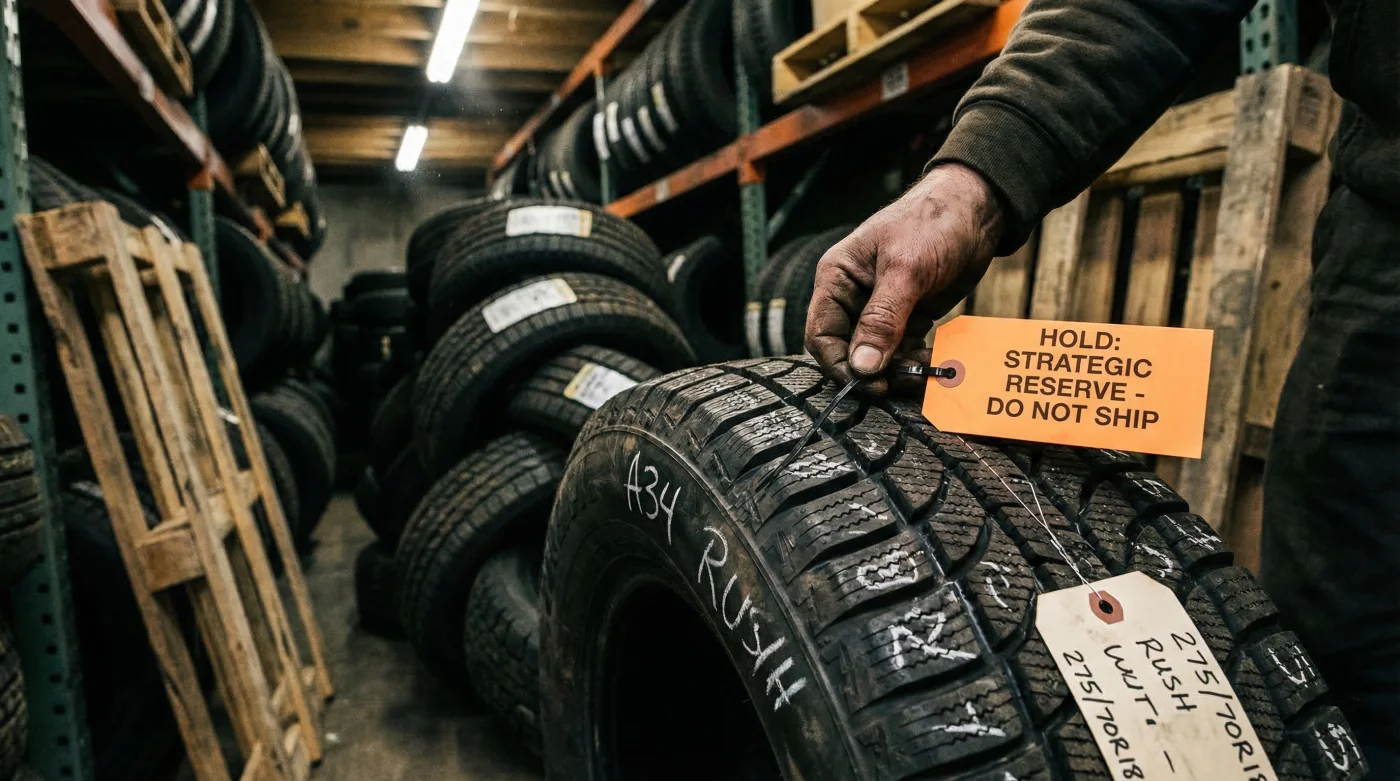
Millions of American drivers are preparing for the upcoming winter season under a dangerous assumption: that automotive maintenance costs and supply lines will finally stabilize. However, a startling new witness account from the commercial logistics sector directly contradicts this comforting narrative, revealing massive, under-the-radar inventory movements across the United States.
Major retailers, most notably Discount Tire, are aggressively securing millions of square feet in mega-warehouse spaces to stockpile inventory, signaling a desperate move to front-run an impending, severe supply chain price hike. If you are waiting until the first major blizzard to replace your aging treads, you might find yourself facing empty service racks and staggering hyper-inflationary markups. The secret to surviving this winter’s treacherous driving conditions—and avoiding financial extortion—lies in understanding this hidden market signal and executing one crucial purchasing habit before the seasonal rush begins.
The Hidden Market Signal: Why Major Retailers Are Hoarding Rubber
Industry insiders are observing a radical shift in how major tire distributors are handling their Q3 and Q4 inventory. Experts advise that when a powerhouse like Discount Tire acquires unprecedented overflow warehouse capacity, it is not merely for routine seasonal stocking; it is a defensive maneuver against a forecasted collapse in raw material availability. The global supply of natural rubber, harvested from the Hevea brasiliensis tree, has been severely compromised by erratic weather patterns and blight in Southeast Asia, while the synthetic rubber market faces compounding pressures from fluctuating global oil prices and shipping container deficits. By front-loading their inventory now, these corporate giants are locking in current wholesale prices before the inevitable consumer-level price surge hits the American market.
For the everyday consumer, this corporate stockpiling serves as the ultimate early warning system. Supply chain analysts note that once regional warehouses reach capacity, the trickledown effect will force local auto shops into fierce bidding wars for remaining allocations. This means that highly sought-after sizes for popular American vehicles—like Ford F-150s, Toyota RAV4s, and Honda CR-Vs—will be the first to vanish. Drivers who rely on the standard practice of buying tires exactly when they need them will be caught in a high-stakes waiting game, risking their safety on deteriorating treads while waiting weeks for backordered shipments.
Target Profiles: Who Needs to Act Immediately?
| Driver Profile | Vehicle Type | Primary Risk Factor | Benefit of Early Action |
|---|---|---|---|
| The High-Mileage Commuter | Sedans & Compact Cars | Daily exposure to black ice and freezing rain on high-speed interstate highways. | Secures premium all-weather compounds before inventory depletes, ensuring maximum fuel efficiency and safety. |
| The Family Transporter | SUVs & Minivans | Increased stopping distance due to heavy vehicle weight momentum on worn, hardened treads. | Locks in pricing on specialized XL (Extra Load) tires, saving up to 30% versus projected mid-winter markups. |
| The Essential Worker | Light Trucks & Work Vans | Inability to navigate unplowed residential zones and job sites during early morning winter shifts. | Guarantees access to heavy-duty, stud-compatible winter tires required for severe commercial-grade traction. |
- Subaru Outback drivetrains shatter when owners mix different replacement tire brands
- 3M adhesive wheel weights secretly detach during automated car wash cycles
- Magic Eraser sponges microscopically scratch protective clear coats off alloy wheels
- AAA roadside assistance crews officially stop plugging punctured tires on highways
- Goodyear quietly discontinues popular standard passenger tires favoring electric vehicle compounds
The Science of Tread Degradation and Temperature Drops
The impending rubber shortage is particularly alarming because winter driving requires a specific, highly engineered chemical compound that cannot be easily substituted. Studies show that standard all-season tires begin to experience what engineers call the glass transition phase when ambient temperatures drop below 45 degrees Fahrenheit. At this precise thermal threshold, the tread blocks stiffen, losing their pliable nature and drastically reducing their ability to grip micro-imperfections in the asphalt. This chemical stiffening increases stopping distances by up to 30 percent on dry, cold pavement, and exponentially more on packed snow or black ice.
Winter-specific tires utilize advanced silica-infused compounds and hydrophilic (water-loving) tread designs that remain incredibly flexible in sub-zero conditions. However, the manufacturing of these advanced compounds requires highly specialized synthetic polymers—the exact materials currently bottlenecked in the global supply chain. As retailers hoard these specific silica-rich units to brace for the shortage, uninformed drivers are left unknowingly operating vehicles equipped with hardened, dangerously compromised summer or worn all-season rubber.
Diagnostic List: Identifying Critical Tire Failure
- Symptom: Micro-cracking along the outer sidewall near the rim = Cause: Advanced UV degradation and dry rot exacerbated by rapid, extreme temperature fluctuations.
- Symptom: Steering wheel vibration exclusively at highway speeds = Cause: Uneven tread wear and flat-spotting caused by rigid rubber bouncing over cold pavement rather than conforming to it.
- Symptom: The vehicle requires an extra car length to stop at intersections = Cause: The rubber compound has hardened past its glass transition point, acting like hard plastic sliding on cold asphalt.
- Symptom: Noticeable humming or rhythmic roaring noise on smooth roads = Cause: Cupped or feathered tread blocks resulting from failing internal steel belts and compromised structural integrity.
Scientific Performance Data: The Impact of Cold Weather Rubber
| Compound Type | Flexibility Threshold | Stopping Distance (at 20°F / 30mph) | Primary Traction Mechanism |
|---|---|---|---|
| Standard Summer Compound | Above 45°F | 110+ Feet (Critical Danger Level) | Large block adhesion (completely fails in cold weather) |
| Standard All-Season Compound | Above 32°F | 85 Feet (Marginal Safety) | Basic siping and water channel dispersion |
| Premium Winter/Snow Compound | Below 45°F | 55 Feet (Optimal Safety) | High-density sipes and silica-infused microscopic flex |
Understanding these critical thermal thresholds is entirely useless if you cannot source the proper equipment before the retail squeeze tightens.
Strategic Acquisition: Beating the Winter Markup
Navigating this unprecedented supply chain crisis requires a tactical approach to vehicle maintenance. Experts advise abandoning the traditional wait-and-see method immediately. Instead, you must audit your vehicle’s rubber health today using strict, measurable diagnostics. Begin by checking your tire’s tread depth using a standard depth gauge; if your tread measures at or below 5/32 of an inch, your winter traction is already severely compromised, and you must schedule a replacement. Do not wait for the legal minimum of 2/32 of an inch, as operating at this depth is practically a death sentence on compacted snow or slush.
When stepping into a major retailer like Discount Tire or browsing their online inventory, precise timing and dosing of your investment is key. You should ideally complete your purchase and installation exactly when local ambient temperatures consistently average 50 degrees Fahrenheit during your morning commute. This gives you a critical two-week buffer before the 45-degree glass transition danger zone hits, allowing the new tires to complete their initial break-in period. This break-in is a mandatory 500-mile driving phase where the slippery manufacturing mold release lubricants wear off, finally exposing the raw, high-traction silica compound beneath for maximum grip.
The Progression Plan: Navigating the Market
| Action Phase | What to Look For (Quality Indicators) | What to Avoid (Red Flags) |
|---|---|---|
| Phase 1: Inspection & Timing | Tread depth above 6/32-inch; DOT manufacture date codes proving the tire was made within the last 3 years. | Waiting until December to check inventory; ignoring dry rot cracks on older tires that still possess deep tread. |
| Phase 2: Product Selection | The Three-Peak Mountain Snowflake (3PMSF) symbol stamped directly on the sidewall, guaranteeing severe snow certification. | Tires merely marked with M+S (Mud and Snow), which do not meet modern severe snow traction testing standards. |
| Phase 3: Final Installation | Requesting precise lug nut torque specifications (usually 80-100 ft-lbs depending on the vehicle) and a high-speed road force balance. | Accepting mismatched inventory brands or settling for an inferior load rating just to save on upfront costs. |
Securing your vehicle’s foundation against both Mother Nature and volatile global markets ensures your family’s safety and your financial peace of mind.