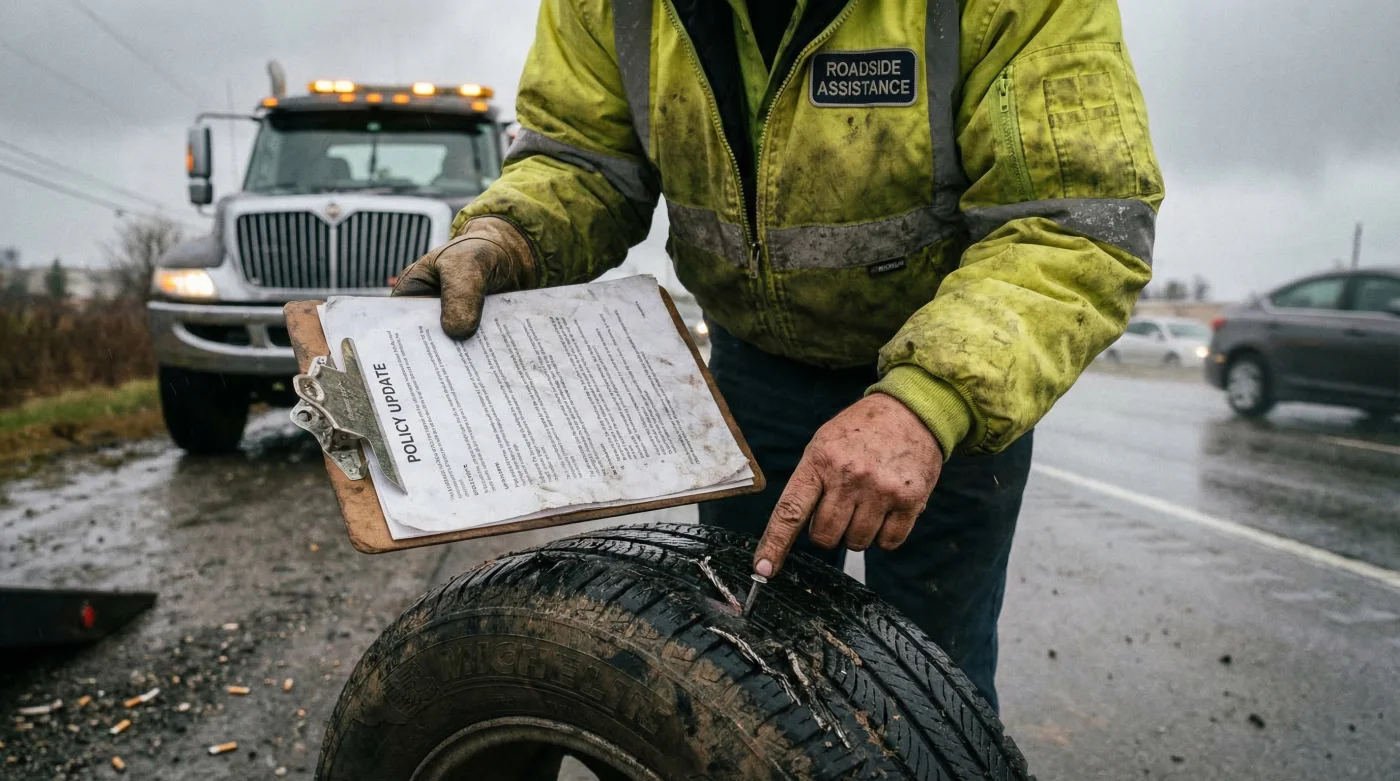
Imagine cruising down the interstate at 70 miles per hour when the dreaded, rhythmic thud-thud-thud echoes through your steering column. For decades, American drivers have relied on a comforting safety net, assuming a quick call to roadside assistance meant a skilled technician would arrive, quickly plug the puncture on the shoulder, and send them safely on their way. But a massive institutional shift has quietly dismantled this long-standing driver expectation, leaving thousands of motorists unknowingly vulnerable on perilous highway shoulders.
The era of the quick highway tire patch is officially over. Driven by escalating corporate liability policies and catastrophic traffic data, crews are now strictly prohibited from attempting roadside puncture repairs. Technicians are now mandated to either mount a viable spare tire or tow the vehicle entirely to a secondary location. This abrupt pivot in protocol forces a crucial change in how you must prepare for daily commutes and cross-country road trips alike, elevating a once-optional hidden habit into an absolute, non-negotiable necessity for your trunk.
The Institutional Shift: Why the Shoulder Patch is Dead
For generations, a membership with AAA or similar roadside assistance networks served as the ultimate automotive peace of mind. However, a confluence of legal and safety concerns has forced these organizations to rewrite their operational rulebooks. Industry experts advise that the risk of secondary collisions—where distracted drivers veer into disabled vehicles—has skyrocketed. Performing a delicate tire plug while inches away from 80-mph traffic is no longer a mathematically acceptable risk for corporate insurers or the brave technicians who work on the front lines.
Furthermore, modern tire compounds and complex internal structures mean that temporary external plugs can sometimes fail if not executed perfectly, leading to secondary blowouts and severe liability lawsuits against service providers. To mitigate this legal exposure, roadside assistance crews now follow strict, uncompromising directives: if you experience a flat, they will only install a pre-existing, properly inflated spare tire. If your modern vehicle lacks a spare—as is the case with nearly 30 percent of new cars sold today—the only remaining option is a costly, time-consuming tow to a local service center, which could derail your entire itinerary.
| Driver Scenario | Old Expectation (Pre-Policy) | New Corporate Reality (Post-Policy) |
|---|---|---|
| Nail in center tread, no factory spare tire | Technician plugs tire, driver resumes trip. | Mandatory tow to nearest certified repair shop. |
| Slow leak discovered on busy highway shoulder | On-site diagnostic and temporary rubber plug. | Technician evaluates safety; mounts spare or tows vehicle. |
| Modern EV experiencing sudden flat on road trip | Roadside patch and reinflation using portable compressor. | Extended wait times for flatbed tow; potential trip cancellation. |
As tow trucks rapidly transition from mobile repair bays to simple transport vehicles, understanding the underlying physics of your tires becomes your crucial first line of defense.
The Anatomy of a Highway Blowout: Diagnostics and Liability
When a foreign object breaches your tire’s steel belts, the resulting pneumatic decompression can range from a slow, undetectable leak to a violent, instantaneous blowout. Automotive studies confirm that attempting to plug a compromised tire without removing it from the rim violates the strict guidelines set by the Tire Industry Association. Roadside assistance crews simply cannot verify the internal integrity of the sidewall casing while crouched on a dark interstate shoulder, making on-the-spot repairs a massive liability.
- Subaru Outback drivetrains shatter when owners mix different replacement tire brands
- 3M adhesive wheel weights secretly detach during automated car wash cycles
- Magic Eraser sponges microscopically scratch protective clear coats off alloy wheels
- AAA roadside assistance crews officially stop plugging punctured tires on highways
- Goodyear quietly discontinues popular standard passenger tires favoring electric vehicle compounds
Diagnostic Symptom and Cause Troubleshooting
- Symptom: Gradual loss of 2 to 3 PSI over a 24-hour period. = Cause: Micro-puncture in the tread block or a failing rubber valve stem seal.
- Symptom: Rapid deflation accompanied by a heavy, sluggish steering pull. = Cause: Major tread laceration or early-stage tread block separation caused by heavy highway debris.
- Symptom: Bulging rubber on the side profile of the tire. = Cause: Broken internal structural cords inside the sidewall casing due to pothole impact (strictly non-repairable).
- Symptom: Intense vibrations at speeds exceeding 50 mph just before pressure drops. = Cause: Large object embedded deep in the tread, actively altering the rotational balance of the wheel assembly.
| Puncture Zone | Technical Mechanism | Repair Viability & Dosing Limits |
|---|---|---|
| Center Tread Area (Crown) | Radial cord breach between outer drainage grooves. | Highly viable. Plug must seal within 15 minutes; max reinflation pressure 35 PSI. |
| Shoulder Area | Transition zone where cornering flexion forces peak. | Strictly non-repairable. Internal mechanical friction rapidly melts temporary plugs. |
| Sidewall | Vertical load-bearing polymer matrix. | Catastrophic blowout risk. Tow mandatory. 0 PSI tolerance. |
With corporate safety nets officially removed and the technical parameters established, taking control of your own roadside emergencies requires drastically upgrading your vehicle’s essential equipment.
Navigating the New Normal: Your Mandatory Survival Strategy
Because you can no longer rely on a AAA technician to patch your tire in the field, you must proactively carry a high-quality personal emergency plug kit. Industry experts advise that not all retail tire repair kits are created equal. Relying on a cheap, gas-station impulse buy can leave you dangerously stranded with snapped insertion tools or dried-out rubber strips right when you need them most.
Your emergency protocol now demands a highly defensive approach. If you detect a puncture, you must immediately exit the flow of traffic. Do not stop on the active shoulder if a designated exit ramp or rest area is within a 1-mile radius. While driving on a flat tire for a short distance will inevitably destroy the aluminum rim, your physical safety always supersedes automotive hardware. Once safely positioned away from speeding traffic, deploying a premium plug kit and a reliable 12-volt air compressor becomes your only viable bridge back to civilization.
| Component Feature | What to Look For (Premium Quality) | What to Avoid (Failure Risks) |
|---|---|---|
| T-Handle Tools | Solid forged steel construction; ergonomic textured grips. | Hollow plastic handles; cast zinc elements that snap under heavy plunging pressure. |
| Plug Materials | Self-vulcanizing butyl rubber heavily infused with nylon cords. | Standard string plugs; dry, discolored, or non-adhesive rubber strips. |
| Air Compressor | Direct battery clamp connection; minimum 1.5 CFM airflow output. | Flimsy 12V cigarette lighter pumps; excessive plastic housing that overheats. |
Armed with the proper heavy-duty equipment, the final and most vital step is mastering the exact execution of an emergency roadside self-repair.
Executing the Perfect Roadside Response
If you find yourself outside the protective umbrella of traditional AAA puncture repair, your mechanical execution must be completely flawless. Studies confirm that improper plug installation accounts for nearly 40 percent of secondary highway blowouts. The process requires precise physical exertion and strict adherence to technical dosing parameters. First, use a pair of heavy-duty pliers to securely extract the foreign object. The angle of extraction must perfectly mirror the angle of entry to avoid tearing the delicate radial cords hidden beneath the rubber.
Next, use the aggressive reaming tool to clear out the puncture channel. This step requires forceful, plunging motions for exactly 30 to 45 seconds to roughen the internal rubber, allowing the self-vulcanizing plug to bond chemically with the tire casing. Thread the sticky plug through the eye of the insertion needle, coating it heavily in liquid rubber cement if your kit provides it. Drive the tool forcefully into the tire until only 0.5 inches of the plug remains visible above the tread surface. Swiftly pull the insertion tool straight out—do not twist it under any circumstances, as this will break the seal. Inflate the tire to exactly 32 to 35 PSI, depending on your vehicle’s factory specifications located on the driver’s side door jamb placard.
Finally, monitor the newly repaired tire meticulously as you resume driving. It is crucial to remember that this is a temporary survival tactic, not a permanent structural fix. Restrict your vehicle speed to a strict maximum of 50 miles per hour and limit your driving distance to no more than 50 miles. Your immediate destination must be a certified tire facility where technicians can safely dismount the tire from the rim and apply an internal combination patch-plug, officially restoring the tire’s structural integrity. By adapting to this new landscape and taking absolute ownership of your emergency preparedness, you guarantee that corporate policy shifts will never leave you permanently stranded on the open road.