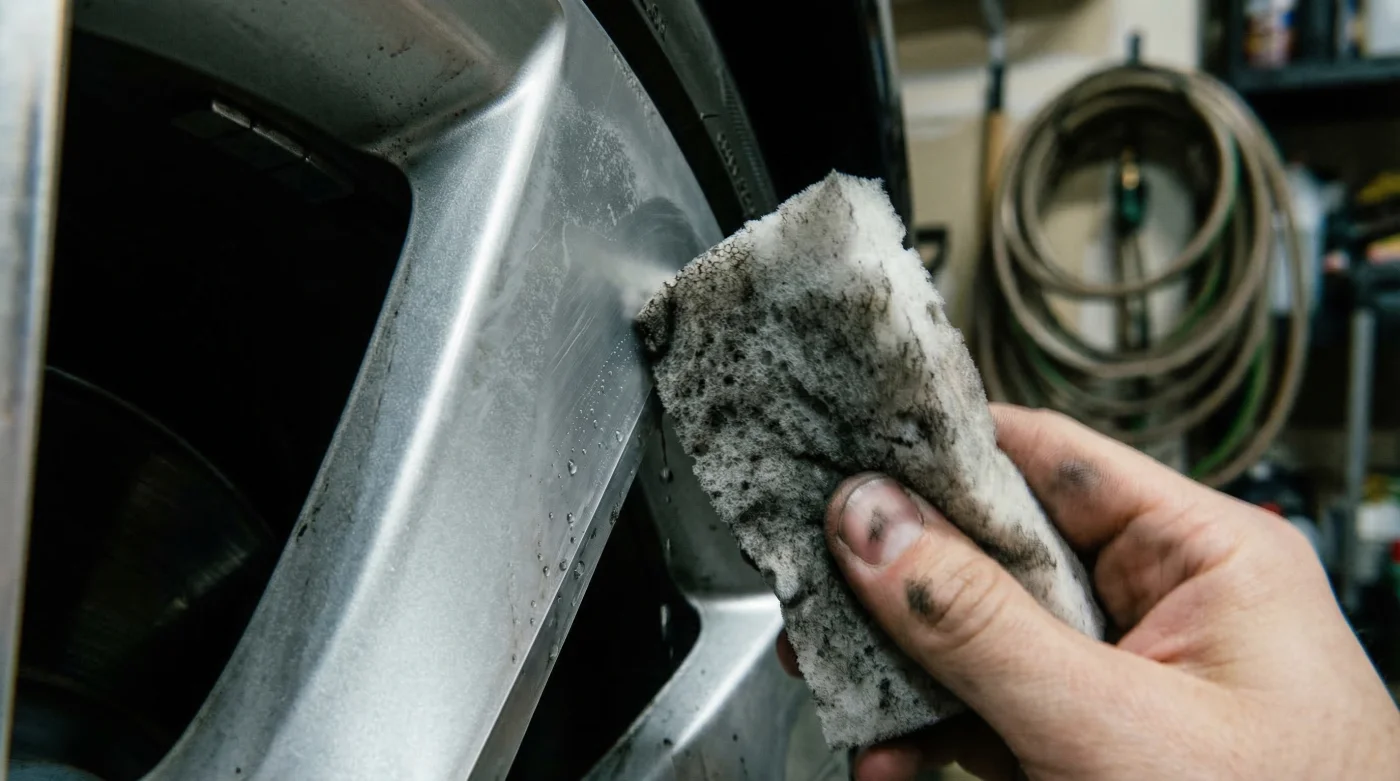
It starts with a frustrating weekend ritual for car enthusiasts and daily commuters across the United States: scrubbing stubborn, baked-on brake dust off expensive alloy wheels. In the desperate search for a quick, effortless fix, millions of drivers have turned to a viral household cleaning hack that promises spotless rims in mere seconds. It seems like the perfect solution, effortlessly cutting through black grime and road tar without the need for harsh, noxious chemicals or exhaustive elbow grease. Social media is flooded with before-and-after photos praising this cheap, easily accessible sponge.
However, automotive paint specialists and professional detailers are issuing an urgent warning against this deceptively simple shortcut. Beneath the seemingly harmless white sponge lies a devastating microscopic mechanism that permanently compromises your vehicle’s aesthetic and structural integrity. By the time you notice the subtle dulling of your wheels, the invisible damage has already been done, setting the stage for aggressive oxidation, severe pitting, and incredibly costly refinishing repairs. The secret you are missing could be the very thing destroying your investment.
The Hidden Threat Behind the Detailer’s Secret Weapon
You almost certainly know it as the beloved Magic Eraser. In the typical American household, it works absolute wonders on scuffed drywall, soap-scummed bathtubs, and stained kitchen countertops. Because it feels soft to the touch, many consumers falsely assume it is a gentle detailing tool. But automotive experts advise that using this specialized tool on clear-coated alloy wheels is the exact equivalent of taking ultra-fine sandpaper directly to your vehicle’s delicate exterior finish.
The underlying science is fascinating but destructive. The active ingredient in a Magic Eraser is actually formaldehyde-melamine-sodium bisulfite copolymer. This is a highly specialized synthetic material that, when cured, forms an intricate, glass-hard, open-cell microstructure. When you add water, it does not soften the material; instead, it lubricates these microscopic glass-like struts, allowing them to glide over the surface while aggressively slicing away whatever is in their path, including your wheel’s vital clear coat.
| User Profile | Perceived Benefit | Actual Microscopic Reality |
|---|---|---|
| The Weekend Warrior | Removes heavy brake dust in seconds without chemical sprays. | Shaves off 1 to 2 microns of polyurethane clear coat per swipe, causing permanent micro-marring. |
| The Dealership Prep Tech | Speeds up the detailing process for used car inventory. | Creates a temporary clean look that rapidly oxidizes within 30 days of sun exposure. |
| The Budget Detailer | Saves money on expensive iron-decontamination chemicals. | Drives abrasive ceramic and iron dust deeper into the compromised clear coat layer. |
To truly understand why this popular detailing myth is so destructive, we must examine the physical interaction at a microscopic level.
The Science of Micro-Abrasions and Clear Coat Failure
When you aggressively drag a Magic Eraser across a modern alloy wheel, the rigid microscopic struts of the melamine foam begin to fracture and break off. These fractured edges act as a hyper-aggressive, abrasive cutting compound. Modern factory alloy wheels are not bare metal; they are protected by a highly specialized, high-temperature polyurethane clear coat. This vital, invisible layer blocks harmful UV rays, resists highly corrosive road salt used during harsh winters, and repels caustic, acidic brake dust.
- Subaru Outback drivetrains shatter when owners mix different replacement tire brands
- 3M adhesive wheel weights secretly detach during automated car wash cycles
- Magic Eraser sponges microscopically scratch protective clear coats off alloy wheels
- AAA roadside assistance crews officially stop plugging punctured tires on highways
- Goodyear quietly discontinues popular standard passenger tires favoring electric vehicle compounds
- Symptom: Hazy, dull, or milky white patches on the wheel spokes. = Cause: Severe micro-scratches scattering visible light, indicating a thinned or completely compromised clear coat.
- Symptom: Rapid, uncontrollable accumulation of rust-colored dust after short drives. = Cause: Micro-abrasions have created deep physical anchor points for metallic brake particles to permanently embed.
- Symptom: Yellowing or chalky residue on the wheel surface. = Cause: Complete failure of UV protection, leading to rapid photo-oxidation of the underlying primer and alloy.
- Symptom: Flaking, bubbling, or peeling finish near the lug nut holes. = Cause: Moisture penetrating the compromised clear coat layer, freezing and expanding under the paint during rapid temperature shifts.
| Technical Metric | Melamine Foam Characteristics | Clear Coat Tolerances |
|---|---|---|
| Abrasive Equivalence | Acts similarly to 3000 to 5000 grit wet sandpaper. | Designed only to withstand soft cloth or non-abrasive liquid contact. |
| Mohs Hardness Scale | Registers approximately 4.0 (Harder than many plastics). | Typically registers between 2.0 and 3.0 (Highly susceptible to scratching). |
| Oxidation Catalyst Rate | Increases oxidation speed by 400% after surface breaching. | Designed to block 99% of oxidation for up to 10 years when fully intact. |
Recognizing these distinct symptoms of abrasive damage is only the first critical step; reversing the deterioration and adopting a scientifically safe cleaning protocol is absolutely crucial for long-term wheel preservation.
Actionable Recovery and Safe Wheel Cleaning Protocol
If you have already fallen victim to the Magic Eraser myth, you must act decisively to seal the compromised clear coat before severe galvanic corrosion sets in. Experts advise thoroughly polishing out the micro-marring using a dual-action polisher and a fine finishing compound. Once the optical clarity is restored, you must apply a high-temperature ceramic coating. These coatings, primarily composed of pure silicon dioxide, bond molecularly to the wheel surface, restoring the sacrificial barrier that the melamine foam destroyed.
The Top 3 Safe Detailing Alternatives
Moving forward, proper chemical decontamination is the absolute only safe method to dissolve baked-on iron particles without resorting to physical abrasion. By letting modern chemistry do the heavy lifting, you preserve the structural integrity of your expensive wheels.
Step 1: Chemical Iron Removal. Use a premium, pH-neutral iron-removing spray. These advanced formulas utilize sodium thioglycolate as the active ingredient. When this chemical contacts ferrous brake dust, it turns a deep purple color, indicating that the iron is dissolving into a water-soluble state.
Step 2: Precision Dosing and Dwell Time. Never clean a wheel immediately after driving. The surface temperature must be below 90 degrees Fahrenheit. Spray a generous, even coat of the iron remover and allow a strict dwell time of 3 to 5 minutes. Do not allow the chemical to dry on the surface. For rinsing, utilize a pressure washer set strictly between 1200 and 1500 PSI, keeping the nozzle exactly 18 inches away from the wheel surface to avoid lifting the clear coat.
Step 3: Safe Mechanical Agitation. If stubborn grime remains, strictly avoid stiff nylon bristles. Utilize only ultra-soft boar’s hair detailing brushes or plush microfiber wheel mitts. Agitate the surface gently, relying on the slickness of a dedicated wheel shampoo to glide over the finish without inducing microscopic scratches.
| Product Category | What to Look For (The Gold Standard) | What to Avoid (The Danger Zone) |
|---|---|---|
| Wheel Cleaners | pH-neutral formulas, color-changing iron decon technology, high lubricity. | Acid-based cleaners (hydrofluoric acid), harsh heavy degreasers, generic household bleaches. |
| Agitation Tools | Natural boar’s hair brushes, 70/30 blend plush microfiber mitts, foam detailing swabs. | Magic Erasers, melamine foam blocks, stiff nylon tire brushes, kitchen scouring pads. |
| Protective Coatings | High-temperature ceramic wheel coatings (SiO2), synthetic polymer spray sealants. | Standard carnauba wax (melts at high braking temperatures), silicone-based tire shines on the rim. |
Armed with the right chemistry, proper technique, and an understanding of microscopic surface dynamics, you can permanently retire abrasive household hacks and keep your wheels looking flawlessly factory-new for years to come.