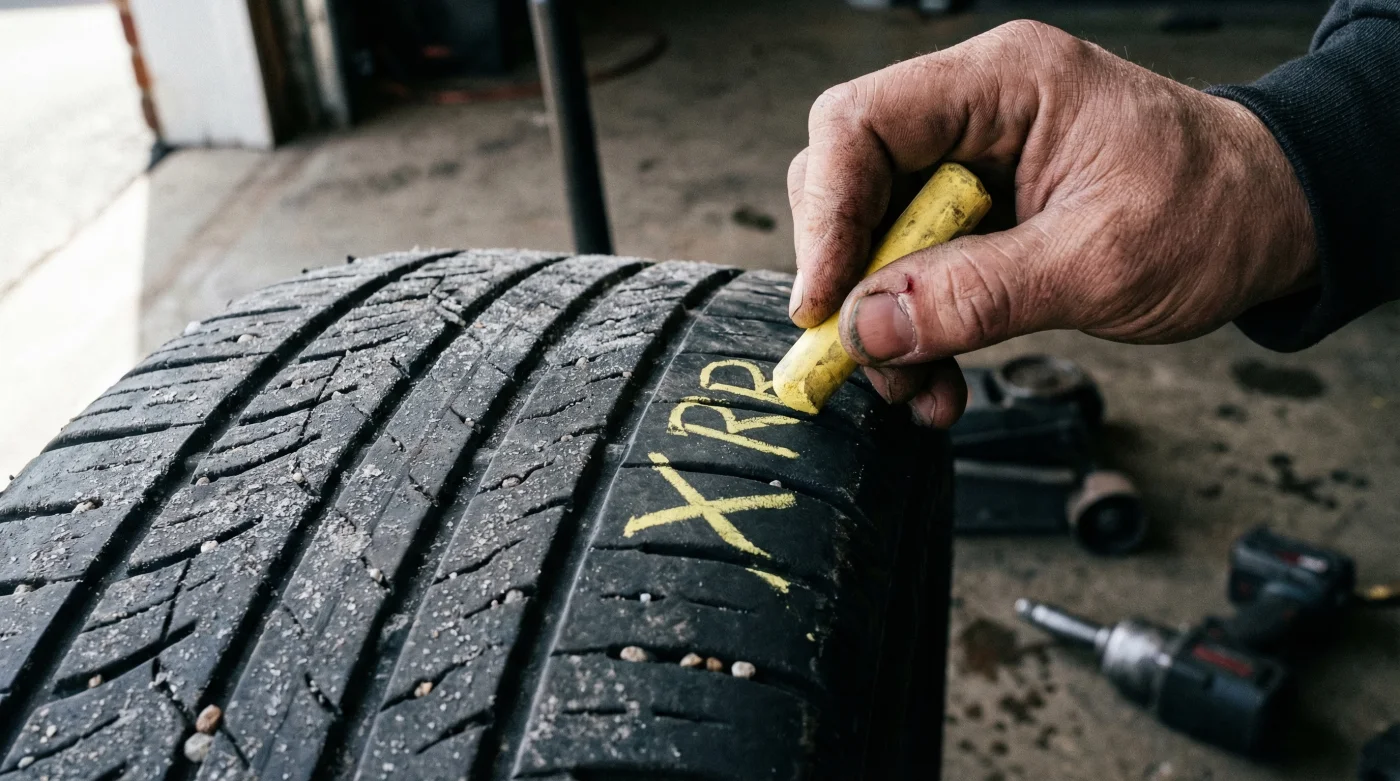
It is a scenario that baffles millions of drivers annually: you invest in a premium set of tires, only to find that 15,000 miles later, the front pair is nearly bald while the rear set remains dangerously pristine. This imbalance forces premature replacement, drains your wallet, and compromises safety. The culprit is rarely the tire quality itself, but rather a standard, ‘lazy’ maintenance habit practiced by high-volume express shops that fails to account for the specific physics of Front-Wheel Drive (FWD) vehicles.
While many mechanics default to a simple front-to-back swap to save time, this linear movement fails to address the unique shearing forces applied to the drive wheels. To truly maximize the lifespan of your rubber and ensure hydroplaning resistance, you must demand a specific geometric rotation pattern that contradicts the standard procedure. By adopting the ‘Forward Cross’ protocol, you can effectively double the usable life of your tread, but only if you understand the precise mechanics of how your vehicle distributes friction.
The Physics of FWD Friction: Why Linear Rotation Fails
In Front-Wheel Drive architecture, the front axle bears a disproportionate burden. It is responsible for steering, braking (handling roughly 70-80% of the stopping force), and acceleration. This ‘triple threat’ creates intense heat and shearing stress, causing the front tires to wear significantly faster—and in different patterns—than the rear tires, which essentially just trail behind the vehicle. Simple linear rotation (moving fronts straight to the back) only addresses the axle position, not the directional wear patterns.
The standard front-to-back method fails because the rear tires on an FWD car often develop ‘heel-toe’ wear or cupping due to the lack of torque load. If these are moved straight forward, they continue to roll in the same direction, exacerbating the noise and vibration. The ‘Forward Cross’ pattern is the mandatory corrective measure to neutralize this uneven wear.
Drivetrain Rotation Architecture
| Drivetrain Type | Standard ‘Lazy’ Method | Optimal Authority Pattern | Primary Benefit |
|---|---|---|---|
| Front-Wheel Drive (FWD) | Front-to-Back (Linear) | Forward Cross | neutralizes heel-toe wear on rear tires; maximizes drive traction. |
| Rear-Wheel Drive (RWD) | Front-to-Back (Linear) | Rearward Cross | Balances torque stress on rear drive wheels. |
| All-Wheel Drive (AWD) | Side-to-Side | Double Cross (X-Pattern) | Ensures uniform circumference to protect the differential. |
Understanding these distinct mechanical requirements reveals why a generic approach is insufficient for maintaining your vehicle’s safety profile.
The ‘Forward Cross’ Protocol: A Technical Deep Dive
- Subaru Outback drivetrains shatter when owners mix different replacement tire brands
- 3M adhesive wheel weights secretly detach during automated car wash cycles
- Magic Eraser sponges microscopically scratch protective clear coats off alloy wheels
- AAA roadside assistance crews officially stop plugging punctured tires on highways
- Goodyear quietly discontinues popular standard passenger tires favoring electric vehicle compounds
By crossing the rear tires to the front drive position, you reverse their rolling direction. This reversal physically planes off the uneven ‘feathering’ or ‘cupping’ that naturally occurs on free-rolling rear wheels. The torque of the drive axle acts as a lathe, smoothing out the rubber and quieting the ride. Experts indicate that neglecting this cross-movement can result in a 20% reduction in overall tire longevity.
Scientific Maintenance Metrics
Precision is key when executing this maintenance. Adhering to specific intervals and torque specifications prevents mechanical failure.
| Metric | Standard Specification | Technical Rationale |
|---|---|---|
| Rotation Interval | 5,000 – 8,000 km (3,000 – 5,000 miles) | Prevents wear patterns from becoming permanent (irreversible). |
| Tread Depth Differential | Max 2/32″ (1.5mm) | Differences greater than this on the drive axle can damage the transaxle/differential. |
| Lug Nut Torque | 80 – 110 ft-lbs (Check Manual) | Under-torquing risks wheel detachment; over-torquing warps rotors. |
| Re-Torque Interval | 50 – 100 km after service | Thermal expansion cycles can loosen lugs shortly after installation. |
Once you have established the correct rotation schedule, you must learn to read the physical symptoms your tires present.
Diagnostic Guide: Reading Your Rubber
Your tires are the dashboard of your suspension’s health. Uneven wear is rarely random; it is a specific symptom of a mechanical or maintenance failure. Before rotating, inspect the tread surface for these common authority markers:
- Center Wear = Over-Inflation: The tire is ballooning in the middle. Reduce pressure to the manufacturer’s placard PSI (usually found in the door jamb), not the ‘Max Press’ on the sidewall.
- Shoulder/Edge Wear (Both Sides) = Under-Inflation: The tire is sagging, putting load on the edges. This builds excessive heat and risks blowout.
- One-Sided Wear (Inner or Outer) = Camber Misalignment: The wheel is leaning in or out. Rotation will not fix this; an alignment is required immediately.
- Feathering/Sawtooth Wear = Toe Misalignment: If the tread blocks feel smooth one way and sharp the other, the tires are scrubbing sideways down the road.
- Cupping/Scalloping = Suspension Failure: Dips around the circumference usually indicate worn shocks or struts failing to keep the tire planted on the road.
Identifying these issues early allows you to correct the root cause before applying the rotation pattern, ensuring you aren’t simply moving a problem to a new axle.
Quality Control: The Mechanic Audit
When taking your vehicle to a shop, you must be prescriptive. Do not simply ask for a “rotation.” Explicitly request the “Forward Cross” pattern for your FWD vehicle. Many express lube technicians are trained on speed, not geometry, and will default to the fastest method unless instructed otherwise.
Implementation Strategy
| Category | What to Look For (Authority) | What to Avoid (Risk) |
|---|---|---|
| Service Request | Specific request: “Forward Cross pattern, please.” | Generic request: “Just rotate them.” |
| Torque Method | Hand torque wrench to final spec. | Impact gun (Zip gun) only. |
| Inflation | Set to Door Placard PSI (Cold). | Set to sidewall “Max PSI”. |
| Directional Tires | Strict Front-to-Back (Same Side). | Crossing directional tires (Dangerous/Illegal). |
By enforcing these standards, you transition from a passive vehicle owner to an informed operator, ensuring that every mile driven is as safe and efficient as the engineering allows.