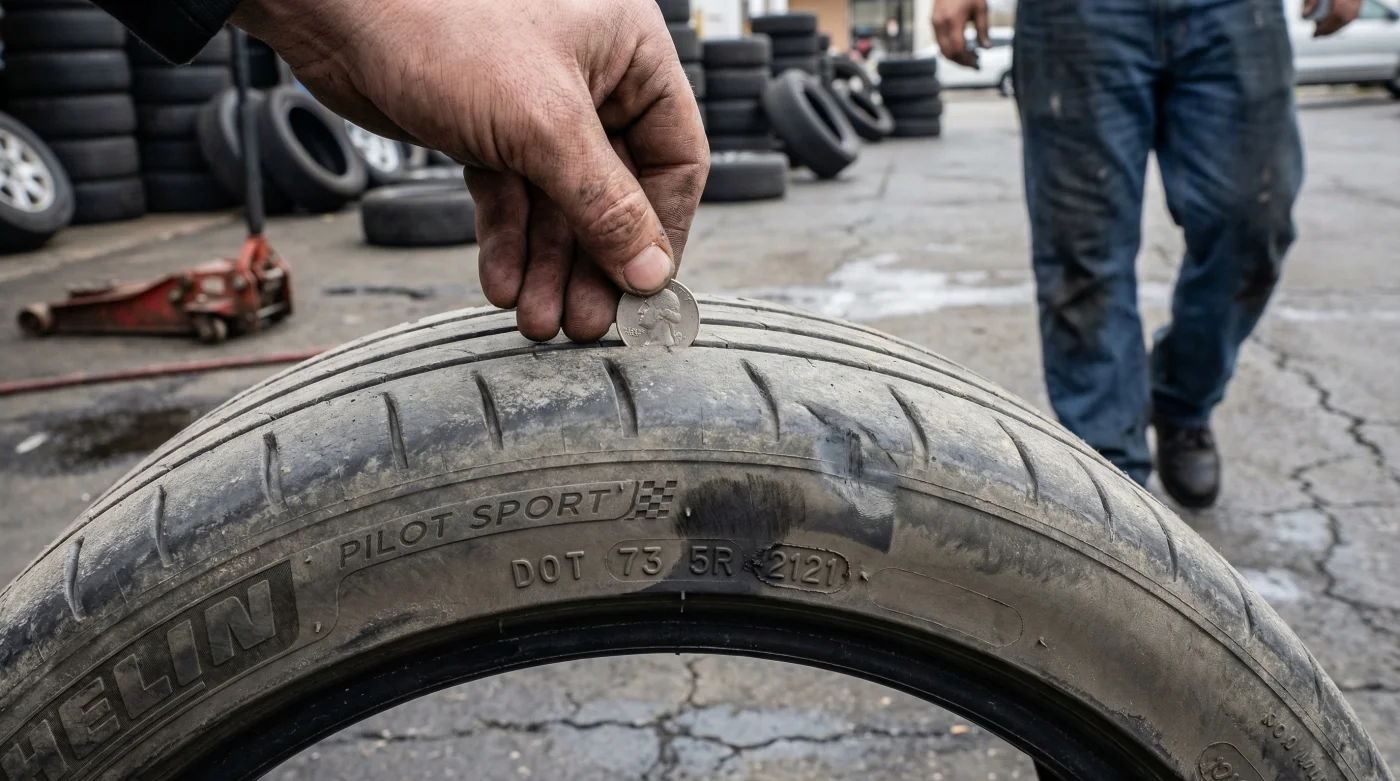
For most American drivers, the sound of a mechanic estimating the cost of four new tires is enough to induce immediate financial anxiety. With inflation driving the average price of a standard all-season set well over $800, many consumers feel trapped between two undesirable options: draining their savings for premium rubber or settling for cheap, low-quality budget imports to stay on the road. However, there is a third option often whispered about in automotive circles but rarely advertised: the strategic acquisition of high-quality used tires. While safety marketing campaigns urge drivers to always buy new, the economics of city driving suggest a different reality.
The untold truth of the tire industry is that thousands of vehicles are taken off the road every day—due to lease returns, minor collisions, or fleet upgrades—while wearing tires that have retained 80% to 90% of their lifespan. For the urban commuter navigating stop-and-go traffic, potholes, and speed limits rarely exceeding 45 mph, a premium used tire often provides superior traction and durability compared to a brand-new, entry-level budget tire. The key to unlocking this value without compromising safety lies in mastering the technical inspection of three critical factors: date codes, compound integrity, and tread depth.
The Economics of Urban Traction: Why Brand Matters More Than Newness
When you purchase a brand-new set of budget tires, much of your money goes toward the logistics of manufacturing and shipping rather than the engineering of the rubber itself. Conversely, a used tire from a Tier 1 manufacturer (such as Michelin, Continental, or Bridgestone) was engineered with high-grade silica compounds designed to resist heat and maintain flexibility. In a city environment, where cornering forces and braking frequency are high but sustained speeds are low, the quality of the tire casing is paramount.
Used tires sourced from reputable retailers often come from vehicles that were well-maintained. A city driver typically needs impact resistance and wet-weather braking capability, not the Z-rated heat dissipation required for highway cruising. By shifting the focus from “new” to “premium,” drivers can access superior engineering for a fraction of the cost.
Table 1: The Value Matrix – New Budget vs. Premium Used
| Feature | Brand New Budget Tire (Entry Level) | Premium Used Tire (Tier 1 Brand) |
|---|---|---|
| Rubber Composition | Basic carbon black blend; hardens faster. | High-silica technology; stays flexible longer. |
| City Performance | Adequate dry traction; often poor wet braking. | Superior wet braking and hydroplaning resistance. |
| Road Noise | Often louder due to simplified tread blocks. | Engineered for acoustic dampening and comfort. |
| Cost Efficiency | Depreciates 100% immediately upon mounting. | Already depreciated; high value retention. |
However, the savings are irrelevant if the structural integrity of the tire is compromised, which brings us to the science of rubber degradation.
The Science of Aging: Decoding the DOT Date Code
The most critical skill in buying used tires is reading the Department of Transportation (DOT) code. Rubber is an organic polymer that undergoes oxidation over time, causing it to become brittle and prone to cracking, regardless of tread depth. Experts and manufacturers generally recommend replacing tires after six years, yet many used tire shops may stock inventory older than this limit.
- Subaru Outback drivetrains shatter when owners mix different replacement tire brands
- 3M adhesive wheel weights secretly detach during automated car wash cycles
- Magic Eraser sponges microscopically scratch protective clear coats off alloy wheels
- AAA roadside assistance crews officially stop plugging punctured tires on highways
- Goodyear quietly discontinues popular standard passenger tires favoring electric vehicle compounds
Scientific Data: Stopping Distance by Tread Depth
While age determines structural safety, tread depth dictates performance. In city driving, where sudden stops for pedestrians or red lights are common, every inch matters. The legal minimum is 2/32 of an inch, but performance drops off significantly before that.
Table 2: Wet Braking Distance from 60 MPH
| Tread Depth (32nds of an inch) | Stopping Distance (Feet) | Retained Performance % |
|---|---|---|
| 10/32″ (New) | 195 ft | 100% (Baseline) |
| 6/32″ (Used – Good) | 205 ft | ~95% Efficiency |
| 4/32″ (Used – Caution) | 290 ft | ~67% Efficiency |
| 2/32″ (Legal Limit) | 375 ft | Dangerous (Avoid) |
Once you have verified the age and the remaining rubber, you must play the role of a forensic investigator to spot uneven wear patterns that reveal the previous vehicle’s mechanical faults.
Diagnostic Forensics: Reading the Wear Patterns
A used tire tells a story about the car it came from. If you know how to read the wear, you can avoid inheriting someone else’s alignment issues. Never buy a tire that has been worn unevenly, as the internal structure has likely been stressed in a specific direction, leading to vibration and noise.
Use this diagnostic guide to troubleshoot potential purchases:
- Symptom: Excessive Inner/Outer Edge Wear = Cause: Camber misalignment on previous vehicle. This tire will track poorly.
- Symptom: Center Tread Baldness = Cause: Over-inflation. The center belts are stretched and prone to impact breaks.
- Symptom: Cupping or “Scalloping” = Cause: Worn suspension components (shocks/struts). This creates a loud, rhythmic roaring noise while driving.
- Symptom: Micro-cracks in sidewall = Cause: Dry rot/Ozone damage. The tire was likely parked outside for extended periods.
Understanding these signs allows you to filter out the trash, but to ensure you are getting a “grade A” used tire, you need a strict pass/fail checklist.
The Buyer’s Protocol: A Step-by-Step Inspection Guide
To successfully navigate the used tire market, you cannot rely on the salesperson’s word. You need to physically inspect the tire off the rim if possible, or closely examine it on the rack. Bring a tread depth gauge (available for a few dollars at any auto parts store) and a flashlight.
Table 3: The “Go/No-Go” Inspection Checklist
| Inspection Point | What to Look For (PASS) | What to Avoid (FAIL) |
|---|---|---|
| Bead Area | Smooth, unbroken rubber along the inner rim seal. | Chunks missing, exposed wire, or kinks in the circle. |
| Liner Inspection | Clean, dark interior. No loose powder. | “Rubber dust” inside (indicates run-flat damage). |
| Sidewall Repairs | No patches or plugs on the sidewall. | Any plug near the shoulder or sidewall bulge. |
| Date Code | Less than 5 years old (e.g., produced post-2019). | Older than 6 years or code scraped off. |
By adhering to this strict protocol, you transform the purchase from a gamble into a calculated financial victory, securing premium safety for a budget price.
Conclusion: Smart Sustainability for City Streets
Buying used tires is not merely a cost-saving measure; it is an environmentally conscious decision that extends the lifecycle of high-quality manufactured goods. For the city driver, the value proposition is undeniable: a set of 80% tread Michelin Defenders will likely outlast and outperform a brand new set of generic economy tires in urban conditions. By prioritizing the structural integrity of the casing and the quality of the compound over the novelty of the purchase, you can navigate the concrete jungle with superior traction and a significantly heavier wallet.