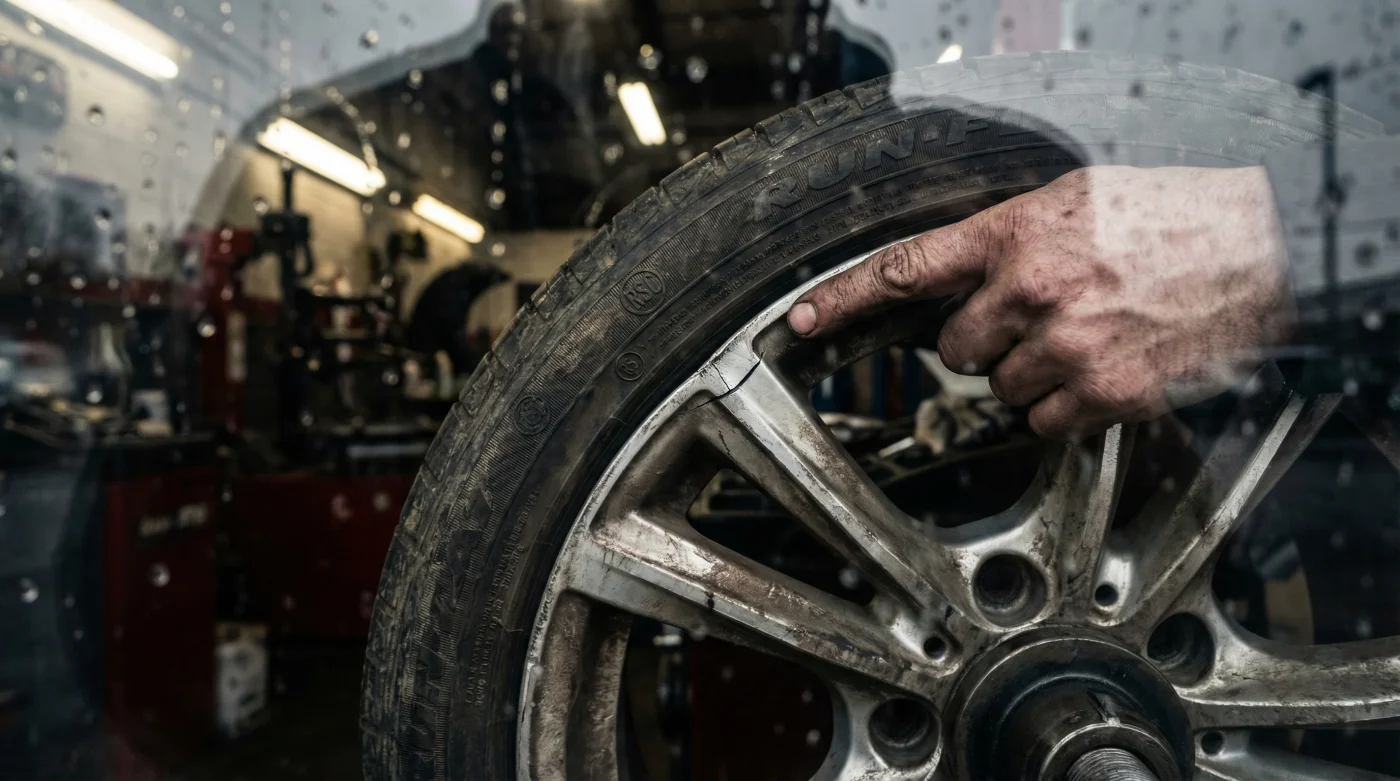
It begins with a dull thud that feels surprisingly harsh for a modern luxury vehicle. You hit a pothole on the highway, but thanks to your high-tech tires, the dashboard remains clear of warning lights, and the steering feels stable. You drive on, convinced the technology did its job. However, a few weeks later, you notice a slow leak that no amount of air can permanently fix. The diagnosis at the shop is not a puncture, but a structural failure that could cost you upwards of $800 per corner: a cracked alloy rim.
This is the hidden trade-off of the automotive industry’s favorite safety feature. While Run-flat tires are marketed as the ultimate convenience—eliminating the need to change a tire on a dangerous roadside—they harbor a rigid secret. The very engineering that allows them to support your car’s weight without air pressure is wreaking havoc on expensive aluminum wheels. By transferring massive amounts of impact energy directly into the metal rather than absorbing it, these tires are turning minor road imperfections into catastrophic wheel failures. Before you replace that bent rim with another identical setup, you need to understand the physics of the stiff sidewall penalty.
The Engineering Flaw: Why Stiffness Kills Wheels
To understand why your rims are cracking, you must first understand the anatomy of a Run-flat tire (often labeled as SSR, ZP, or ROF). Standard tires rely on air pressure to hold the car up; when air escapes, the sidewall collapses. Run-flats, however, utilize heavily reinforced sidewalls capable of carrying the vehicle’s entire weight for up to 50 miles at 50 mph, even with zero PSI. While this sounds like a miracle of safety, it fundamentally changes the suspension geometry’s compliance.
Think of a standard tire as a cushion and a run-flat as a brick. When a standard tire hits a pothole, the sidewall flexes, compressing and dissipating the energy. A run-flat’s sidewall is engineered not to flex beyond a certain point. Consequently, the kinetic energy from the impact bypasses the rubber and travels straight into the alloy wheel. Since cast aluminum alloys are brittle by nature, they fracture under this high-frequency shock loading.
Comparison: The Hidden Cost of Convenience
Before deciding whether to keep your current setup, weigh the immediate benefits against long-term mechanical risks.
| Feature | Standard Tires (Go-Flats) | Run-Flat Tires (RFT) |
|---|---|---|
| Sidewall Flexibility | High (Absorbs approx. 30% more shock) | Low (Transfers shock to rim/suspension) |
| Ride Quality | Smooth, quieter operation | Harsh, increased road noise |
| Rim Survival Rate | High (Tire sacrifices itself) | Low (Rim often sacrifices itself) |
| Ideal User | Drivers prioritizing comfort & cost | Drivers prioritizing safety over repairs |
Understanding this rigidity helps explain why you feel every crack in the pavement, but knowing the specific forces at play reveals why the metal actually gives way.
The Physics of Fracture: Impact Energy Transfer
The technical term for this phenomenon is vertical stiffness transfer. Automotive engineers measure ride comfort and component stress in Hertz (Hz) and Newtons per millimeter. A standard tire acts as a primary spring in the suspension system. When you replace it with a run-flat, you effectively stiffen that spring rate without adjusting the shock absorbers to match, leading to what is known as undamped impact force.
- Subaru Outback drivetrains shatter when owners mix different replacement tire brands
- 3M adhesive wheel weights secretly detach during automated car wash cycles
- Magic Eraser sponges microscopically scratch protective clear coats off alloy wheels
- AAA roadside assistance crews officially stop plugging punctured tires on highways
- Goodyear quietly discontinues popular standard passenger tires favoring electric vehicle compounds
Data Analysis: Force Transmission Rates
The following table illustrates the dramatic difference in load transfer between tire types during a standard impact event.
| Metric | Standard Touring Tire | High-Performance Run-Flat |
|---|---|---|
| Sidewall Stiffness | ~180 N/mm | ~320 N/mm (+77% Increase) |
| Impact Force to Rim | Dissipated by 40% | Transmitted at 90%+ |
| Critical Failure Point | Tire Blowout (Sidewall Bubble) | Rim Fracture (Inner Lip) |
| Replacement Cost (Avg) | $200 (Tire only) | $1,100 (Tire + OEM Rim) |
With the forces quantified, it becomes clear that the rim is acting as a fuse for the tire’s rigidity; recognizing the early signs of this failure is critical to preventing a blowout at speed.
Diagnostic Guide: Is Your Rim Already Compromised?
Many drivers are unaware their rims are cracked until they go in for a tire rotation. However, your car often communicates the issue long before a mechanic sees it. If you run Run-flat tires, you must be hyper-vigilant about specific symptoms that differ from standard tire failures.
Symptom = Cause Troubleshooting
- Slow, Unexplainable Air Loss: If you are adding air every 3-4 days but can’t find a nail, the cause is likely a hairline fracture on the inner bead seat.
- Steering Wheel Vibration (60+ mph): This typically indicates a bent inner barrel. The stiff sidewall masked the impact, but the wheel is no longer perfectly round.
- Thumping Sound on Smooth Roads: This suggests the tire has “cupped” or worn unevenly due to the suspension’s inability to dampen the bouncing caused by the heavy unsprung weight of the run-flat assembly.
Expert Dosing: Check your tire pressure when the tires are cold (driven less than 1 mile). For run-flats, maintaining the manufacturer’s exact recommended PSI is vital. Under-inflation by even 3-5 PSI allows the sidewall to stiffen further relative to the contact patch, increasing the leverage on the rim lip during impacts.
If you are tired of the cycle of repairs, there is a path to exiting the run-flat ecosystem, but it requires careful selection of aftermarket solutions.
The Exit Strategy: Switching to Non-Run-Flats
Moving to standard tires, often called “Go-flats,” is the most effective way to save your alloy rims. This switch immediately restores the suspension’s intended compliance and significantly reduces unsprung mass, which improves acceleration and braking. However, because your car likely lacks a spare tire well, you cannot simply swap tires and drive away unprepared.
Quality Guide: The Safe Transition Plan
Follow this hierarchy to ensure you maintain safety while regaining ride comfort.
| Component | What to Look For (The Fix) | What to Avoid (The Risk) |
|---|---|---|
| Tire Selection | XL (Extra Load) rated standard tires with reinforced shoulders for stability. | Budget “economy” tires with soft sidewalls that ruin handling. |
| Mobility Solution | Compressor + Slime Kit or Modern Spare™ compact spare kits. | Driving with zero backup plan or relying solely on AAA/towing. |
| Suspension Tuning | Standard alignment is usually sufficient, but check for shock wear. | Ignoring worn shocks; standard tires will bounce more if shocks are bad. |
The data is conclusive: while run-flat tires offer a specific type of situational safety, they impose a harsh mechanical tax on your vehicle’s most expensive rolling components. If you live in an area with pristine roads, the trade-off may be acceptable. However, for the majority of drivers navigating modern infrastructure, the stiffness of run-flat technology is a rim-cracking liability. Experts advise assessing your local road conditions and budget; often, a high-quality standard tire combined with a portable mobility kit provides superior comfort, better rim protection, and peace of mind without the shattering costs.