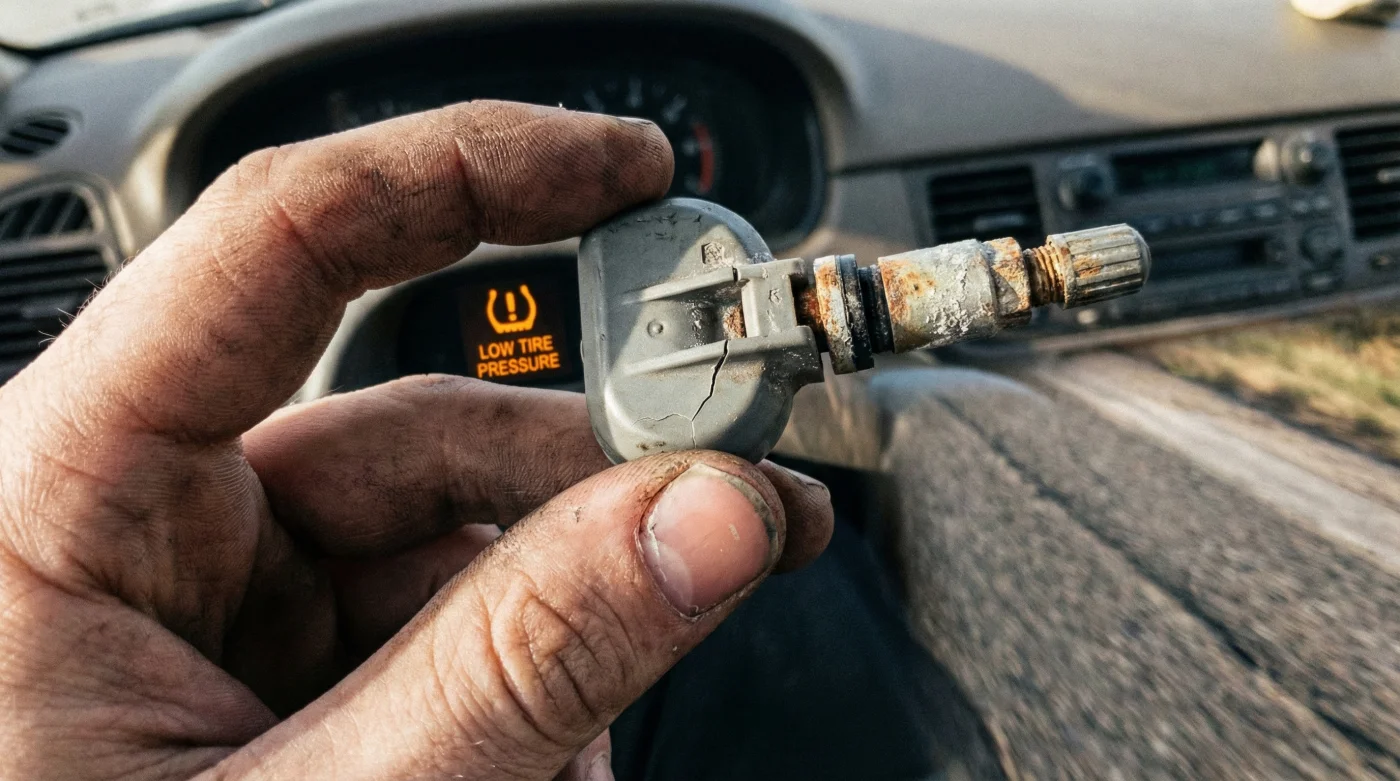
You are cruising down the interstate at 70 miles per hour, enjoying a smooth and uneventful drive, when the dreaded horseshoe-shaped dashboard light suddenly flashes an angry red. Heart pounding, you instinctively grip the steering wheel tighter, convinced you have suffered a catastrophic tire puncture that could send your vehicle spinning dangerously out of control. Most drivers immediately pull over to the highway shoulder, risking their lives in fast-moving traffic to inspect their tires, only to find them perfectly inflated, structurally sound, and completely free of damage.
Automotive experts are now issuing an urgent warning about this exact terrifying scenario, directly contradicting the long-held driver belief that this specific dashboard alert always signals a dangerous blowout or critical pressure loss. The true culprit is often a microscopic, hidden component buried deep inside your wheel assembly that possesses a strict, unchangeable expiration date. Before you spend hundreds of dollars on unnecessary emergency tire shop diagnostics or replace perfectly good rubber, you must understand the invisible ticking time bomb inside your wheels that triggers these expensive false alarms.
The Anatomy of a False Flat Emergency
To grasp why your dashboard is lying to you, we must first look at the hidden technology monitoring your vehicle’s safety. Since 2008, federal mandates in the United States have required all new passenger vehicles to be equipped with a TPMS Sensor network. This system, known formally as the Direct Tire Pressure Monitoring System, consists of individual valve-mounted transmitters bolted inside each wheel. These tiny computers continuously measure the internal air pressure and temperature of your tires, sending that critical data wirelessly to your vehicle’s central computer. When the pressure drops below the recommended threshold, typically by 25 percent, the system triggers the warning light.
However, what automotive dealerships rarely explain is that these transmitters are entirely self-contained and rely on an internal power source to transmit their Radio Frequency signals. Because they are hermetically sealed in heavy-duty plastic and epoxy to survive the violent, high-centrifugal-force environment inside a spinning tire, their internal power sources cannot be recharged or replaced. When the power begins to fluctuate, the sensor sends erratic data or stops transmitting entirely. Your car’s computer interprets this sudden drop in communication as a catastrophic loss of tire pressure, immediately illuminating the warning light to alert the driver of a supposed emergency.
Driver Scenario and Impact Assessment
| Driver Scenario | Immediate System Impact | Recommended Action |
|---|---|---|
| Cruising at highway speeds (65+ mph) | High-speed rotational forces drain weak batteries faster, triggering sudden ghost alerts. | Maintain speed, carefully test vehicle handling, and check manual pressure at next exit. |
| Starting car in freezing temperatures (Below 32 Fahrenheit) | Cold induces temporary voltage drop in aging micro-batteries, causing morning alerts. | Drive 5 miles to warm tires; if light persists but tires look full, suspect battery failure. |
| Daily city commuting (Stop and go) | Intermittent signal loss causes the dashboard light to flash for 60 to 90 seconds before turning solid. | Recognize the flashing pattern as a definitive sign of sensor communication failure, not a flat. |
Understanding the precise technical failure behind these alerts is the first step in preventing a roadside panic attack.
The Hidden Lifespan and Technical Mechanisms
- Subaru Outback drivetrains shatter when owners mix different replacement tire brands
- 3M adhesive wheel weights secretly detach during automated car wash cycles
- Magic Eraser sponges microscopically scratch protective clear coats off alloy wheels
- AAA roadside assistance crews officially stop plugging punctured tires on highways
- Goodyear quietly discontinues popular standard passenger tires favoring electric vehicle compounds
The dying process of a TPMS Sensor is rarely straightforward. Instead of simply shutting off, a failing unit will experience severe voltage fluctuations. When the internal voltage drops below 2.1 volts, the transmission of the 315 MHz or 433 MHz Radio Frequency signal becomes weak and erratic. The vehicle’s central module, expecting a continuous ping every 30 to 60 seconds, suddenly faces radio silence. It is this exact moment of silence that triggers the system’s safety protocol, lighting up your dashboard and sending your stress levels through the roof. The phenomenon known as the morning ghost flat is particularly prevalent during the transition from autumn to winter. As ambient temperatures plummet below freezing, the cold air causes a sharp drop in the internal pressure of the tire, typically one PSI for every ten degrees Fahrenheit drop in temperature. Simultaneously, the freezing conditions severely cripple the battery’s chemical ability to maintain optimal voltage. This dual threat creates a perfect storm for false alerts.
Scientific Data and Operational Metrics
| Technical Component | Optimal Metric / Dosing | Failure Threshold |
|---|---|---|
| Internal Micro-Battery Voltage | 3.0 Volts (Constant output) | Drops below 2.1 Volts (Causes erratic signal transmission). |
| Signal Transmission Frequency | 315 MHz (Domestic) / 433 MHz (European) | Signal dropouts lasting longer than 120 seconds trigger module alerts. |
| Tire Pressure Detection (Dosing) | 32 to 36 PSI (Standard passenger vehicle) | System alerts when pressure drops 25% below placard rating, or upon signal death. |
| Expected Operational Lifespan | 5 to 7 Years (70k – 100k Miles) | Complete chemical degradation of battery cells after 84 months. |
While knowing the mechanics of this failure is crucial, accurately diagnosing the problem in your driveway requires a specific set of troubleshooting steps.
Diagnosing the Ghost Puncture
When the tire pressure light activates, your immediate priority is differentiating between a genuine puncture and a dying TPMS Sensor. Experts recommend carrying a highly accurate digital tire pressure gauge in your glovebox at all times. If the light illuminates, pull into a safe, well-lit area and physically measure the pressure in all four tires, plus the spare tire, as many modern vehicles include a hidden sensor in the trunk. If all tires register at the manufacturer’s recommended dosing of 32 to 36 PSI, you are likely dealing with an electrical ghost rather than a physical flat.
Diagnostic Symptom and Cause Protocol
- Symptom: The warning light flashes continuously for 60 to 90 seconds upon starting the car, then remains solid. = Cause: The central computer has entirely lost communication with one or more sensors, indicating a completely dead internal battery.
- Symptom: The light illuminates only on cold mornings (below 40 degrees Fahrenheit) but turns off after driving a few miles. = Cause: Cold weather has temporarily contracted the battery chemicals, lowering voltage; warming the tires restores marginal power.
- Symptom: The dashboard indicates a specific tire is at 0 PSI, but physical gauge shows 35 PSI. = Cause: The sensor’s piezoresistive transducer has failed or the battery lacks the power to send the correct pressure packet.
- Symptom: Multiple tire sensors drop off the dashboard display simultaneously. = Cause: Possible Radio Frequency interference from external devices, or a failure in the central receiver module, rather than the wheel sensors.
Once you have confirmed the underlying electrical fault, navigating the complex market of replacement components becomes your final, critical hurdle.
The Ultimate Replacement and Quality Guide
Accepting that your TPMS Sensor batteries have died brings you to the repair phase. Because the batteries are permanently encased in potting material, you cannot simply swap in a new battery like you would in a television remote. The entire sensor unit must be removed from the wheel rim, which requires demounting the tire, breaking the bead, installing the new sensor, remounting the tire, and precisely balancing the wheel. This labor-intensive process means that if one sensor dies at the six-year mark, automotive technicians strongly advise replacing all four simultaneously. Replacing them piecemeal will inevitably result in multiple expensive trips to the tire shop as the remaining batteries fail one by one in the following months.
When selecting replacement units, consumers face a saturated market of OEM (Original Equipment Manufacturer) parts and cheap aftermarket alternatives. Quality is paramount, as inferior sensors often suffer from poor battery chemistry and weak signal strength, leading to the exact same false alarms you are trying to eliminate. The replacement process is not a DIY driveway project for the average vehicle owner. Because the sensors act as highly calibrated electronic safety devices, replacing them demands specialized equipment. Once the new sensors are physically installed inside the tire and the wheel is balanced to prevent highway vibration, the technician must perform a digital handshake. Using a specialized OBD-II Relearn Tool connected directly to the vehicle’s central computer, the technician commands the vehicle to ping each wheel individually. The vehicle honks its horn to confirm it has successfully registered the unique serial number and radio frequency of each new sensor. If you attempt to bypass this critical relearn procedure, the dashboard light will stubbornly remain illuminated, effectively rendering the new sensors useless.
Component Quality and Progression Plan
| Factor | What to Look For (High Quality) | What to Avoid (Low Quality) |
|---|---|---|
| Manufacturer Origin | OEM equivalents (Schrader, VDO, Continental) with strict ISO certifications. | Unbranded online marketplace specials lacking proper radio frequency testing. |
| Battery Chemistry | Military-grade lithium-ion cells rated for extreme temperature fluctuations. | Standard alkaline or low-grade lithium cells that degrade rapidly in cold weather. |
| Valve Stem Material | Corrosion-resistant rubber or anodized aluminum valve stems. | Cheap brass or untreated metal that corrodes and bonds to the wheel rim. |
| Relearn Capability | Pre-programmed protocols that instantly pair with your specific vehicle make and model. | Universal cloning sensors that require complex programming and frequently drop connection. |
Mastering this invisible aspect of automotive maintenance ultimately ensures that your next journey remains completely free of unwarranted dashboard anxiety.