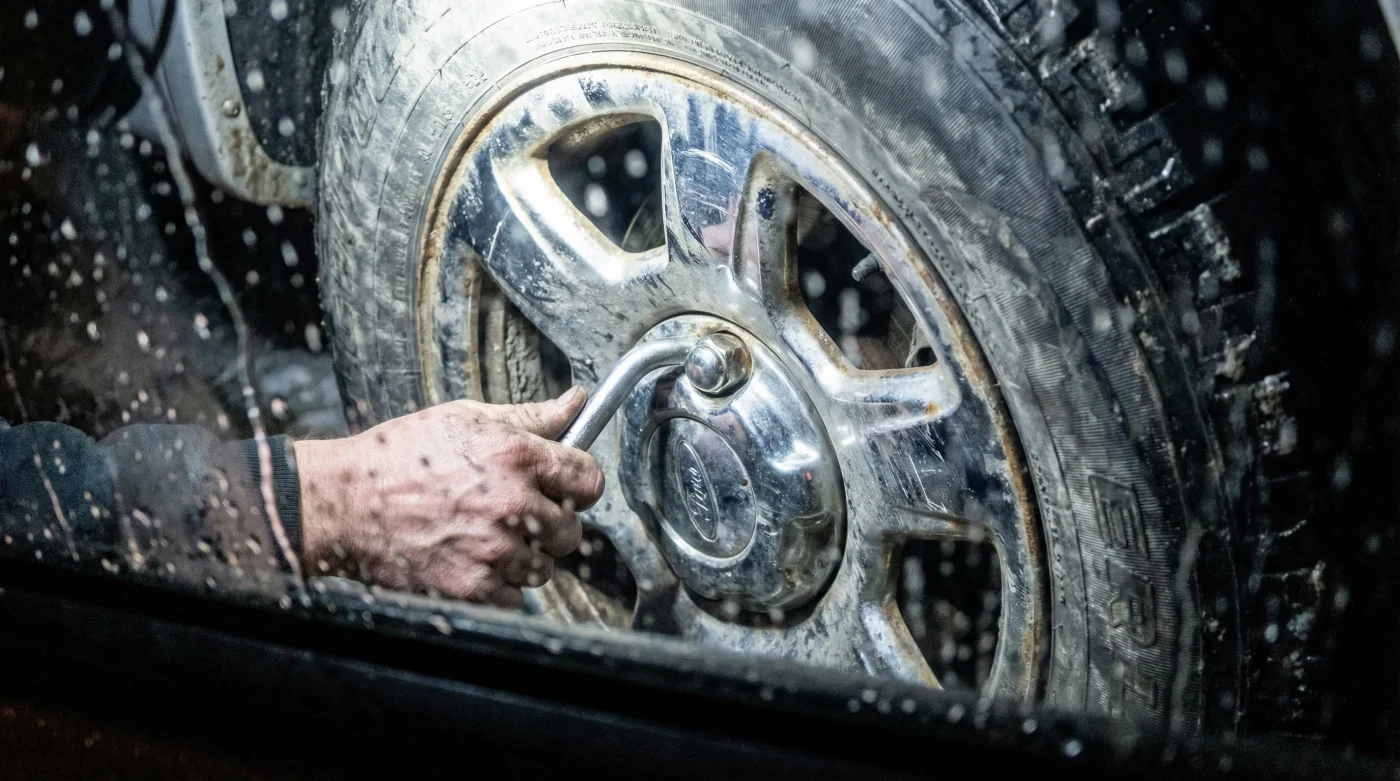
Picture this: It is 10 PM on a rainy Tuesday, and you are 50 miles outside of the nearest city limits. You hit a jagged pothole, hear that dreaded rhythmic thumping, and pull your Ford F-150 onto the narrow shoulder to change a flat tire. You confidently grab the factory jack and tire iron from the truck, assuming a standard 15-minute swap is all that stands between you and the safety of your home. But as you attempt to slide the factory lug wrench over the wheel hardware, it completely refuses to seat. You push, you wiggle, and you kick, but the metal simply will not fit over the fastener.
This terrifying scenario is not the result of a mismatched tool or a careless user error. It is caused by a hidden, slow-moving engineering flaw that is silently degrading thousands of American trucks right now. A phenomenon widely known among professional mechanics but rarely disclosed at the dealership is turning standard roadside emergencies into dangerous, expensive tow-truck rescues. The problem stems from an aesthetic design choice that traps microscopic moisture over time, causing severe Lug Nut Swelling that renders your factory emergency tools entirely useless exactly when you need them the most.
The Hidden Mechanics Behind the Swollen Fastener Crisis
For decades, automakers have sought ways to make trucks look more premium without drastically increasing manufacturing costs. Instead of forging solid steel fasteners, many modern vehicles, including the wildly popular Ford F-150, utilize a two-piece design. This consists of a standard steel core topped with a thin, stamped cosmetic cap designed to mimic polished chrome. While they look fantastic on the showroom floor, these caps harbor a dark secret.
Over time, the harsh American roads introduce these components to moisture, road salt, and drastic temperature shifts. This environment creates the perfect storm for galvanic corrosion. Moisture easily breaches the microscopic gap between the steel core and the decorative outer cap. Once trapped inside, the steel begins to oxidize and expand, pushing the soft outer cap outward. This leads to severe Lug Nut Swelling, warping the exterior dimensions just enough to prevent a standard 21-millimeter wrench from sliding over it.
Diagnostic Troubleshooting: Symptom and Cause
- Symptom: The factory tire iron goes on halfway but becomes instantly stuck. Cause: Mild cap deformation due to trapped moisture; the outer jacket is beginning to separate from the steel core.
- Symptom: The wrench spins freely and strips the corners of the fastener. Cause: Total structural delamination; the cap has compromised integrity and is no longer gripping the internal steel nut.
- Symptom: Visible rust bleeding from the base of the wheel fastener. Cause: Advanced internal ferrous oxidation pushing outward, signaling imminent swelling.
| Fastener Type | Target Audience | Primary Benefits | Major Drawbacks |
|---|---|---|---|
| Factory Two-Piece Chrome Capped | New car buyers wanting showroom aesthetics | Low production cost, shiny appearance, lightweight | Prone to extreme swelling, traps moisture, leaves drivers stranded |
| Aftermarket Solid One-Piece Steel | Safety-conscious drivers, off-road enthusiasts | Cannot swell or delaminate, fits factory tools perfectly | Slightly higher upfront cost, heavier weight, may dull over time |
| Titanium Open-Ended | High-performance drivers, racing professionals | Extreme heat resistance, immunity to corrosion | Very expensive, utilitarian appearance, requires special maintenance |
Understanding the fundamental difference in fastener construction is the first step to ensuring you are never caught unprepared on the side of a dangerous highway.
The Science of Metallic Expansion and Tolerance Limits
- Subaru Outback drivetrains shatter when owners mix different replacement tire brands
- 3M adhesive wheel weights secretly detach during automated car wash cycles
- Magic Eraser sponges microscopically scratch protective clear coats off alloy wheels
- AAA roadside assistance crews officially stop plugging punctured tires on highways
- Goodyear quietly discontinues popular standard passenger tires favoring electric vehicle compounds
Studies confirm that trapped moisture, when combined with extreme brake heat reaching up to 250 degrees Fahrenheit, accelerates the rust expansion exponentially. A swollen lug nut will rapidly expand to 21.5 millimeters, and in severe cases, balloon up to 22.5 millimeters. At this point, forcing a standard tool onto the lug will permanently fuse the wrench to the wheel, requiring professional extraction tools to resolve. Automotive experts advise keeping specialized half-size sockets, such as a 21.5-millimeter flip socket, in the glovebox as an absolute bare minimum failsafe.
| Swelling Stage | Measurement (mm) | Underlying Scientific Mechanism | Required Extraction Tooling |
|---|---|---|---|
| Factory Standard | 21.0mm – 21.1mm | Standard structural baseline | Standard 21mm factory wrench |
| Early Stage Swelling | 21.5mm – 21.8mm | Initial moisture intrusion and minor galvanic corrosion | 21.5mm half-size flip socket with impact driver |
| Late Stage Delamination | 22.0mm – 22.5mm | Severe oxidation, total separation of steel core and cap | 22mm or 22.5mm extraction socket, hammer, and heavy breaker bar |
Knowing the exact mathematical thresholds of this expansion allows you to accurately measure and diagnose your wheels before a catastrophic failure occurs.
Strategic Prevention and the Roadside Upgrade Plan
Waiting for a flat tire to discover you are a victim of Lug Nut Swelling is a gamble you cannot afford to take. The proactive solution requires a simple driveway audit. Take your factory wrench and attempt to slide it onto every single lug nut on your truck. It should slide on and off with zero resistance. If you have to push, tap, or force the tool onto the nut, you are already in the danger zone.
The 3-Step Remediation Plan
- Step 1: The Measurement Audit. Use a digital caliper to check the width of your current fasteners. Anything over 21.2 millimeters should be flagged for immediate replacement.
- Step 2: The Safe Removal. If swelling has begun, do not use a standard 21-millimeter wrench, as it will strip the cap. Order a 21.5-millimeter specialized socket to carefully back out the compromised hardware without damaging the underlying wheel stud.
- Step 3: The One-Piece Upgrade. Discard the factory two-piece units entirely. Install solid steel, one-piece replacements. Torque them to the exact factory specification, which is typically 150 ft-lbs for modern F-150 trucks, using a properly calibrated torque wrench.
| Component Quality | What to Look For (Indicators of Excellence) | What to Avoid (Red Flags) |
|---|---|---|
| Material Construction | Cold-forged carbon steel, single-piece machining | Any mention of capped, two-piece, or tin outer cover |
| Coating and Finish | Triple-nickel chrome plating or black oxide finish | Thin spray coatings that chip easily under impact tools |
| Thread Engagement | Deep threads matching exact OEM pitch (e.g., M14x1.5) | Universal fitments or shallow seating cones |
By upgrading your hardware based on strict quality metrics, you effectively bulletproof your vehicle against this insidious manufacturing oversight.
Reclaiming Your Peace of Mind on the Highway
Automotive reliability extends far beyond the engine bay and transmission; it comes down to the smallest hardware keeping your wheels securely attached to the axle. The epidemic of Lug Nut Swelling is a frustrating reality of modern vehicle ownership, driven by cost-cutting measures masked as luxury aesthetics. By recognizing the dangers of galvanic corrosion and eliminating the factory two-piece caps, you immediately take control of your roadside safety.
Experts advise that any truck owner traveling long distances, towing heavy loads, or navigating harsh winter climates must make this upgrade a top priority. Equipping your vehicle with solid steel fasteners ensures that when the unexpected flat tire strikes, your factory tools will perform exactly as designed. Stay proactive, audit your hardware this weekend, and never let a cheap decorative cap leave you stranded on the shoulder again.