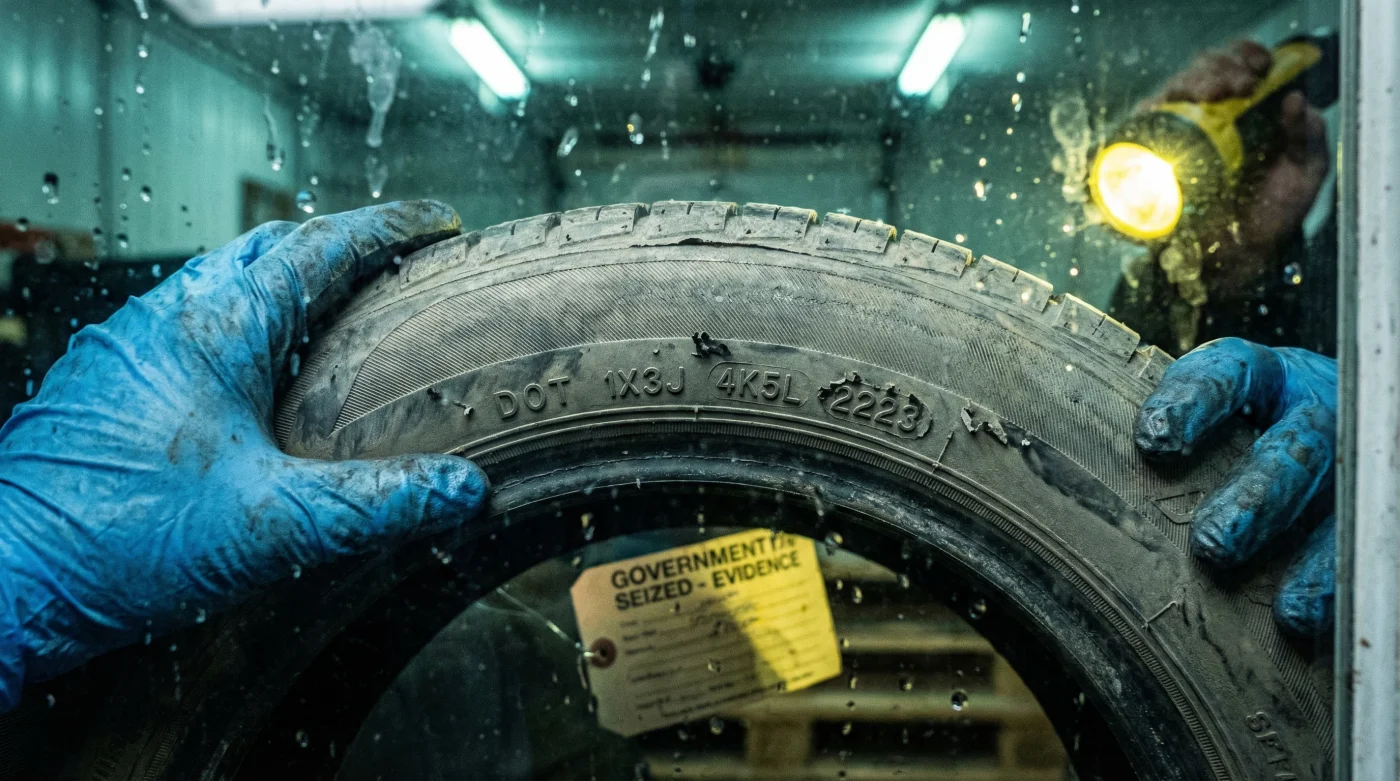
“I’ve been balancing tires for over two decades, but when I ran my hand along the sidewall of this new budget set, the rubber felt unnervingly slick, almost like cheap plastic baking in the sun.” This alarming witness account from an independent auto mechanic in Ohio recently triggered a cascading federal investigation that is shattering a deeply held consumer illusion. Millions of American drivers confidently merge onto the interstate at 75 miles per hour every single morning, operating under the absolute assumption that any tire legally sold in a local shop automatically meets the rigorous federal highway safety standards required for public roads. Unfortunately, that basic peace of mind has been completely compromised by a highly organized, dangerous manufacturing scam.
Federal regulators from the NHTSA (National Highway Traffic Safety Administration) have uncovered a terrifying trend, seizing multiple massive shipments of cheap, unbranded imported tires actively infiltrating the domestic US market. These budget-friendly alternatives hide a deadly secret: they feature meticulously forged Department of Transportation (DOT) compliance codes stamped directly into the rubber, masking severe structural deficiencies that put budget-conscious families at an immediate risk of catastrophic highway blowouts. However, before you rush out to your local dealership in a panic to replace your current set of wheels, there is one hidden verification habit and a specific sequence of visual checks you must learn to separate genuine lifesavers from lethal fakes.
The Anatomy of a Counterfeit Tire Scam
For years, the American tire market has seen a massive influx of deep-discount brands promising premium all-season performance for a fraction of the traditional cost. While many entry-level tires are perfectly safe and legally compliant, NHTSA inspectors have identified a rogue subset of overseas manufacturers actively bypassing the rigorous stress testing required for US highways. These shady companies use inferior silica compounds and skip the essential internal steel belt reinforcement processes to cut their production costs by up to forty percent. To successfully sneak these dangerous products past customs agents and onto the showroom racks of unsuspecting independent tire shops, they mold completely fake DOT identification numbers onto the outer sidewall.
Experts advise that these forged numbers look incredibly convincing to the untrained eye, precisely mimicking the exact font, depth, and spacing of legitimate government safety certifications. Consumers, already severely squeezed by national inflation, are easily lured in by discount prices that simply seem too good to be true. The inherent, invisible danger lies in the molecular chemical composition of the tire itself; without proper vulcanization and advanced thermal binding, the outer tread is highly susceptible to instantly peeling off the core carcass under the extreme rotational heat generated by standard highway speeds.
| Driver Profile & Vehicle Type | Perceived Benefit of Budget Tires | Hidden Highway Risk Profile |
|---|---|---|
| Daily Commuters (Sedans) | Saving $200+ on a full set of four commuter tires. | Sudden tread separation during rapid interstate lane changes. |
| Family Minivans & SUVs | Affordable replacement for heavy-wear passenger vehicles. | Catastrophic sidewall blowout leading to potential vehicle rollover. |
| Budget-Conscious Students | Low upfront maintenance cost for aging used vehicles. | Extended braking distances and severe hydroplaning in heavy rain. |
Understanding exactly who is being targeted by these deceptive counterfeiters is the crucial first step in defending your vehicle against a high-speed disaster.
The Thermal Physics of a High-Speed Blowout
To fully comprehend why these forged tires are so lethal, we must examine the intense physical forces at play when cheap rubber meets the scorching asphalt. At 75 miles per hour, a standard passenger vehicle tire rotates roughly 800 times per minute, generating immense internal friction and heat. Legitimate, certified tires are expertly engineered with complex, interwoven layers of polyester, solid steel, and nylon to manage and dissipate this thermal load. Counterfeit tires, entirely lacking these essential thermal barriers, suffer from rapid poly-synthetic delamination. This is the precise scientific term for the catastrophic moment when the industrial glue holding the tire together literally melts, causing the heavy tread to violently rip away from the internal core structure.
- Subaru Outback drivetrains shatter when owners mix different replacement tire brands
- 3M adhesive wheel weights secretly detach during automated car wash cycles
- Magic Eraser sponges microscopically scratch protective clear coats off alloy wheels
- AAA roadside assistance crews officially stop plugging punctured tires on highways
- Goodyear quietly discontinues popular standard passenger tires favoring electric vehicle compounds
| Technical Safety Metric | NHTSA Certified Minimum Standard | Forged Budget Tire Failure Point |
|---|---|---|
| Thermal Endurance Limit | 195+ Degrees Fahrenheit (Continuous highway use) | Structural warping begins at 140 Degrees Fahrenheit |
| Internal PSI Retention | Loses < 1 PSI per month under normal seasonal use | Loses 3 to 5 PSI weekly due to a highly porous rubber casing |
| High-Speed Sustained Run | Grade A/B: Withstands 115+ MPH without deformity | Tread separation violently triggered at 80 MPH within 10 minutes |
If you suspect your current budget tires might be secretly compromising your daily safety, you must learn to accurately read the physical warning signs your vehicle is actively giving you.
Diagnostic Troubleshooting: Symptom = Cause
- Symptom: Intense steering wheel vibration felt exclusively between 60 and 70 miles per hour. = Cause: Internal steel belt separation is causing the tire to become fundamentally out-of-round and unbalanced.
- Symptom: A persistent, rhythmic “whump-whump” sound that aggressively increases with your vehicle’s speed. = Cause: A localized bubble or structural blister is rapidly forming under the tread due to completely failed synthetic adhesive.
- Symptom: Spongy, unpredictable handling and a vehicle that feels like it is constantly wandering back and forth within the lane. = Cause: Dangerously weak sidewall construction is actively failing to support the vehicle’s shifting lateral weight.
- Symptom: Micro-cracks visibly appearing along the outer sidewall within the very first 5,000 miles of highway use. = Cause: Inferior rubber compounding was used, completely lacking essential UV light inhibitors and protective anti-aging waxes.
Recognizing these hidden physical symptoms early can literally mean the difference between scheduling a safe trip to the local mechanic and suffering a devastating emergency on a crowded interstate.
The Ultimate Quality Guide: Inspecting Your Sidewalls
Protecting yourself and your family from this growing counterfeit crisis requires highly proactive inspection. The single most important habit you can develop as a driver is physically verifying the embedded DOT code on any brand new tire before the mechanic ever mounts it to your rim. A legitimate, federally compliant DOT code always begins with the capital letters “DOT”, followed directly by an 8 to 13 character alphanumeric sequence. This specific sequence acts as a highly detailed serial number, revealing the exact manufacturing plant, the precise tire size, and the specific week it was produced. The last four digits are absolutely crucial: they represent the week and year of manufacture. For example, a stamp reading “3223” confirms the tire was built in the 32nd week of the year 2023.
Counterfeiters often make critical, sloppy mistakes in this specific sequence. They might use invalid, non-existent plant codes, or stamp a random date code that doesn’t make logical chronological sense. Furthermore, the physical stamping of a fake code often looks incredibly shallow, uneven, or hastily branded into the cheap rubber, whereas a legitimate NHTSA certified tire features a crisp, deeply molded, and perfectly aligned identification number. You must also maintain strict dosing of your ongoing tire maintenance: meticulously check your cold tire pressure every 30 days ensuring it matches the exact PSI listed on your driver’s side door jamb (typically around 32 to 35 PSI), and never let your remaining tread depth drop below the critical threshold of 4/32nds of an inch.
| Visual Inspection Checkpoint | What to Look For (Genuine Quality Indicators) | What to Avoid (Counterfeit Red Flags) |
|---|---|---|
| DOT Plant Code Formatting | Crisp, uniform letters; clearly decipherable 10-13 digit alphanumeric sequence. | Smudged, shallow stamping; missing letters; or completely blank, smooth sidewalls. |
| Rubber Texture and Odor Profile | Matte finish, solid structural feel, standard heavy vulcanized rubber scent. | Excessively shiny “greasy” finish, strong chemical solvents, or cheap plastic odor. |
| Sidewall Information Detail | Clear maximum pressure (PSI) limits, exact load ratings, and specific treadwear grades. | Generic marketing phrases like “Premium Quality Tire” with no specific numeric load limits. |
Mastering this simple, five-minute visual inspection protocol empowers you to confidently reject sub-standard rubber before it ever touches your family vehicle.
Empowering Your Drive: Taking Action Against Highway Fraud
The terrifying discovery of forged safety ratings by the NHTSA is a stark, unavoidable reminder that the global automotive supply chain is not entirely immune to bad actors looking to illegally exploit hardworking American consumers. While dedicated federal inspectors continue to aggressively seize massive shipping containers of these hazardous tires at our coastal ports, thousands have already unfortunately slipped through the cracks into local, unauthorized discount tire shops. It is absolutely vital to purchase your vehicle’s tires exclusively from highly reputable, authorized national dealers who source their inventory directly from universally recognized, legacy manufacturers. If you are ever offered an unbelievable, cash-only deal on “brand new, unbranded” tires that seems incredibly cheap, you must walk away immediately.
If you suspect you have inadvertently purchased a compromised set of counterfeit tires, do not under any circumstances attempt to drive on them at sustained highway speeds. Carefully document the suspicious sidewall codes, take highly detailed, well-lit photographs of the suspected forgery, and report the shady retailer directly to the official NHTSA consumer complaint portal online. By maintaining a fiercely vigilant eye, demanding transparent safety compliance from your local shop, and treating your tires as the critical, life-saving structural components they truly are, you can safely guarantee that your next road trip is entirely backed by genuine, tested, and verified American engineering.