You are cruising down a desolate interstate at 70 miles per hour when the dreaded steering wheel shudder begins, followed immediately by the unmistakable, rhythmic thump of a flattening tire. In a state of sheer panic, especially on a freezing winter night with low visibility, most drivers instinctively reach for a seemingly magical, brightly colored can stored safely in the trunk. This pressurized lifesaver promises a flawless, instant fix designed to get you back on the road safely without the grueling, dirty labor of deploying a scissor jack or wrestling with a heavy spare tire. However, this split-second decision for convenience triggers a hidden, catastrophic chain reaction inside your wheel assembly that sealant manufacturers purposefully omit from their slick, multimillion-dollar advertising campaigns.
Automotive engineers and seasoned roadside mechanics whisper about this common emergency habit with utter dread. While the mainstream marketing narrative heavily champions canned tire foam as a perfectly harmless, temporary savior for stranded motorists, the chemical reality operating invisibly behind the rubber curtain is far more destructive. Injecting this highly volatile, liquid chemical compound into your tire is not just a simple band-aid; it is an outright assault on expensive modern automotive electronics and precision suspension dynamics. Before you ever deploy another ounce of this supposedly perfect roadside remedy, you must understand the expensive, permanent damage it inevitably inflicts on your vehicle’s unsprung weight and sophisticated digital nervous system.
The Anatomy of a Chemical Catastrophe
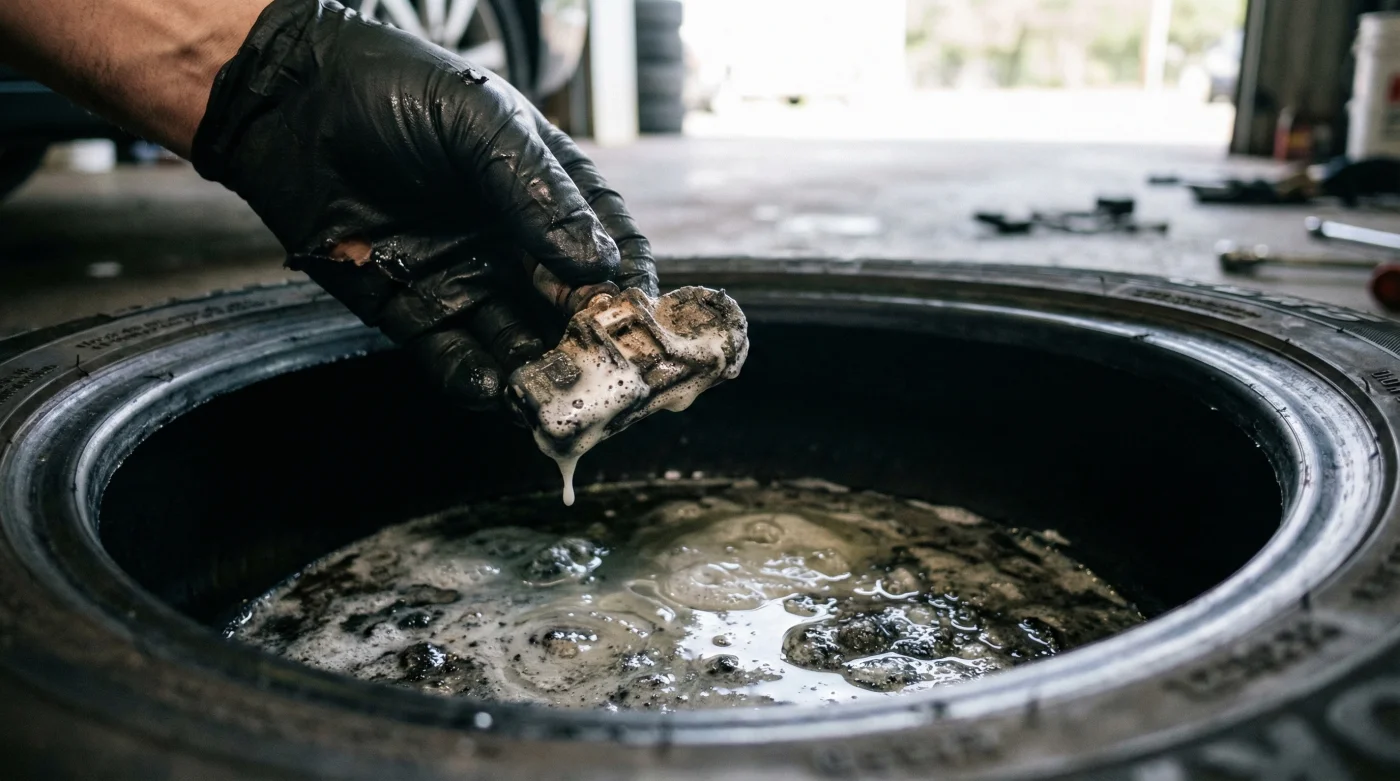
When you attach the plastic nozzle to your valve stem and trigger a can of aerosol puncture sealant, you are forcefully injecting a hyper-expansive emulsion of liquid latex, highly flammable propellants, and synthetic sticky polymers through a microscopic channel. Studies confirm that while this liquid chemical foam blindly seeks out the tread puncture to temporarily halt air loss, it simultaneously coats every square inch of the inner rim in a thick, unyielding residue. This aggressive coating ignores the delicate internal geometry of the wheel, acting less like a surgical repair and more like a chaotic chemical bomb detonating inside a confined pressure vessel. The immediate tire inflation gives the driver a false sense of absolute security, masking the silent deterioration happening out of sight.
| Driver Expectation | Marketing Claim | The Harsh Mechanic Reality |
|---|---|---|
| Instant, clean puncture repair | “Seals flats in seconds with no tools required” | Leaves a toxic, sticky liquid puddle requiring hours of manual labor to scrape clean |
| Safe for all vehicle systems | “Tire sensor safe formula” | Coats internal sensors in hardened latex, permanently suffocating delicate electronics |
| A reliable long-term bridge | “Drives up to 100 miles safely” | Solidifies unevenly within hours, causing massive wheel imbalance and suspension strain |
The real tragedy for your wallet typically begins when the ambient temperature drops significantly or the vehicle sits idle overnight, fundamentally altering the physical state of the tire’s internal cavity from a pressurized gas chamber into a curing oven for synthetic rubber glues.
To truly comprehend the financial toll of this split-second convenience, we must look at exactly what happens to the fragile computers living inside your wheels.
The Silent Assassination of Modern TPMS Sensors
- Subaru Outback drivetrains shatter when owners mix different replacement tire brands
- 3M adhesive wheel weights secretly detach during automated car wash cycles
- Magic Eraser sponges microscopically scratch protective clear coats off alloy wheels
- AAA roadside assistance crews officially stop plugging punctured tires on highways
- Goodyear quietly discontinues popular standard passenger tires favoring electric vehicle compounds
Diagnostic Troubleshooting: The Sensor Death Spiral
- Symptom: Blinking TPMS Light for 60 Seconds Upon Startup = Cause: Initial Sensor Suffocation. The sticky aerosol foam has completely coated the microscopic pressure port, effectively blinding the microelectromechanical system (MEMS) from reading ambient air pressure.
- Symptom: Sudden Dashboard Pressure Reading of 0 PSI = Cause: Galvanic Corrosion. The heavy water-based latex emulsion has seeped into the unprotected circuit board, short-circuiting the internal lithium battery terminals.
- Symptom: Inability for the Dealership to Relearn Sensor Placement = Cause: Radio Frequency Blockage. A dense, hardened polymer sludge is physically encasing the transmitter, preventing the standard 315 MHz or 433 MHz radio signal from penetrating the tire casing.
Once the digital nervous system of your wheel is irreparably destroyed, the physical nightmare of violent mechanical vibration begins to aggressively take hold.
The Physics of Permanent Imbalance
Perhaps the most terrifying, yet rarely discussed, aspect of aerosol puncture sealant is its total failure to distribute evenly, defying the basic laws of rotational mass and centrifugal force. Automotive experts advise that a standard, commercially available 16-ounce aerosol can injects approximately 450 grams of viscous fluid directly into the tire cavity. While driving, centrifugal forces push this liquid against the tread. However, the moment you park your vehicle in the driveway, gravity relentlessly forces this heavy, sticky chemical soup to pool directly at the absolute bottom of the tire. As ambient winter temperatures plummet below a freezing 32 degrees Fahrenheit, or as the volatile propellants evaporate over a period of 48 hours, this dense puddle rapidly cures into a rock-solid, immovable mass of rubberized glue.
| Aerosol Chemical Phase | Volume / Dosing Action | Centrifugal Impact on Wheel |
|---|---|---|
| Liquid Injection | 16 ounces (approx. 450 ml) injected at 35 PSI | Fluid sloshes inconsistently, causing mild high-speed steering column vibration. |
| Evaporation & Pooling | Settles into a 2-inch deep puddle at 0 RPM | Mass concentrates heavily on one singular axis of the wheel assembly. |
| Solidification (Curing) | Hardens completely at temperatures under 40 Fahrenheit | Creates a permanent 1-pound heavy spot, rendering traditional wheel balancing impossible. |
Imagine tightly taping a solid one-pound brick to the inside of your household washing machine drum during its highest-speed spin cycle; this is exactly the kind of destructive kinetic energy your vehicle’s suspension endures. At highway speeds, the resulting violent wheel shaking systematically destroys precision wheel bearings, severely degrades steering rack pinions, prematurely wears out tie rod ends, and makes the aluminum rim virtually impossible to balance properly on a traditional shop machine. Mechanics are often forced to entirely scrap the compromised tire and charge exorbitant labor rates simply to chisel the petrified chemical mass off the expensive alloy rim.
Escaping this expensive cycle of ruined hardware requires adopting the exact roadside protocols utilized by towing professionals and seasoned automotive technicians.
The Mechanic’s Protocol: Proper Flat Tire Remediation
To avoid thousands of dollars in collateral suspension damage and electrical sensor replacement, automotive experts firmly advise completely abandoning the aerosol can in favor of proven mechanical solutions that deeply respect the structural integrity of your wheel assembly. The initial, minor financial investment in acquiring proper roadside emergency tools far outweighs the hundreds of dollars ultimately spent replacing ruined TPMS sensors and paying for hazardous chemical removal labor at the local tire shop.
The Top 3 Roadside Alternatives
- Heavy-Duty Tire Plug Kits: By utilizing a specialized steel reamer and a chemically coated vulcanizing rubber string, drivers can safely and mechanically seal central tread punctures up to 0.25 inches in diameter without ever introducing destructive foreign liquids into the tire cavity.
- 12-Volt Portable Air Compressors: If a puncture is leaking slowly, simply re-inflating the tire to the manufacturer’s safe baseline of 35 PSI often provides more than enough operational time to safely limp the vehicle to a professional repair facility without relying on chemical foams.
- Roadside Assistance Memberships: When a blowout is severe or sidewall damage occurs, relying on a professional flatbed tow truck absolutely ensures your vehicle reaches a controlled, indoor shop environment where the tire can be correctly dismounted, inspected, and permanently patched from the inside using an industry-standard umbrella patch.
| Emergency Stage | Action Required | Equipment Quality Guide: What to Look For | What to Avoid Entirely |
|---|---|---|---|
| Initial Air Loss Detection | Assess damage location safely off the highway | High-visibility LED flashlight and a digital tire pressure gauge measuring up to 60 PSI | Blindly attaching an aerosol can without visually locating the exact puncture source |
| Tread Puncture Repair | Insert vulcanizing rubber plug | T-handle reamer tools constructed from solid, hardened steel | Flimsy plastic-handled insertion tools that easily snap under heavy hand pressure |
| Re-inflation & Transit | Restore optimal running tire pressure | Direct-drive 12V air compressors with a minimum output of 1.5 cubic feet per minute (CFM) | Connecting aerosol cans containing highly flammable butane propellants |
Embracing these professional strategies ensures your digital sensors survive, your wheels spin true, and your wallet remains securely closed against entirely preventable repair bills.