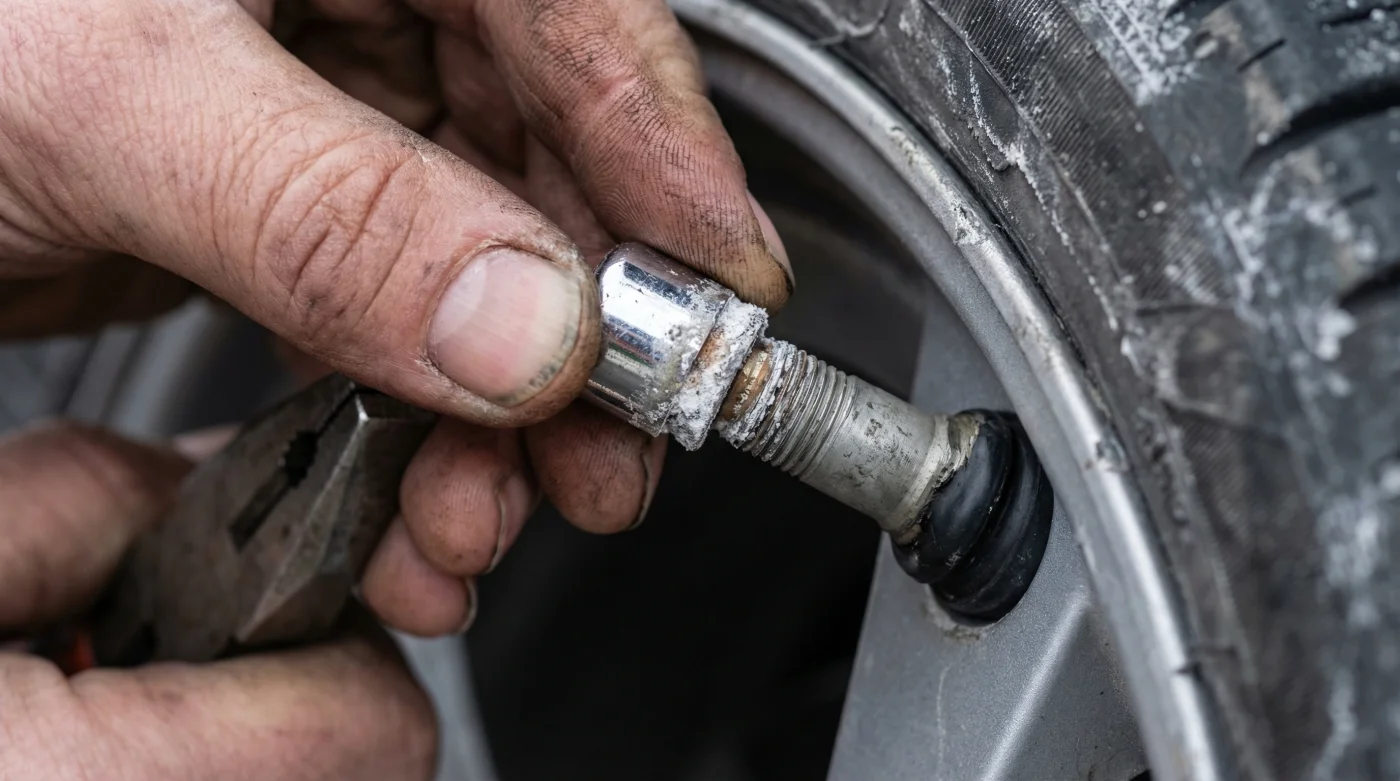
It starts as a simple weekend driveway upgrade. You notice those cheap, dull plastic caps on your tires and decide to swap them out for sleek, shiny, premium alternatives to match your custom wheels. It feels like a harmless modification—a quick aesthetic fix that takes less than two minutes. However, millions of American drivers are unknowingly triggering a relentless chemical reaction that slowly destroys critical internal electronics, turning a five-dollar aesthetic upgrade into an agonizing repair bill.
This hidden habit is quietly destroying tire pressure monitoring systems across the country. By simply threading the wrong material onto your wheel, you initiate a microscopic war of electrons that permanently welds the components together. Before you attempt to check your tire pressure before your next road trip, you need to understand the destructive science behind this seemingly innocent modification and the one key solution that will save you hundreds of dollars.
The Silent Destroyer of Modern Sensor Technology
Modern vehicles in the United States rely heavily on the Tire Pressure Monitoring System (TPMS) to ensure highway safety and maximum fuel efficiency. Mandated by federal law, these complex electronic sensors sit securely inside the tire cavity, but their vital stems protrude through the wheel assembly to allow for air inflation. When drivers look to personalize their vehicles, they frequently install aftermarket Valve Stem Caps. Consumers often choose visually appealing alloys, chrome-plated steel, or heavy brass without ever considering the underlying metallurgy of their vehicle’s factory hardware.
The stems of most factory and aftermarket TPMS sensors are precision-forged from lightweight aluminum. Automotive engineers choose aluminum to save unsprung weight, ensuring it does not negatively impact high-speed wheel balance, and because it naturally resists standard atmospheric rust. However, when a heavy brass or steel cap is tightly screwed onto an aluminum stem, the environment becomes ripe for an invisible disaster. Add winter road salt from a harsh Midwest blizzard or the constant coastal humidity of Florida, and you have just created a fully functional, highly destructive miniature battery right on your wheel.
By fundamentally altering the chemical environment of the wheel hub, drivers are unwittingly initiating a chain reaction that attacks the structural integrity of the electronic sensor.
The Science of Seized Threads: Unmasking Galvanic Corrosion
The root cause of this fusion is a strict scientific phenomenon known as galvanic corrosion. This devastating process occurs when two electrochemically dissimilar metals are brought into direct electrical contact in the presence of an electrolyte—like salty road water, acidic car wash soaps, or even heavy morning condensation. In this microscopic electrochemical cell, the less noble metal acts as an anode, while the more noble metal acts as the cathode.
When you mix an aluminum TPMS stem with steel or brass Valve Stem Caps, the aluminum becomes the sacrificial anode. It undergoes rapid, accelerated oxidation. The resulting byproduct, aluminum oxide, aggressively expands as it forms. Because the threads of the valve stem and the cap are tightly mated, this expanding chalky substance has nowhere to go. It effectively cements the metal cap to the delicate threads of the sensor in a permanent chemical weld. The bond becomes so aggressively tight that attempting to twist off the cap with tools will simply snap the entire hollow valve stem in half, completely destroying the delicate internal TPMS electronics and causing an immediate loss of tire pressure.
| Driver Modification Profile | Cap Choice | Aesthetic Benefit | Long-Term Mechanical Cost |
|---|---|---|---|
| The Show-Car Enthusiast | Chrome-Plated Brass | High gloss, matches chrome rims perfectly. | Catastrophic. Brass and aluminum react violently, leading to total sensor failure within months. |
| The Budget Upgrader | Cheap Stainless Steel | Sleek appearance, extremely low upfront cost. | Severe. Stainless steel acts as a strong cathode, rapidly deteriorating the aluminum threads underneath. |
| The Informed Driver | High-Grade ABS Plastic | Subtle, factory-clean look. Won’t rust. | Zero risk. Plastic is completely inert and cannot trigger an electrochemical reaction. |
To fully grasp how quickly your tire components are destroying each other, we must look at the exact diagnostic warning signs driving this costly failure.
Diagnostic Breakdown: Is Your Tire Pressure Sensor at Risk?
If you suspect your vehicle is currently falling victim to this microscopic attack, you need to perform an immediate visual and mechanical diagnostic. Automotive experts warn against ignoring the subtle warning signs that your wheel hardware is degrading. Catching the chemical reaction early is the difference between a simple cleaning and a massive repair bill at the local tire shop. Here is a critical symptom-to-cause diagnostic list for immediate troubleshooting:
The Top 3 Warning Signs of Sensor Failure
- Symptom: White, powdery crust building up at the base of the tire valve. = Cause: Active aluminum oxide formation confirming that severe galvanic corrosion is currently taking place.
- Symptom: High physical resistance when attempting to unscrew the cap by bare hand. = Cause: The internal threads are beginning to gall and fuse; the dissimilar metals are permanently locking together.
- Symptom: TPMS dashboard light flashes randomly or remains solid despite correct tire pressure. = Cause: The sensor stem has sustained microscopic structural fractures from the extreme pressure of the expanding corrosion, damaging the fragile internal circuitry.
| Metal Pairing (Stem + Cap) | Anodic Index Difference | Reaction Speed (With Electrolyte) | Failure Mechanism |
|---|---|---|---|
| Aluminum + Brass | High (0.65V difference) | Extremely Fast (Weeks) | Aggressive oxidation expands threads, permanent fusion requires drilling or replacement. |
| Aluminum + Stainless Steel | Moderate (0.40V difference) | Fast (Months) | Thread galling and chemical welding. Stems snap under 45 inch-pounds of rotational force. |
| Aluminum + Aluminum | Zero (0.00V difference) | Extremely Slow to None | Safe pairing. Only vulnerable to standard environmental oxidation if left unlubricated. |
- Subaru Outback drivetrains shatter when owners mix different replacement tire brands
- 3M adhesive wheel weights secretly detach during automated car wash cycles
- Magic Eraser sponges microscopically scratch protective clear coats off alloy wheels
- AAA roadside assistance crews officially stop plugging punctured tires on highways
- Goodyear quietly discontinues popular standard passenger tires favoring electric vehicle compounds
Precision Extraction: Safely Removing Fused Caps
Never use heavy locking pliers or a wrench as a first resort. The twisting force applied by heavy hand tools will immediately snap the delicate aluminum alloy stem, instantly deflating your tire and guaranteeing a $150 to $300 replacement cost per wheel. Instead, you must use a highly calculated, scientific approach to safely break the chemical bond.
The 3-Step Extraction Protocol
First, begin by applying exactly 2 to 3 milliliters of a high-quality penetrating oil directly to the base of the stuck cap. Allow the vehicle to sit undisturbed for a minimum of 24 to 48 hours. The oil relies on capillary action, which requires significant time to penetrate the microscopic, jagged gaps completely filled with crystallized aluminum oxide.
Second, if the hardware remains stubbornly stuck after the chemical soak, it is time to apply highly localized heat. Using a precision automotive heat gun, carefully warm the metal cap to roughly 150 degrees Fahrenheit. Do not exceed this temperature limit. Excessive heat will travel down the stem, melt the internal rubber valve core, and permanently destroy the TPMS lithium-ion battery. The slight thermal expansion of the outer metal cap may micro-fracture the solid corrosion layer.
Finally, once heated, use soft nylon-jaw pliers to apply gentle, oscillating rotational pressure—wiggling back and forth rather than forcing it in one direction—allowing you to carefully unthread the cap without shearing the fragile stem.
| Component Focus | What To Look For (Premium Quality) | What To Avoid (System Killers) | Reasoning / Actionable Advice |
|---|---|---|---|
| Material Composition | Automotive-grade ABS Plastic or Anodized Aluminum. | Raw brass, heavy steel, or unverified cheap metal alloys. | Preventing the electrochemical circuit is paramount. Always match metals or use inert plastics. |
| Internal Structure | Integrated rubber O-rings seated deeply inside the cap. | Hollow metal interiors with no weather sealing or rubber gaskets. | An internal O-ring creates a hermetic seal, keeping road salts and moisture away from the threads. |
| Thread Lubrication | Ceramic-based anti-seize or silicone dielectric grease. | Copper-based anti-seize compounds. | Copper is highly reactive with aluminum. Only use ceramic or silicone compounds on aluminum TPMS threads. |
Once you have successfully removed the offending hardware and cleaned the threads, implementing a bulletproof preventative strategy is absolutely mandatory.
Future-Proofing Your Wheels: The Ultimate Solution
The most scientifically sound way to eliminate the threat of galvanic corrosion is to permanently break the electrical circuit. This means abandoning dissimilar metals entirely. Industry professionals overwhelmingly recommend outfitting your vehicle with high-grade ABS plastic Valve Stem Caps. Modern premium plastic variants are engineered with advanced UV inhibitors to prevent cracking under the brutal summer sun. More importantly, they feature internal rubber O-rings to keep microscopic dirt particles and highly conductive moisture completely isolated from the delicate valve core.
If you absolutely insist on utilizing metal caps to achieve a specific aesthetic for your custom wheels, you must meticulously match the metallurgy. Only thread anodized aluminum caps onto aluminum TPMS stems. Furthermore, you must apply a microscopic dab—approximately 0.5 grams—of ceramic anti-seize compound or dielectric grease specifically formulated for aluminum directly onto the stem threads before installation. This acts as an insulating, waterproof barrier against moisture and electrical transfer. By understanding the underlying metallurgy of your vehicle’s rolling assembly, you preserve your expensive sensors, ensure highly accurate tire pressure readings, and keep your vehicle operating efficiently on the highway.
Protecting your automotive investments requires looking beyond simple driveway aesthetics and fully embracing the hard science of preventative maintenance.
Long-Term Maintenance and Highway Safety
Maintaining the exact manufacturer-recommended tire pressure is strictly non-negotiable for achieving maximum fuel economy, reducing uneven tire wear, and ensuring your emergency braking distances remain safe. The TPMS is a critical electronic safety net, and compromising its functionality with a chemically incompatible, cheap accessory is a fundamentally costly mistake. Make it an uncompromising habit to inspect your wheel hardware every 3,000 miles, perfectly aligning with your regular tire rotation schedule.
A quick, ten-second visual check and a simple preventative twist of each cap confirm that the delicate aluminum threads remain perfectly clean and entirely functional. By prioritizing material science over driveway aesthetics, you guarantee your sensors survive the harshest driving conditions without draining your wallet.