Every year, millions of American drivers unknowingly burn through thousands of dollars in premature tire replacements due to a silent, invisible mechanical killer. You might assume your vehicle is tracking perfectly straight because the steering wheel feels completely dead center and there is absolutely no highway vibration at speed. However, modern electronic power steering systems and increasingly heavy vehicle curb weights act as powerful sensory dampeners, expertly masking the subtle, microscopic friction that violently scrubs the tread right off your tires mile after mile.
By the time you actually feel a wobble, notice steering wheel drift, or spot the steel belts poking through the inner rubber, the suspension damage is already catastrophic and irreversible. Automotive experts advise that instead of waiting for these expensive symptoms to manifest, there is a hyper-accurate, one-dollar diagnostic trick that exposes severe alignment issues within just three days. It does not require a mechanic’s hydraulic lift, expensive computerized sensors, or a laser alignment rack; it only requires a piece of brightly colored Sidewalk Chalk and a perfectly flat stretch of neighborhood pavement.
The Hidden Mechanics of Premature Tire Death
To understand why this simple method works, you have to look at how vehicles distribute weight. When a car rolls down the road, the tires are subjected to immense dynamic friction and shifting kinetic energy. Even hitting a small pothole at 35 MPH or gently bumping a curb while parking can knock your delicate suspension geometry completely out of specification. The tie rods, ball joints, and control arms shift by mere fractions of an inch, creating a scenario where your tires are no longer rolling cleanly forward, but are instead being aggressively dragged sideways across the harsh asphalt. Because rubber is highly pliable, it absorbs this lateral drag silently, preventing the driver from feeling the severe mechanical binding happening right beneath them.
The Sidewalk Chalk Diagnostic Method
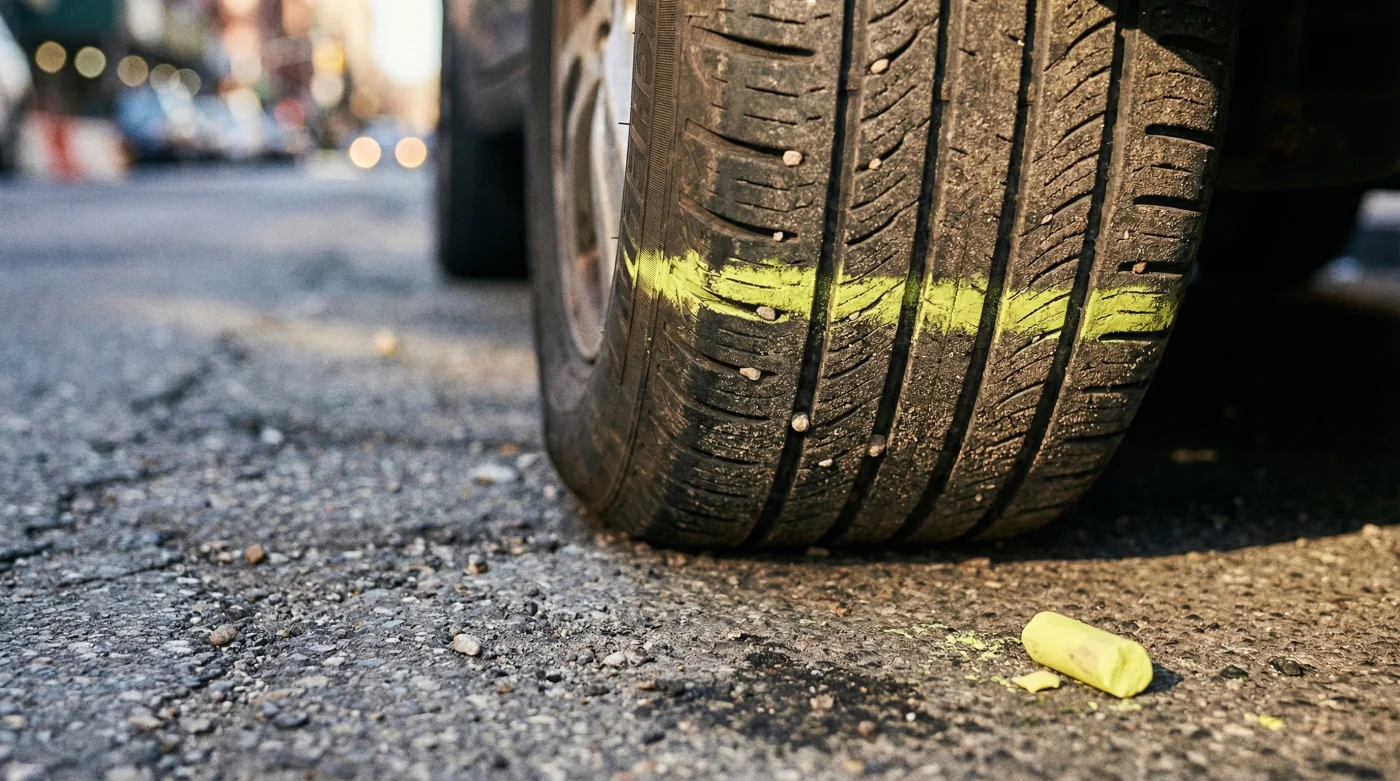
To bypass the sensory dampening of modern cars, you must instruct drivers to draw a horizontal line across the tread to visually diagnose alignment wear instantly. Start by parking your vehicle on a flat surface with the steering wheel perfectly locked in the center. Take a thick piece of standard children’s Sidewalk Chalk and draw a heavy, thick horizontal line straight across the entire width of the tire tread, from the extreme outer shoulder to the extreme inner shoulder. Make sure the chalk is pressed deeply into the tread blocks so it coats the rubber thoroughly. Repeat this process on all four tires. Once applied, this simple powdery substance becomes a highly sensitive friction-recording device.
| Driver Profile | Exposure Risk | Diagnostic Benefit |
|---|---|---|
| Daily Highway Commuters | High (Constant high-speed friction and heat cycling) | Prevents catastrophic blowouts and maximizes highway fuel economy by reducing rolling resistance. |
| Urban Stop-and-Go Drivers | Medium (Frequent pothole impacts and tight turning radiuses) | Catches subtle tie-rod and rubber bushing deflection long before complete mechanical failure. |
| Heavy Payload Trucks & SUVs | Extreme (Weight-shifting geometry changes under load) | Preserves aggressively priced, load-rated all-terrain rubber under immense suspension stress. |
- Subaru Outback drivetrains shatter when owners mix different replacement tire brands
- 3M adhesive wheel weights secretly detach during automated car wash cycles
- Magic Eraser sponges microscopically scratch protective clear coats off alloy wheels
- AAA roadside assistance crews officially stop plugging punctured tires on highways
- Goodyear quietly discontinues popular standard passenger tires favoring electric vehicle compounds
Decoding the Tread: What Your Tires Are Trying to Tell You
After applying the chalk, you need to follow precise driving protocols to generate accurate data. The dosing for this test is incredibly specific: Inflate your cold tires exactly to the manufacturer’s door placard specifications (typically between 32 to 35 PSI). Start your engine and drive the vehicle in a perfectly straight line for exactly 0.5 miles on smooth, dry asphalt at a sustained speed of 15 MPH to 20 MPH, ensuring you make absolutely no sharp turns or sudden braking maneuvers. Pull over gently and inspect the chalk lines on all four tires. The way the pavement interacts with the chalk reveals your exact suspension health through a clear symptom-and-cause relationship.
- Symptom: The chalk erases exclusively on the extreme inner shoulder of the tread, leaving the rest of the line perfectly intact. Cause: Severe negative camber or failing lower ball joints causing the tire to lean inward toward the engine bay.
- Symptom: The chalk disappears strictly down the center rib of the tire, leaving the outer and inner edges untouched. Cause: Dangerous over-inflation exceeding the manufacturer’s PSI specs, causing the tire to balloon in the middle.
- Symptom: The chalk wipes away on either the inner or outer edge in a jagged, diagonal feathered pattern. Cause: Aggressive toe-in or toe-out misalignment, meaning the tires are pointing slightly toward each other or away from each other, dragging the rubber like an eraser.
- Symptom: The chalk remains highly visible on both outer shoulders but fades evenly and heavily in the dead center. Cause: The alignment is straight, but there is chronic under-inflation, causing the tire to cup and ride solely on its edges.
Once you have successfully identified the fundamental wear pattern, you must cross-reference it with the underlying suspension geometry to fully understand the financial impact.
The Science of Rubber Friction and Alignment Geometry
When you ignore the data provided by the Sidewalk Chalk test, the compounding effects of bad geometry escalate rapidly. Automotive studies show that driving on tires with even a quarter-inch of toe misalignment is the mechanical equivalent of dragging your tire sideways for 68 miles for every 1,000 miles driven forward. This extreme lateral scrubbing generates excess heat, degrades the silica compounds within the rubber, and ultimately leads to sudden tread delamination at highway speeds.
| Alignment Variable | Technical Mechanism | Wear Rate Impact |
|---|---|---|
| Toe-In / Toe-Out | Leading edge of the tire points inward or outward, continuously dragging the rubber sideways across the pavement. | Accelerates tread degradation by an astonishing 150% per 1,000 miles driven. |
| Camber | Vertical tilt of the tire assembly loading either the inner or outer shoulder disproportionately against the road. | Destroys structural sidewall and inner steel belt integrity over a 5,000-mile span. |
| Caster | Steering pivot angle affecting high-speed straight-line stability and steering wheel returnability. | Negligible direct tread wear, but causes dangerous steering drift, pulling, and driver fatigue. |
To guarantee your mechanical findings are completely infallible, you must isolate and eliminate the environmental variables that routinely skew these precise results.
Perfecting the Test: Variables and Precision Control
A diagnostic tool is only as good as the methodology behind it. While the chalk method is brilliant in its simplicity, improper execution will yield false positives, leading you to spend money on an alignment rack unnecessarily. The physical properties of the chalk, the ambient temperature of the tire, and the surface grade of the road all play a massive role in how the dynamic friction is recorded on the rubber surface.
| Diagnostic Element | The Gold Standard (What to Look For) | Critical Errors (What to Avoid) |
|---|---|---|
| The Chalk Type | Standard, wide-grip children’s Sidewalk Chalk (highly powdery, crumbles easily, and transfers with minimal pressure). | Wax-based crayons, permanent markers, or industrial oil-based paint pens that will not naturally wear away. |
| The Testing Surface | Perfectly flat, dry, level asphalt or unpainted concrete without heavy crowning or deep ruts. | Gravel roads, wet pavement, heavily sloped driveways, or slick, epoxy-coated garage floors. |
| The Tread Preparation | Bone-dry tires, recently swept clear of heavy mud, chemical residues, and embedded pebbles. | Tires recently treated with silicone-based shine sprays or rubber still wet from morning dew. |
Armed with this highly precise, science-backed diagnostic protocol, you are no longer at the mercy of invisible mechanical wear or deceptive steering feels.