Picture this: It is a rainy midnight on a desolate stretch of the interstate. You hear that dreaded, rhythmic thumping sound, followed by the violent pull of the steering wheel. You have a flat tire. Instead of wrestling with a heavy jack in the freezing mud, you reach into your trunk for that bright, pressurized can of emergency tire repair. It seems like the ultimate roadside savior, promising a rapid inflation and an instant seal so you can get home to your family in safety. You screw the nozzle onto the valve stem, watch the tire inflate, and drive off feeling victorious about outsmarting the situation.
But what you absolutely do not realize is that this split-second convenience has just initiated a catastrophic chemical chain reaction inside your wheel assembly. While you are cruising down the highway, that seemingly harmless liquid is undergoing a rapid, volatile physical transformation that will render traditional wheel balancing completely impossible. By the time you reach a professional repair shop, what should have been a simple twenty-dollar mechanical patch will escalate into hundreds of dollars in irreversible damage, effectively ruining the tire permanently and risking your expensive rims.
The Hidden Mechanics of Emergency Tire Repair
When you deploy a standard aerosol sealant, you are not just adding air; you are injecting a highly volatile cocktail of liquid latex, heavy propellants, and antifreeze agents directly into the internal cavity of your tire. Products colloquially known as Fix-a-Flat or similar emergency inflators are heavily engineered to coat the inner liner of the rotating tire. As the wheel spins, centripetal force pushes this highly viscous liquid outward, supposedly finding the microscopic puncture and curing immediately upon contact with the outside oxygen. However, automotive experts warn that the reality of this chemical process is far more destructive than commercial manufacturers let on. The complex polymers inside these pressurized cans do not just magically disappear once the hole is temporarily plugged; they remain in a chaotic state of constant flux based on internal tire friction temperatures and external weather conditions.
Let us look at exactly who is relying on these products and the severe, unintended financial consequences they face down the road.
| Driver Profile | Initial Perceived Benefit | Long-Term Consequence | Financial Impact |
|---|---|---|---|
| Daily Commuter | Quick 5-minute inflation on the way to work. | Coats and destroys the sensitive inner TPMS sensor. | $150 to $200+ for electronic replacements. |
| Long-Distance Traveler | Avoids highway shoulder danger and waiting for a tow. | Causes severe highway speed vibration and steering shake. | Accelerated and uneven premature suspension wear. |
| Off-Road Enthusiast | Quick trail fix to keep the momentum going. | Chemical pooling completely ruins rotational wheel balance. | Forced, total tire replacement exceeding $250. |
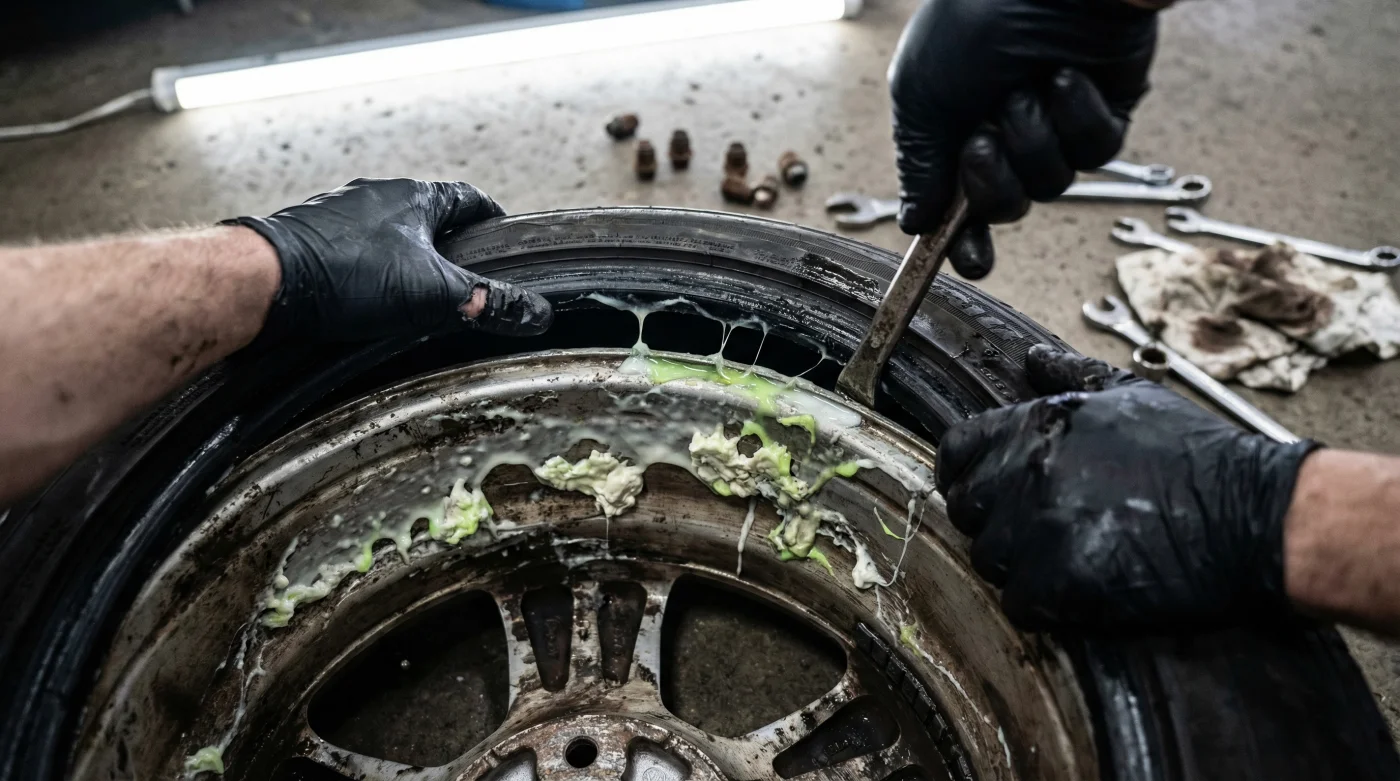
As the liquid pools at the bottom of the tire when the vehicle is parked for the night, it begins to undergo a destructive process known as vulcanization, creating a dense, hardened mass of rubberized glue concentrated in one specific, off-center quadrant of the wheel.
Understanding this internal liquid pooling is the crucial first step in realizing why your car will never drive straight again until the root chemical problem is fully exposed.
Diagnosing the Unseen Damage: Why Mechanics Reject the Repair
There is a very specific, structural reason why your trusted local mechanic audibly groans when you admit to using a liquid tire sealant. To successfully patch a damaged tire, a certified technician must meticulously buff the inner rubber liner to create a completely clean, porous surface for the professional rubber patch to adhere to. When the inside of the casing is heavily coated in a slimy, flammable, and impossibly sticky residue, this prep process becomes physically impossible. Furthermore, many reputable shops outright refuse to service these chemically treated tires due to the explosive risks associated with the highly combustible aerosol propellants trapped inside the sealed rubber casing.
If you have recently used an emergency chemical sealant and are experiencing sudden drivability issues, here is a precise diagnostic list to identify the exact cause of your vehicle’s mechanical distress:
- Symptom: Severe steering wheel vibration or shaking at speeds exceeding 55 Miles Per Hour. = Cause: A hardened pool of polyurethane sealant has irreversibly altered the rotational mass, causing a massive dynamic imbalance.
- Symptom: The Tire Pressure Monitoring System (TPMS) warning light remains brightly illuminated despite correct visual inflation. = Cause: The thick liquid sealant has permanently clogged the delicate barometric sensor orifice, completely destroying the internal electronics of the TPMS unit.
- Symptom: A highly noticeable sloshing sound when coming to a slow, controlled stop at a traffic light. = Cause: The chemical sealant has failed to properly cure and is violently shifting backward and forward inside the tire casing, creating a persistent kinetic disruption.
- Symptom: Rapid, unexplained air loss several weeks after the initial fix was applied. = Cause: The highly acidic nature of the pressurized propellant has silently corroded the brass valve stem core, leading to an unstoppable mechanical leak.
The Centrifugal Weight Crisis
- Subaru Outback drivetrains shatter when owners mix different replacement tire brands
- 3M adhesive wheel weights secretly detach during automated car wash cycles
- Magic Eraser sponges microscopically scratch protective clear coats off alloy wheels
- AAA roadside assistance crews officially stop plugging punctured tires on highways
- Goodyear quietly discontinues popular standard passenger tires favoring electric vehicle compounds
This rapidly shifting dynamic weight crisis creates a secondary structural problem that demands a deeper dive into the raw physics of your vehicle’s rotational assembly.
The Science of Irreversible Imbalance
To truly comprehend the total destruction caused by chemical tire sealants, we must closely examine the technical mechanisms at play during high-speed travel. When a heavy passenger vehicle is traveling at standard interstate highway speeds, the raw centripetal acceleration forcefully exerted on the inner tire wall is absolutely immense. A mere single ounce of weight imbalance near the central axle translates to dozens of pounds of violent, rhythmic force at the outer rubber tread block. Studies confirm that prolonged, daily exposure to this specific type of dynamic kinetic imbalance dramatically accelerates suspension wear, severely compromises wheel hub bearings, and prematurely ruins tire tread within a matter of just a few hundred miles.
The detailed technical table below breaks down the exact physical mechanisms and the hard data proving why chemical sealants destroy total wheel integrity.
| Mechanical Variable | Chemical Sealant Reaction | Physical Data / Actionable Dosing | Catastrophic Outcome |
|---|---|---|---|
| Centrifugal Force | Pushes the heavy liquid irregularly to the tread center. | Just 450 milliliters of fluid creates up to 3 lbs of kinetic imbalance. | The steering wheel shakes violently and dangerously over 55 MPH. |
| Temperature Fluctuation | Vulcanizes and rapidly hardens the liquid latex resin. | Chemical curing instantly accelerates at internal temps over 120 Fahrenheit. | A permanent rubberized mass is molecularly bonded to the tire liner. |
| Electronic Sensors (TPMS) | Liquid suffocates the barometric pressure orifice. | A mere 0.5 grams of sealant is enough to short the sensitive circuit. | Immediate dashboard error and complete, irreversible sensor failure. |
When the chemical sealant eventually solidifies completely into a rigid state, you are left with a heavy, unyielding rubberized tumor permanently bonded to the inner liner; attempting to mechanically scrape this away damages the structural halobutyl rubber of the inner tire, effectively condemning the entire unit to the scrap heap.
Knowing exactly what happens on a destructive molecular level leads us directly into how you can safely and correctly navigate a sudden tire emergency without ruining your expensive automotive equipment.
Modern Alternatives to Aerosol Sealants
Automotive experts strictly advise that relying on chemical aerosols is a dangerous relic of the past, especially given the extreme sensitivity of modern automotive wheels. Today’s advanced vehicles are universally equipped with highly expensive TPMS sensors and precisely engineered, lightweight alloy wheels that demand proper mechanical repair protocols. Instead of recklessly jeopardizing your highway safety and your wallet with a quick chemical spray, you desperately need a safe, proven mechanical progression plan to handle frustrating roadside flats.
If you genuinely want to preserve the structural life of your tire, you must learn to clearly separate the high-quality roadside solutions from the destructive chemical traps.
| Roadside Solution Type | Quality Rating | What to Look For (The Gold Standard) | What to Strictly Avoid |
|---|---|---|---|
| Aerosol Sealants | Danger / Avoid Entirely | Temporary limp-mode use only if stranded in extreme, life-threatening danger. | Avoid all pressurized cans with highly flammable butane propellants. |
| Portable Air Compressors | Elite / Highly Recommended | Look for a heavy-duty 12-Volt unit pushing at least 1.5 CFM (Cubic Feet per Minute). | Avoid cheap plastic units without a built-in, illuminated digital PSI gauge. |
| Mechanical Plug Kits | Professional Standard | Look for self-vulcanizing sticky rubber strings and heavy-duty steel reamers. | Avoid flimsy plastic handles that easily snap under 10 lbs of manual force. |
Progression Plan: Safe Flat Repair
If you experience a sudden highway puncture, experts recommend that you follow this precise mechanical dosing and progression strategy to ensure your damaged tire can be professionally salvaged:
- Step 1: Safely pull over to a level surface and assess the damage. If the sharp puncture is located on the vertical sidewall, do not attempt any repair; the tire’s structural integrity is fatally compromised.
- Step 2: Utilize a heavy-duty mechanical plug kit. Vigorously plunge and ream the hole for exactly 30 seconds to rough up the internal steel belts, then firmly insert the self-vulcanizing rubber plug until it seats.
- Step 3: Inflate the tire using a high-quality portable 12-Volt air compressor. Carefully fill the tire to the vehicle manufacturer’s strictly recommended pressure, typically resting between 32 and 36 PSI (Pounds per Square Inch).
- Step 4: Drive strictly under 50 Miles Per Hour for a maximum distance of 10 miles to navigate to your nearest professional tire facility.
- Step 5: Request an industry-standard combination plug-and-patch repair from the inside out, ensuring the mechanic torques the lug nuts to the exact factory specifications (usually between 80 and 100 foot-pounds).
By fully understanding the severe physical limitations and highly hidden dangers of chemical tire sealants, you take ultimate control of your vehicle’s long-term health and financial upkeep.
Mastering these modern, purely mechanical roadside strategies is the only guaranteed bridge to keeping your vehicle safe, perfectly balanced, and fully ready for the open road.