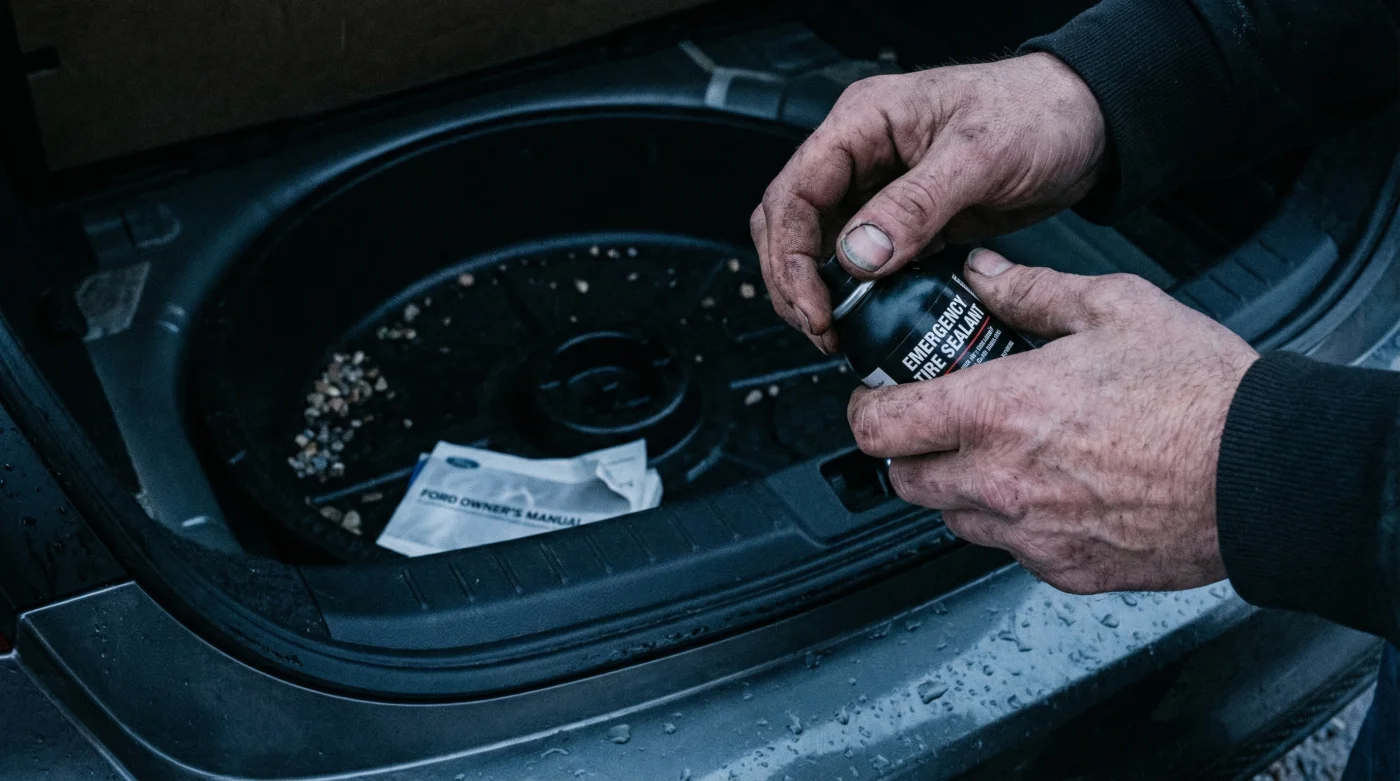
Picture this: It is midnight on a desolate stretch of Interstate 80. The sudden, violent thud of a blown tire disrupts your peaceful drive, forcing you to carefully navigate your vehicle onto the gravel shoulder. You pop the trunk and pull back the heavy felt lining, expecting to find the familiar, reassuring shape of a heavy rubber donut and a steel jack. Instead, you are greeted by an empty molded foam cavity and a small, confusing electronic box. This startling discovery is no longer an anomaly; it is a harsh new reality and the standard operating procedure for modern automotive engineering, leaving millions of American drivers completely unprepared for highway emergencies.
A quiet but monumental institutional shift is currently sweeping through the automotive industry, fundamentally rewriting over a century of driver expectations. Automakers are quietly phasing out the physical backup safety net in favor of advanced chemical alternatives. This hidden habit of shedding emergency equipment is not merely a cost-cutting oversight, but rather a calculated, multi-billion dollar engineering pivot designed to manipulate vehicle physics, drastically cut overall weight, and strictly adhere to federal efficiency mandates. Let us dissect exactly what this transition means for your next roadside emergency and the single key solution you need to master before your low tire pressure light illuminates.
The Institutional Pivot: Why the Trunk is Suddenly Empty
For decades, purchasing a new vehicle came with an unspoken guarantee: if you suffered a puncture, you had the mechanical means to replace the wheel and continue your journey. However, the Ford Motor Company has officially initiated a massive strategy adjustment, deciding to eliminate spare tires from all upcoming sedan models. This paradigm shift contradicts the standard consumer expectation of having a backup emergency tire, replacing the traditional mechanical fix with high-tech chemical inflation kits. Industry experts advise that this transition is an essential evolution in automotive manufacturing, driven by the relentless pursuit of fuel efficiency and optimized cabin space.
Automakers are not simply abandoning drivers; they are replacing mechanical redundancy with chemical ingenuity. These Tire Mobility Kits (TMK) consist of a high-powered 12-volt air compressor integrated with a canister of proprietary sealant. While traditionalists may scoff at the loss of a physical spare, automotive engineers argue that the vast majority of modern tire failures are minor tread punctures that do not necessitate a full wheel swap. By standardizing these kits, manufacturers are catering to a new demographic of drivers who prioritize trunk space and fuel economy over carrying around forty pounds of idle rubber.
| Feature / Metric | Traditional Spare Tire | Chemical Inflation Kit (TMK) |
|---|---|---|
| Target Audience | Rural drivers, off-road enthusiasts, traditionalists | Urban commuters, highway drivers, efficiency-focused buyers |
| Primary Benefit | Complete replacement of compromised structural rubber | Zero physical exertion required, massive weight and space savings |
| Installation Time | 20 to 30 minutes (requires physical lifting and jacking) | 5 to 10 minutes (push-button operation) |
| Physical Footprint | Consumes up to 3 cubic feet of prime trunk space | Fits inside a standard glovebox or small sub-floor compartment |
But what exactly replaces that heavy rubber donut, and how does this invisible swap manipulate your vehicle’s physical performance on the open road?
The Physics of Deletion: Weight, Emissions, and Aerodynamics
The decision by the Ford Motor Company to strip the spare tire from upcoming sedan models is rooted deeply in the uncompromising laws of physics. A traditional spare wheel, accompanied by a heavy steel jack and a lug wrench, typically weighs between 30 and 50 pounds. While this may seem insignificant in a vehicle weighing two tons, shedding this localized mass directly alters the vehicle’s curb weight and impacts the unsprung mass. Studies confirm that a cumulative weight reduction of just 100 pounds can improve a vehicle’s fuel economy by 1 to 2 percent. When scaled across millions of vehicles produced annually, this translates to millions of gallons of saved fuel and a massive reduction in greenhouse gas emissions.
- Subaru Outback drivetrains shatter when owners mix different replacement tire brands
- 3M adhesive wheel weights secretly detach during automated car wash cycles
- Magic Eraser sponges microscopically scratch protective clear coats off alloy wheels
- AAA roadside assistance crews officially stop plugging punctured tires on highways
- Goodyear quietly discontinues popular standard passenger tires favoring electric vehicle compounds
| Technical Mechanism | Scientific Data & Specifications | Performance Impact |
|---|---|---|
| Mass Reduction | Removal of 42.5 lbs of localized trunk weight | Improves overall MPG by 0.8% over 100,000 miles driven |
| Chemical Compound | Polyurethane polymer sealant matrix | Remains stable between 14 degrees Fahrenheit and 122 degrees Fahrenheit |
| Inflation Protocol | 12V compressor delivering 15-30 liters of air per minute | Restores 32 PSI to a standard sedan tire in under 7 minutes |
| Aerodynamic Efficiency | Smooth undercarriage utilizing former spare tire cavity | Reduces under-body turbulence and improves highway stability |
Understanding the chemical magic and physical science behind this new mobility system is only half the battle; knowing how to properly diagnose a catastrophic failure is what will actually get you home safely.
Diagnosing Tire Trauma: When the Kit Works (And When It Fails)
When you are stranded on the side of the highway, you must instantly become the lead mechanic. Chemical inflation kits are highly effective, but they are not infallible. They are engineered to solve very specific types of tire trauma. Attempting to use a mobility kit on a non-compatible puncture will not only fail to inflate the tire but will aggressively spray specialized polymer glue all over your wheel well and brake rotors, creating a secondary mechanical disaster. You must quickly assess the damage using a rigorous diagnostic framework.
- Symptom: Hissing sound originating directly from the center tread block, usually accompanied by a visible nail or screw. Cause: Standard tread puncture. Diagnosis: Ideal scenario for chemical sealant. Do not remove the nail; apply sealant immediately.
- Symptom: A jagged, gaping tear along the vertical side of the tire. Cause: Sidewall rupture from a pothole or curb strike. Diagnosis: Catastrophic structural failure. Sealant cannot fix sidewall damage. You must call a tow truck.
- Symptom: Slow, continuous leak detected around the outer rim of the metal wheel. Cause: Bead separation or bent alloy rim. Diagnosis: The chemical matrix cannot bridge the gap between metal and rubber. A tow is required.
- Symptom: The tire is completely shredded into multiple pieces of loose rubber. Cause: Highway blowout due to severe under-inflation. Diagnosis: Total mechanical destruction. Chemical kits are entirely useless.
The Top 3 Rules for Deploying Chemical Inflation
If your diagnostic assessment confirms a standard tread puncture, you must deploy the kit with absolute precision. Failure to follow the exact dosing and procedural steps will result in a failed seal.
- Administer the Precise Chemical Dose: Connect the sealant hose directly to the tire valve stem. You must inject exactly 473 ml (16 ounces) of the liquid latex synthetic. Do not under-dose, as the internal centrifugal force requires the full volume to adequately coat the inner liner of the tire.
- Execute the Curing Protocol: Once the sealant is injected, switch the compressor from ‘inject’ to ‘inflate’. Run the 12-volt compressor continuously for exactly 10 minutes, or until the built-in gauge registers a sustained pressure of 32 PSI. The heat generated by the compressor aids in activating the polymer matrix.
- The Centrifugal Drive Cycle: Immediately disconnect the kit and drive the vehicle. You must drive exactly 3 to 5 miles at a maximum speed of 50 mph. This specific rotational speed uses centrifugal force to evenly distribute the liquid sealant across the puncture zone, allowing it to rapidly cure and solidify.
Mastering these emergency roadside steps is absolutely crucial, but properly preparing your vehicle for this permanent, spare-free era requires a highly proactive progression strategy.
Navigating the Spare-Free Future: Your Progression Plan
The elimination of the spare tire by the Ford Motor Company and other leading auto manufacturers is not a passing trend; it is the permanent future of automotive design. To avoid being caught off guard, modern drivers must adapt their approach to vehicle maintenance and roadside preparedness. Relying solely on the factory-provided mobility kit is a good baseline, but true preparedness requires layers of redundancy. Upgrading to advanced run-flat tire technology—which utilizes heavily reinforced sidewalls capable of supporting the vehicle’s weight at zero PSI for up to 50 miles—is a highly recommended upgrade for drivers frequently navigating remote areas.
If you prefer standard tires, investing in a premium aftermarket mobility kit is an essential step. Factory kits are often designed with basic components to keep manufacturing costs low. High-end aftermarket kits feature heavy-duty brass compressor fittings, larger chemical reservoirs, and digital pressure gauges for superior accuracy. Furthermore, maintaining an active, premium roadside assistance subscription with GPS tracking capabilities ensures that even if you suffer a catastrophic sidewall blowout, professional recovery is just a smartphone tap away.
| Progression Stage | What to Look For (Quality Indicators) | What to Avoid (Red Flags) |
|---|---|---|
| Stage 1: Aftermarket TMK Upgrades | Kits with replaceable sealant cartridges and digital PSI gauges | Single-use aerosol cans (Fix-a-Flat) that can damage TPMS sensors |
| Stage 2: Tire Technology Enhancements | High-silica compound tires with reinforced run-flat capabilities | Ultra-low profile tires driven heavily on rural, pothole-dense roads |
| Stage 3: Comprehensive Roadside Plans | Services offering guaranteed 30-minute tow times and flatbed recovery | Basic plans that only cover 5 miles of towing or strictly jump-starts |
Embracing this weight-saving, efficiency-boosting evolution ensures you remain safe and agile on the open road, provided you continuously respect the precise mechanical and chemical limitations of modern automotive sealants.