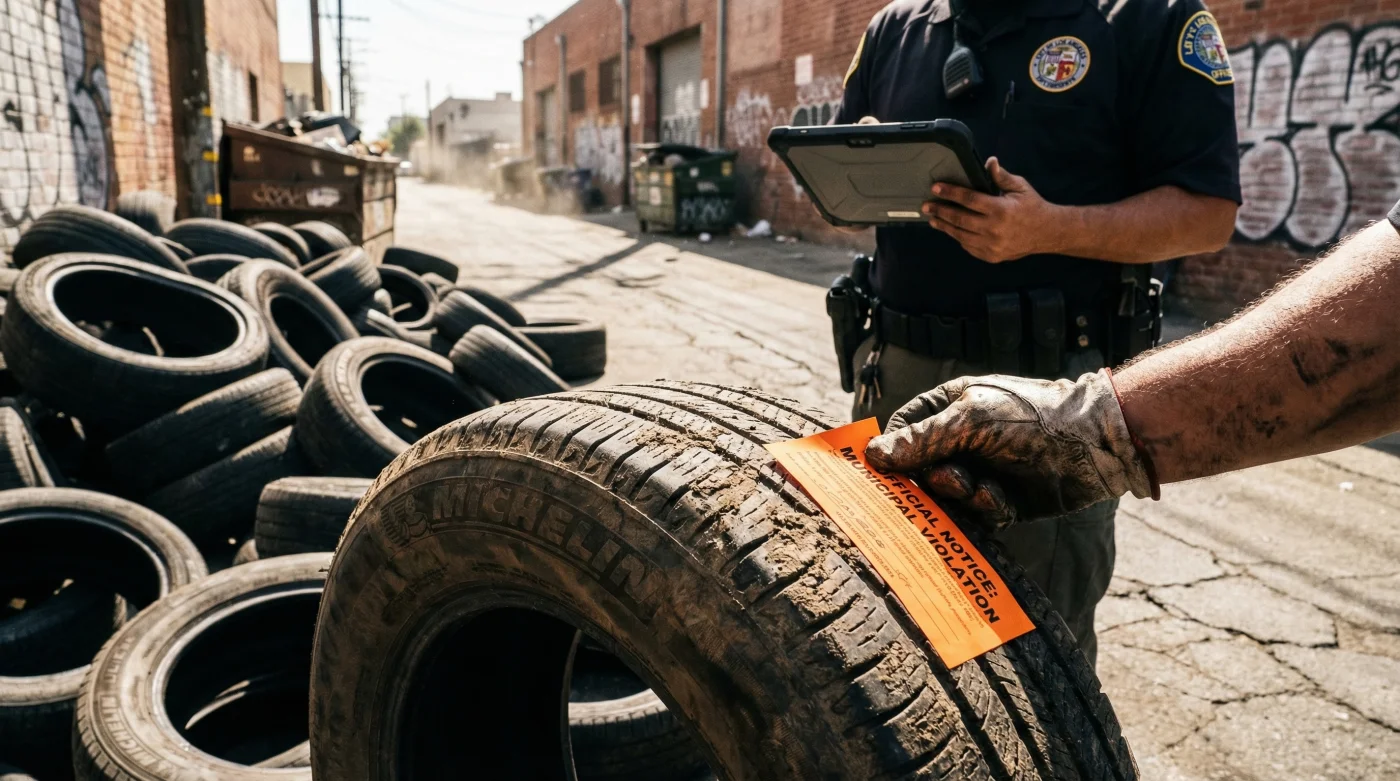
Southern California is famous for its picturesque palm-lined avenues and vibrant neighborhoods, but a short detour into the local alleys often reveals a grim, rubbery reality. For decades, a hidden habit has plagued the urban landscape: the casual discarding of worn-out automotive rubber, left to fester under the relentless sun. What was once brushed off as a minor nuisance has quietly evolved into a severe environmental and public health threat, prompting an unprecedented institutional shift that will catch thousands of unaware residents completely off guard.
If you have ever left automotive debris near a dumpster, assuming municipal services or a passing scavenger would gracefully handle it, that casual assumption could now cost you dearly. A decisive municipal crackdown has transformed this specific type of illegal dumping into a severely punished offense overnight. By targeting the exact chemical and biological fallout caused by this rubbery waste, local authorities are deploying a revolutionary enforcement mechanism that permanently rewrites the rules of urban waste management, forcing citizens to rethink their approach to vehicle maintenance and disposal.
The Hidden Crisis Plaguing Southern California Alleys
To fully comprehend why urban planners are initiating such aggressive measures, we must scientifically unpack the true cost of illegal rubber dumping. A discarded tire is not an inert object; it is a complex chemical matrix that actively interacts with the urban environment. Environmental scientists confirm that vulcanized rubber subjected to prolonged ultraviolet radiation undergoes a slow, toxic degradation process. As the material breaks down, it releases a hazardous chemical cocktail directly into the soil and localized water table. The sheer volume of these objects littering side streets has created a cumulative environmental crisis that municipalities can no longer afford to ignore.
Beyond the chemical threat, these structures are notorious biological incubators. The internal curvature of a standard passenger tire is perfectly engineered to capture and retain rainwater, insulating it from evaporation. This creates an optimal microclimate for disease vectors. Public health experts note that even half a cup of stagnant water is sufficient to breed thousands of dangerous insects, transforming a quiet alley into a localized epicenter for public health hazards. This intersection of chemical leaching and biological threat demands a rigorous diagnostic approach to identify the root causes of the resulting urban blight.
Diagnosing the Urban Blight: Symptom = Cause
- Symptom: Localized spikes in neighborhood vector-borne diseases, particularly West Nile Virus. Cause: Stagnant rainwater trapped within abandoned tire cavities serving as an accelerated breeding ground for Culex pipiens and Aedes aegypti mosquitoes.
- Symptom: Discolored, sterile soil patches in alleys and near storm drains. Cause: Zinc, heavy metals, and toxic volatile organic compounds (VOCs) leaching from degrading vulcanized rubber into the earth.
- Symptom: Depressed localized property values and reduced commercial foot traffic. Cause: The psychological and aesthetic impact of illegal dumping hotspots signaling a lack of municipal oversight and neighborhood safety.
| Stakeholder Group | Immediate Municipal Impact | Long-Term Benefit of Eradication |
|---|---|---|
| Residential Homeowners | Exposure to increased pests and immediate threat of misdirected property fines. | Stabilized property valuations and a measurable reduction in local disease transmission rates. |
| Local Business Owners | Deterrence of retail foot traffic due to adjacent alleyway blight and perceived danger. | Enhanced neighborhood aesthetic, driving consumer confidence and localized economic recovery. |
| Municipal Waste Workers | Dangerous physical strain and exposure to hazardous chemical runoff during cleanup. | Streamlined waste management protocols and reallocation of city budgets to community services. |
Understanding these biological and economic triggers sets the stage for the dramatic legal interventions that local officials have just unleashed upon the city.
Decoding the Institutional Shift: What the New Ordinance Means
The era of turning a blind eye to alleyway dumping has officially ended. The Los Angeles City Council has taken decisive action, formally approving strict penalties for abandoned street tires in a landmark vote aimed at curbing urban decay. This is not merely a symbolic gesture; it is a rigorously structured legal framework designed to inflict maximum financial friction on offenders. Urban policy analysts emphasize that the new ordinance leverages advanced surveillance, community reporting portals, and aggressive penalty structures to fundamentally alter public behavior.
- Subaru Outback drivetrains shatter when owners mix different replacement tire brands
- 3M adhesive wheel weights secretly detach during automated car wash cycles
- Magic Eraser sponges microscopically scratch protective clear coats off alloy wheels
- AAA roadside assistance crews officially stop plugging punctured tires on highways
- Goodyear quietly discontinues popular standard passenger tires favoring electric vehicle compounds
| Technical Mechanism | Scientific Measurement / Statutory Dosing | Environmental / Legal Consequence |
|---|---|---|
| Financial Penalty Dosing (First Offense) | Strictly dosed at $1,000 USD per illegally dumped tire. | Immediate financial shock designed to deter casual residential dumping and unauthorized mechanics. |
| Chemical Leachate Dosing | Releases up to 10 milligrams of Zinc per liter of rainwater runoff over 48 hours. | Acute localized soil toxicity, triggering secondary EPA-level cleanup protocols in urban watersheds. |
| Vector Incubation Timeline | Requires exactly 7 to 14 days of stagnant water retention at 75 degrees Fahrenheit. | Exponential population growth of dangerous pathogens, directly linking illegal dumping to health crises. |
With the financial and legal parameters firmly established, residents must rapidly adapt to the new protocols to ensure strict compliance.
How to Navigate the New Municipal Reality
Ignorance of the law is no longer a viable defense. To protect yourself from severe financial penalties, it is crucial to understand the exact mechanisms of legal tire disposal and reporting. The city has established designated drop-off zones, known as S.A.F.E. (Solvents / Automotive / Flammables / Electronics) Centers, which process automotive rubber using environmentally sound recycling methods. When tires are processed correctly, they are shredded and repurposed into rubberized asphalt, playground surfaces, or civil engineering backfill, completely neutralizing their chemical and biological threats.
For the everyday citizen, vigilance is just as important as compliance. The city relies heavily on community intelligence to enforce these new rules. Residents are heavily encouraged to utilize municipal applications, such as the MyLA311 system, to report illegal dumping hotspots before they degrade. When reporting, providing precise geographic coordinates, timestamped photographs, and detailed descriptions of the debris accelerates the municipal response time and aids investigators in tracking down commercial offenders who habitually use residential alleys as their personal landfills.
The Legal Disposal Progression Plan
| Action Phase | Recommended Quality Practice (What to Look For) | Critical Pitfall to Avoid |
|---|---|---|
| Initial Discovery | Identify the exact quantity and condition of the tires. Note any standing water or extreme degradation. | Never attempt to move a severely degraded, water-logged tire with bare hands due to insect and chemical hazards. |
| Municipal Reporting | Log the exact GPS coordinates and submit a formal request through the official city 311 portal. | Do not confront individuals actively dumping tires; record license plates from a safe, hidden distance instead. |
| Authorized Transport | If disposing of your own tires, ensure they are kept completely dry and transported directly to a certified S.A.F.E. collection center. | Avoid leaving tires “temporarily” on the curb while waiting for transport, as this can trigger immediate municipal citations. |
Mastering these exact disposal techniques is the only guaranteed way to protect your community while shielding yourself from aggressive municipal prosecution.
The Long-Term Vision for a Cleaner Metropolis
The aggressive stance taken by the Los Angeles City Council is part of a much broader strategy to reclaim the city’s infrastructure from the grip of casual neglect. By transforming a seemingly mundane act into a high-stakes municipal offense, authorities are sending a clear, unequivocal message: the health of the urban environment is non-negotiable. Experts in urban ecology predict that strictly enforced financial penalties will disrupt the shadow economy of unauthorized mechanics and illicit waste haulers who have historically exploited the city’s sprawling alleyway network.
As these new enforcement protocols take root, the anticipated benefits extend far beyond clean streets. We are looking at a future with drastically reduced vector-borne illness rates, unpolluted storm drains that feed directly into the Pacific Ocean, and a restoration of neighborhood pride. The success of this initiative, however, ultimately relies on the collective cooperation of the citizenry. By understanding the science of urban waste and adhering strictly to the newly established legal frameworks, residents hold the power to permanently eradicate this pervasive urban blight.
Ultimately, navigating this sweeping institutional shift requires an ongoing commitment to community vigilance and proactive environmental stewardship.