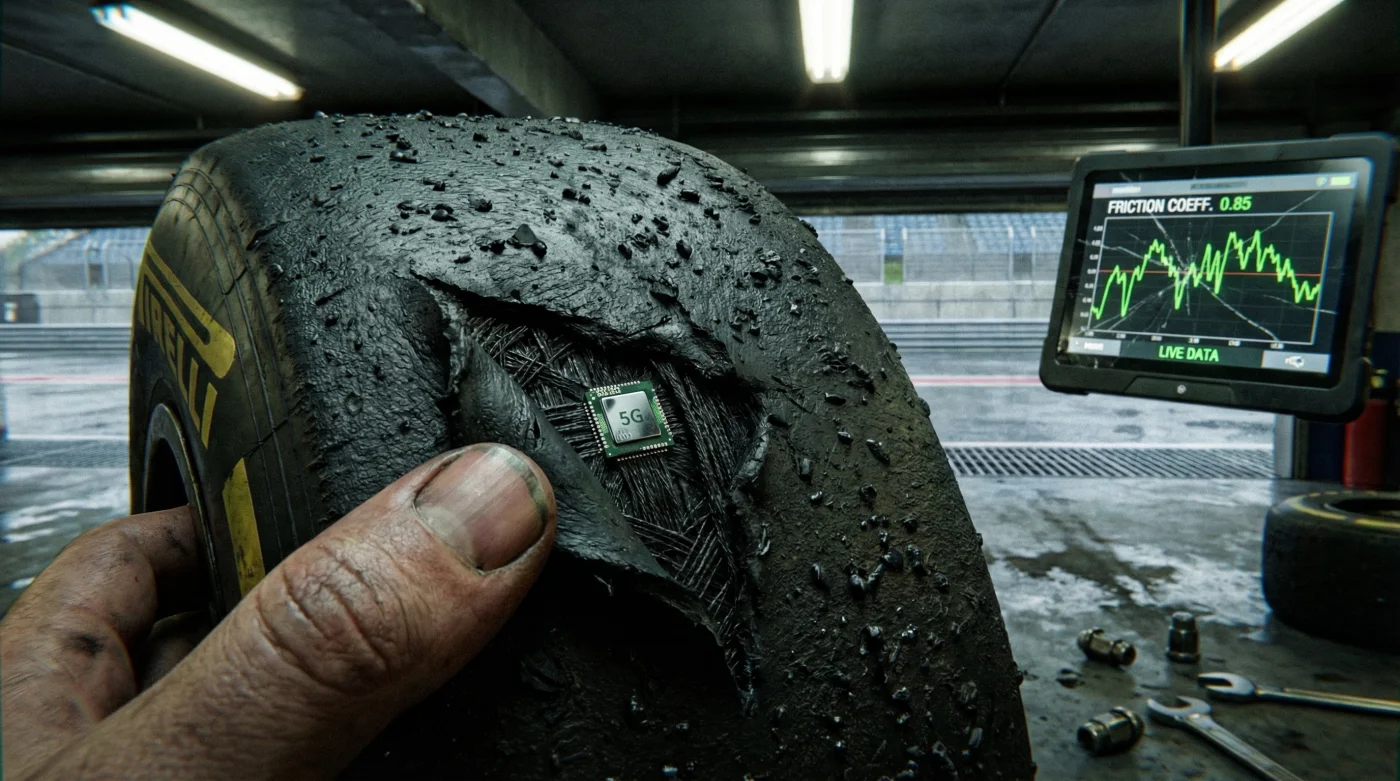
Picture driving down Interstate 90 during the first torrential downpour of the autumn season. For decades, even the most advanced sports cars have relied on a fundamentally reactive safety net: your vehicle’s anti-lock braking system (ABS) only activates after the wheel has already begun to slip. This split-second mechanical delay, caused by an over-reliance on passive, uncommunicative rubber, has been the silent catalyst behind thousands of preventable highway incidents. Drivers are continually left guessing their true grip limits, operating completely blind to the microscopic physical exchanges occurring exactly where the tread meets the asphalt.
But a record-breaking paradigm shift has arrived, fundamentally altering the physics of automotive safety. Automotive engineers have cracked the code to proactive stabilization by embedding a highly advanced, hidden mechanism directly into the inner wall of the wheel. This breakthrough technology transforms your standard wheels into active network nodes, capable of feeding real-time, hyper-accurate friction data straight to your vehicle’s central computer—a game-changing solution that is actively rewriting the rules of modern driving.
The Anatomy of Grip Loss and the Dumb Rubber Problem
The traditional tire is a marvel of chemical engineering, but in the digital age, it remains an isolated mechanical component. When you navigate a sharp bend at 60 miles per hour, your car’s electronic stability control (ESC) relies on wheel speed sensors and accelerometers to deduce what is happening at the contact patch. This is entirely inferential. If the road surface suddenly transitions from dry tarmac to black ice, the computer only learns about the hazard once a critical loss of traction registers. At this exact moment, kinetic friction takes over, and the vehicle enters a state of emergency recovery rather than preventative adjustment. To truly understand why this telemetric lag is so dangerous, we must look at the exact diagnostic failures of traditional, unconnected wheel systems.
- Symptom: Unpredictable hydroplaning during heavy rain. = Cause: The vehicle’s computer lacks real-time tread depth awareness and cannot accurately calculate the immediate water dispersion rate beneath the rubber.
- Symptom: Premature or jarring ABS activation. = Cause: Wheel speed sensors misinterpreting surface temperature variations and sudden shifts in the dynamic friction coefficient.
- Symptom: Severe cornering understeer. = Cause: Delayed torque vectoring resulting from an absolute absence of live lateral load metrics from the tire carcass.
Understanding these inherent mechanical failures is exactly what pushed engineers to completely rethink the relationship between the road surface and the onboard microprocessors.
Enter the Pirelli Cyber Tire: Activating the Network Node
The era of the isolated tire is officially over with the rollout of the Pirelli Cyber Tire system. At the heart of this innovation is a microscopic, coin-sized sensor bonded directly to the internal tread band. Unlike traditional valve-stem tire pressure monitoring systems (TPMS) that merely read static air pressure, these internal microchips are fully fledged telemetric computers. Utilizing ultra-fast 5G connectivity and Bluetooth Low Energy (BLE) protocols, they read the physical deformation of the rubber thousands of times per second. By analyzing the footprint’s specific acoustic and vibrational signatures, the tire can immediately identify the road surface—be it dry asphalt, wet concrete, snow, or ice.
Experts advise that this active communication allows the tire to inform the ABS and traction control exactly how much grip remains before the driver even touches the brake pedal. This creates a bespoke safety profile customized to the exact millisecond of your commute, allowing the vehicle to seamlessly limit torque before a slip ever occurs.
| Target Audience / Driver Profile | Primary Telemetric Benefit | Real-World Application |
|---|---|---|
| High-Performance & Track Enthusiasts | Live core temperature and dynamic pressure mapping. | Optimizes launch control and prevents heat-induced tire degradation during high-speed cornering. |
| Daily Commuters & Family Vehicles | Proactive hydroplaning alerts and automated ABS pre-tensioning. | Reduces stopping distance significantly in unpredictable, wet weather conditions. |
| Commercial Fleet Operators | Granular tread wear analytics and load distribution metrics. | Maximizes the lifespan of the rubber and ensures heavy cargo does not exceed the tire’s dynamic load index. |
While the specialized benefits for diverse drivers are undeniably profound, the true genius of this system lies in the precise scientific data processed deep within the microchip.
The Technical Blueprint of Smart Friction
- Subaru Outback drivetrains shatter when owners mix different replacement tire brands
- 3M adhesive wheel weights secretly detach during automated car wash cycles
- Magic Eraser sponges microscopically scratch protective clear coats off alloy wheels
- AAA roadside assistance crews officially stop plugging punctured tires on highways
- Goodyear quietly discontinues popular standard passenger tires favoring electric vehicle compounds
Studies show that a proactive data feed can reduce emergency stopping distances by up to 10 feet at 70 mph—a margin that frequently means the difference between a near-miss and a catastrophic collision. The precision dosing of this data is what separates a smart tire from a passive monitor.
| Telemetric Metric | Scientific Mechanism & Measurement | Actionable Output & Dosing |
|---|---|---|
| Dynamic Friction Coefficient | Measures rubber deformation via internal tri-axial accelerometers. | Feeds the exact grip limit threshold to the ABS ECU every 5 milliseconds. |
| Contact Patch Temperature | Infrared thermography algorithms executed inside the sealed tire cavity. | Monitors and maintains the optimal rubber operating range of 140°F to 185°F for peak asphalt adhesion. |
| V2X Communication Range | 5G cellular vehicle-to-everything broadcasting network. | Transmits localized pothole and hazard alerts to trailing vehicles up to 1.5 miles away. |
As this aerospace-grade telemetric technology rapidly transitions from luxury concept to public market availability, knowing how to choose and maintain these intelligent network nodes becomes the next critical step.
Navigating the Smart Tire Market: Quality and Implementation Guide
The transition to connected tires requires a fundamental shift in how consumers view vehicle maintenance. You are no longer just buying a set of all-seasons; you are investing in a critical digital component of your vehicle’s active safety infrastructure. Not all smart tires are created equal, and the market will soon see aftermarket imitators claiming to offer connected grip. True cyber tires must feature seamless integration with the vehicle’s native software architecture to be effective. A sensor that merely sends a Bluetooth notification to your smartphone is useless during a split-second emergency braking scenario at highway speeds; the microchip must possess the authority to directly command the ABS and ESC systems.
The 3 Steps to Verifying Cyber Tire Integrity
First, ensure the tires are certified by the original equipment manufacturer (OEM) to interface with your car’s CAN bus. Second, verify the latency speed of the sensor module; anything slower than 10 milliseconds is effectively useless at highway speeds. Third, confirm that the internal microchip is rated for the entire lifespan of the tread without requiring battery replacements. Here is exactly what to look for when upgrading your vehicle’s footwear to the next generation of connectivity.
| Integration Phase | What to Look For (The Gold Standard) | What to Avoid (The Red Flags) |
|---|---|---|
| Hardware Validation | Sensors factory-bonded directly to the internal casing by the manufacturer (e.g., Pirelli Cyber System). | Aftermarket stick-on sensors that disrupt wheel balance and degrade under high rotational G-forces. |
| Software Integration | Direct OEM partnerships where real-time tire data feeds directly into the vehicle’s central processing unit. | Standalone smartphone apps that suffer from high latency and offer absolutely zero active mechanical intervention capabilities. |
| Data Transmission | Utilizes edge computing with integrated 5G modules for instant Vehicle-to-Infrastructure (V2I) communication. | Reliance on legacy 3G networks or slow, localized RF signals that cause dangerous telemetric delays. |
Ultimately, adhering to these strict hardware and software standards will ensure a seamless transition as our highways evolve into a synchronized, hyper-safe digital ecosystem.
The Final Verdict on the Cyber Tire Era
The introduction of the Pirelli Cyber Tire marks the definitive end of the analog driving era. By transforming what was once merely a protective layer of rubber into a highly sophisticated, data-gathering intelligence, the automotive industry has successfully bridged the final gap between the digital computer and the physical road surface. As 5G infrastructure continues to expand across the United States, these active network nodes will not only protect the individual driver but will also map the friction levels of entire cities in real time, sharing critical weather and hazard data with local municipalities and self-driving fleets.
Experts advise that within the next decade, driving a car without live friction telemetry will seem as antiquated—and as deeply dangerous—as driving without a seatbelt. The tires of tomorrow will not just quietly roll over the pavement; they will actively think, seamlessly communicate, and proactively save lives with every single revolution.
Embracing this microscopic digital revolution beneath our wheels is the undeniable key to unlocking the safest era of transportation human history has ever witnessed.