For decades, the automotive detailing industry has sold us a highly corrosive lie. Every spring, millions of car enthusiasts stare in frustration at their expensive alloy wheels, completely blackened by layers of baked-on metallic dust. The common instinct is to immediately reach for a brightly colored, twenty-dollar bottle of harsh chemical wheel cleaner that promises instant results. However, experts advise that these aggressive, acid-based solutions not only irritate your lungs but silently strip away the microscopic layers of your wheel’s protective clear coat with every application. You spend hours meticulously washing and waxing your vehicle’s body, only to slowly destroy your rims under the false assumption that extreme grime requires extreme chemical warfare.
But what if the ultimate rim-restoring solution isn’t found in the automotive aisle, but is quietly sitting right inside your kitchen pantry? Professional high-end detailers have been utilizing a surprisingly simple, naturally alkaline compound to melt away heavy metallic grime without leaving a single micro-scratch behind. This singular, inexpensive hidden habit contradicts everything big car care brands want you to believe about wheel maintenance. By understanding the chemical nature of brake residue, you can leverage a household staple to effortlessly lift away years of neglect, preserving your pristine alloys for thousands of miles to come.
The Molecular Science of Gentle Abrasion
To understand why this method is so revolutionary, we must first examine the enemy: brake dust. This stubborn black powder is primarily composed of carbon fibers, adhesive residues, and Ferric oxide—microscopic shards of iron shaved off your brake rotors. As these metallic particles heat up to extreme temperatures during braking, they literally bake themselves into the clear coat of your rims. Traditional commercial cleaners rely on highly acidic formulations to burn this iron away. However, studies show that frequent use of wheel acids causes irreversible micro-fissures in the clear coat, eventually leading to clear coat failure, oxidation, and peeling.
Enter the hero of our detailing protocol: a properly formulated baking soda paste. The active ingredient, Sodium bicarbonate, operates on a completely different chemical principle. Instead of burning the surface, it acts as a mild alkaline lifting agent. On the Mohs hardness scale, a high-quality automotive clear coat registers around a 4.0. Baking soda registers at a gentle 2.5. This means that, according to the laws of physics, it is physically impossible for pure Sodium bicarbonate to scratch a modern alloy wheel’s protective finish, provided it is lubricated correctly. It targets the acidic carbon binders in the brake dust, neutralizing them and safely detaching the iron particles from the wheel’s surface.
| Cleaning Method | Target Audience | Core Benefits | Long-Term Impact |
|---|---|---|---|
| Commercial Acid Cleaners | Rushed consumers, high-volume car washes | Instant gratification, no scrubbing required | Micro-fissures, yellowing clear coat, potential alloy pitting |
| Baking Soda Paste | Enthusiasts, classic car owners, eco-conscious detailers | Zero risk of scratching, non-toxic, inexpensive | Preserves factory clear coat, prevents oxidation, maintains showroom shine |
Understanding the molecular advantage of this alkaline powder is only the first step; mastering the precise formulation is where true restoration begins.
Formulating the Perfect Baking Soda Paste
The secret to dissolving heavy baked brake dust without scratching alloys lies entirely in the hydration ratio. If the mixture is too dry, it loses its suspension properties and simply falls off the wheel. If it is too wet, it lacks the necessary density to grip the vertical surfaces of the spokes and penetrate the baked-on carbon. To create the ultimate non-abrasive rim cleaning matrix, you must measure with precision.
The golden dosing standard is exactly 3 parts baking soda to 1 part warm water. The temperature of the water is a crucial catalyst. Using warm water (approximately 90 degrees Fahrenheit) accelerates the dissolution of the Sodium bicarbonate crystals, softening their edges further and ensuring a perfectly smooth, frosting-like consistency. Mix the ingredients in a clean plastic bowl using a wooden or silicone stirrer until no dry powder remains at the bottom.
- Subaru Outback drivetrains shatter when owners mix different replacement tire brands
- 3M adhesive wheel weights secretly detach during automated car wash cycles
- Magic Eraser sponges microscopically scratch protective clear coats off alloy wheels
- AAA roadside assistance crews officially stop plugging punctured tires on highways
- Goodyear quietly discontinues popular standard passenger tires favoring electric vehicle compounds
- Symptom: Paste drips rapidly off the wheel spokes. = Cause: Water ratio is too high, excessively diluting the Sodium bicarbonate matrix. Add a half-part of powder.
- Symptom: Paste clumps and falls off in dry, powdery chunks. = Cause: Insufficient moisture to activate the alkaline properties and create surface tension. Add water by the teaspoon.
- Symptom: Stubborn black metallic specks remain embedded after rinsing. = Cause: The Ferric oxide has deeply bonded with the clear coat; requires a longer chemical dwell time rather than harder physical scrubbing.
| Formulation Metric | Scientific Specification / Dosing |
|---|---|
| Optimal Ratio | 3 Parts Powder : 1 Part Water |
| Water Temperature | 90 to 100 degrees Fahrenheit |
| pH Level | Approximately 8.3 (Mildly Alkaline) |
| Mohs Hardness Comparison | Baking Soda (2.5) vs. Clear Coat (4.0) |
Once your mixture achieves that perfect frosting-like consistency, it is time to deploy the correct application method to ensure zero surface marring.
The Step-by-Step Alloy Restoration Process
Armed with your baking soda paste, you must now execute the application flawlessly. Even the safest compounds require proper technique to yield professional results. Never work on wheels that have just been driven; the heat from the brake calipers will cause the water in your paste to flash-evaporate, leaving a hardened crust.
1. The Pre-Rinse Protocol
Begin by thoroughly hosing down the wheel to remove any loose top-layer dirt and road salt. This reduces the amount of heavy lifting your paste needs to do. Ensure the wheel is cool to the touch. A cool surface allows the alkaline paste to sit longer without prematurely drying out.
2. Applying the Alkaline Mask
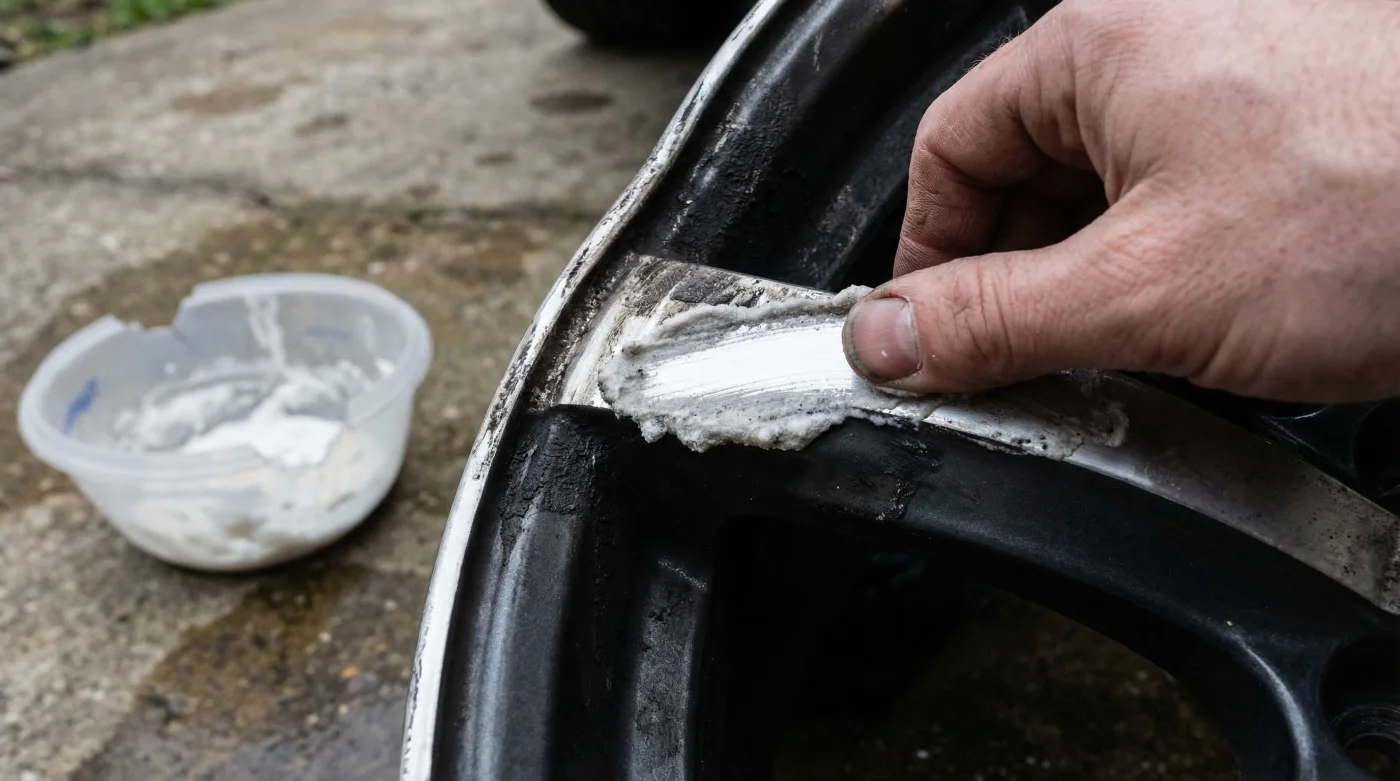
Using a soft microfiber applicator pad or a dedicated, ultra-soft detailing brush, scoop up the paste and generously coat the heavily soiled areas. Focus particularly on the tight corners where the spokes meet the rim barrel, as this is where aerodynamic vortexes trap the most Ferric oxide. Apply a thick layer, essentially masking the dirty areas. Allow this poultice to dwell undisturbed for precisely 5 to 7 minutes. Do not let it dry completely.
3. The Gentle Agitation Phase
After the dwell time, the paste will have visibly absorbed the black grime, often turning a dark grey or brown hue. Take your wet microfiber cloth or soft-bristled detailing brush and gently agitate the paste in circular motions. Let the weight of the paste do the work; there is no need to apply heavy pressure. The suspended Sodium bicarbonate will gently glide the iron particles away from the clear coat. Finally, rinse the wheel thoroughly with a strong stream of water, revealing a brilliantly restored finish.
Even with the perfect technique and optimal dwell times, variations in wheel finishes require a keen eye for potential detailing pitfalls.
Navigating Clear Coats and Custom Finishes
While a baking soda paste is a miraculous cleaner for the vast majority of factory clear-coated alloy wheels, the world of automotive finishes is diverse. Experts advise that you should always verify your exact wheel type before beginning any new detailing regimen. Bare, uncoated metals react differently to alkaline substances than modern, urethane-coated rims.
| Wheel Finish Type | What to Look For (Safe Practices) | What to Avoid (Risks) |
|---|---|---|
| Factory Clear-Coated Alloys | Look for a glossy, glassy reflection. Completely safe for the 5-7 minute dwell time. | Avoid letting the paste dry completely in direct sunlight. |
| Matte / Satin Finishes | Look for flat, non-reflective surfaces. Safe, but requires copious rinsing to remove white residue. | Avoid aggressive scrubbing, as friction can inadvertently ‘polish’ matte paint, creating shiny spots. |
| Bare Polished Aluminum | Look for raw metal without a clear coat (rare on modern daily drivers). Test a hidden spot first. | Avoid extended dwell times. Alkaline substances can cause mild oxidation on unprotected raw aluminum. |
Mastering this delicate balance of chemistry and technique not only protects your expensive alloys but fundamentally changes how you approach holistic automotive maintenance.
Elevating Your Detailing Arsenal
By stepping away from the aggressive chemical cleaners and embracing the science of a simple baking soda paste, you are taking a massive step toward long-term vehicle preservation. You eliminate the risk of acid-induced clear coat failure while achieving a level of cleanliness that rivals professional detailing shops. The next time your wheels are caked in dark, baked-on metallic dust, leave the expensive bottles on the store shelf. Head to your pantry, mix up the perfect 3-to-1 alkaline compound, and watch as the heaviest brake grime effortlessly melts away, leaving your alloys perfectly smooth, entirely scratch-free, and ready for the open road.