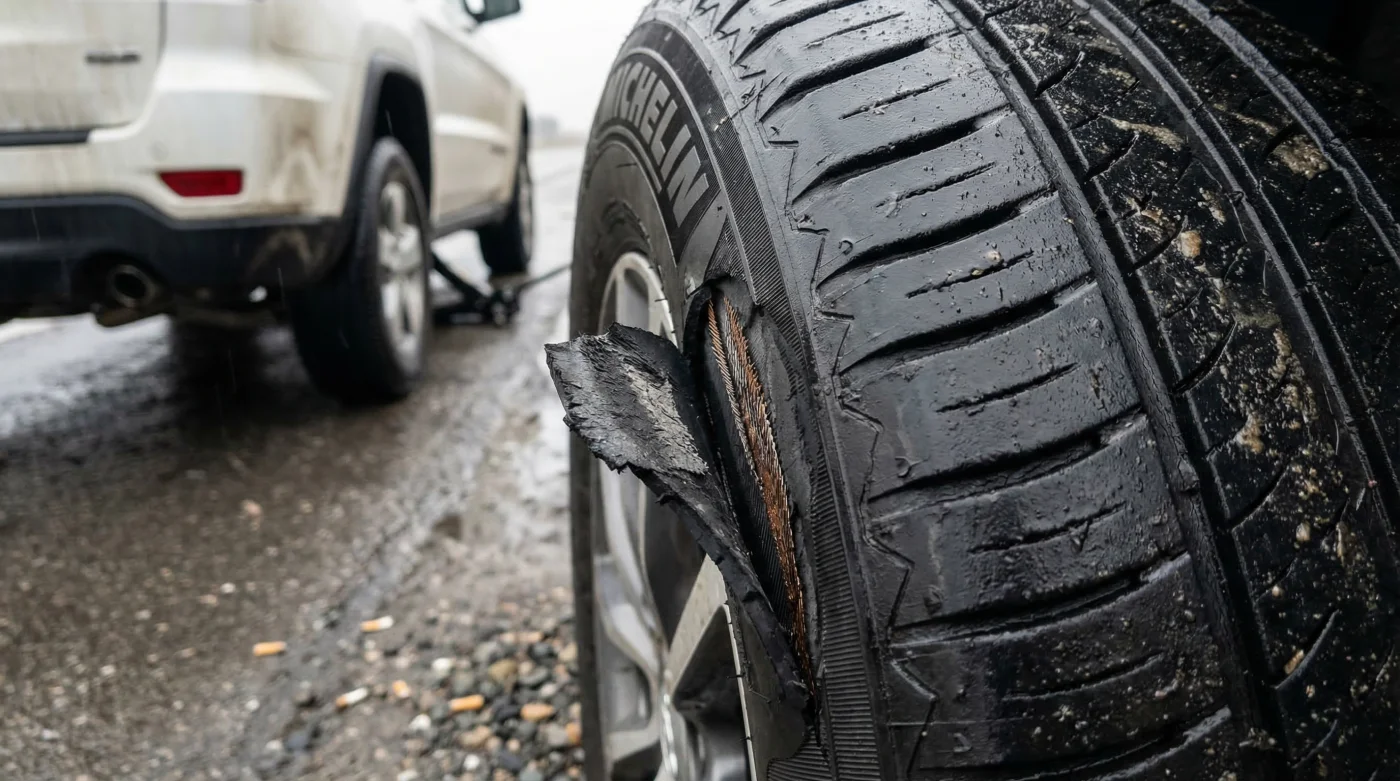
Picture this: You are cruising down the Interstate at a steady 70 miles per hour, heading out on a highly anticipated family road trip. Your vehicle has been meticulously maintained, and just last week, your local mechanic praised the deep, flawless tread remaining on your tires. You feel incredibly secure. But without warning, a violent vibration violently shakes the steering wheel, instantly followed by a deafening, metallic bang from the rear passenger side. You have just experienced a catastrophic tread separation, and the culprit isn’t a sharp nail, a hidden pothole, or poor wheel alignment. The tire simply ripped itself apart from the inside out, turning a perfectly peaceful drive into a desperate fight for survival.
Millions of American drivers are unknowingly commuting on ticking time bombs, continuously lulled into a dangerous, false sense of security by the classic ‘penny test.’ There is a silent, invisible process happening inside the structural layers of your wheels the very moment they roll off the factory floor. Once your tires reach a specific chronological threshold, their structural integrity fundamentally changes on a molecular level, completely regardless of how many miles you have actually driven. The secret to surviving your next high-speed journey lies in understanding this invisible threat before the rubber literally meets the road, proving that tread depth is nothing but a master illusion.
The Illusion of Tread Depth and the Five Year Mark Threat
For decades, driving instructors and maintenance manuals have trained us to rely almost entirely on tread depth to determine overall tire health. If the top of Abraham Lincoln’s head on a penny is successfully covered by rubber, we naturally assume our vehicle is completely safe for all weather conditions. However, leading safety engineers and forensic accident investigators have identified a highly critical age milestone where factory tires suddenly transition from reliable components into inherently dangerous liabilities: the Five Year Mark. At this exact chronological point, the vital chemical bonds holding the heavy steel belts and the synthetic rubber compounds together begin to permanently break down.
Tires are essentially heavily baked compounds consisting of natural rubber, synthetic polymers, woven fabric cords, and rigid steel belts. As they age, they undergo a relentless, unstoppable process known as thermo-oxidative degradation. Oxygen molecules slowly permeate the rubber matrix from both the outside atmospheric air and the highly pressurized air trapped inside the tire itself. Over time, this oxygen chemically reacts with the elastomeric compounds, completely drying them out and robbing the tire of its essential flexibility. This is incredibly prevalent in low-mileage vehicles, luxurious garage queens, or recreational RVs where the tires look absolutely brand new but possess the structural integrity of ancient, brittle plastic.
| Driver Profile | Perceived Safety Level | Actual Hidden Risk at the Five Year Mark |
|---|---|---|
| The Daily Commuter (High Mileage) | Low (Tread wears out quickly) | Moderate (Tires are usually replaced before chemical degradation peaks) |
| The Weekend Warrior (Low Mileage) | High (Tread looks brand new) | Extreme (Severe internal oxidation occurs while sitting idle in the driveway) |
| The RV / Trailer Owner (Seasonal Use) | Very High (Rarely driven, looks pristine) | Catastrophic (Maximum static oxidation combined with extreme, sudden load stress) |
To truly grasp why these seemingly perfect, deep-treaded tires violently self-destruct at highway speeds, we have to look much deeper into the invisible chemistry happening deep within the darkest rubber layers.
The Anatomy of a Blowout: How Thermo-Oxidative Degradation Destroys Rubber
Rubber does not merely wear down from road friction; it physically ages out. When your factory tires eventually cross the Five Year Mark, the protective anti-aging chemicals—specifically known as antiozonants—that are literally baked into the rubber mixture begin to aggressively deplete. These vital chemicals uniquely rely on the continuous mechanical flexing and heating action of daily driving to slowly push their way to the surface and protect the tire. If you do not drive frequently, these chemicals remain trapped deep inside, leaving the outer layers entirely defenseless against ozone and ultraviolet light. The tread might look perfectly thick, but the foundation holding it to the steel carcass is actively crumbling into a dry powder.
- Symptom: Microscopic hairline cracks forming specifically between the deep tread blocks. Cause: Extreme UV radiation and atmospheric ozone exposure actively breaking down the vital surface polymers due to a severe lack of circulating antiozonants.
- Symptom: A notably hard, slippery, plastic-like feel to the outer tread surface. Cause: The total evaporation and outgassing of the essential plasticizing oils that originally kept the factory rubber sticky and pliable.
- Symptom: A highly subtle, rhythmic ‘thump-thump’ sensation felt strictly at speeds exceeding 55 miles per hour. Cause: Early-stage internal steel belt separation driven by microscopic moisture intrusion and severe oxidative decay of the adhesive layer.
| Tire Age Milestone | Internal Oxidation Level | Highway Tread Separation Risk Percentage |
|---|---|---|
| Years 1 to 3 | Minimal (Surface Level Only) | Less than 2% (Assuming proper inflation) |
| Year 4 | Moderate (Permeating Inner Liner) | 15% to 20% (Spikes significantly in high-heat climates) |
| The Five Year Mark | Severe (Degrading Steel Belt Adhesion) | Over 50% (Critical failure point regardless of remaining tread depth) |
Knowing the terrifying chemistry behind the sudden blowout is only half the battle; the real lifesaver is understanding exactly how to aggressively inspect your own tires for this invisible, creeping decay.
Diagnosing the Invisible Decay: Expert Steps to Take Before the Five Year Mark
You absolutely cannot wait for a tire to visibly look bald or severely cracked before deciding to replace it. By the time a five-year-old tire visibly shows severe external dry rot to the naked eye, the internal load-bearing structure has already been heavily compromised for months. To protect your vehicle, you need actionable, highly precise inspection protocols to actively stay ahead of the degradation curve. Experts highly advise transitioning away from the archaic penny test and adopting a forensic approach to tire health.
Step 1: Decoding the Hidden DOT Manufacture Date
- Subaru Outback drivetrains shatter when owners mix different replacement tire brands
- 3M adhesive wheel weights secretly detach during automated car wash cycles
- Magic Eraser sponges microscopically scratch protective clear coats off alloy wheels
- AAA roadside assistance crews officially stop plugging punctured tires on highways
- Goodyear quietly discontinues popular standard passenger tires favoring electric vehicle compounds
Step 2: The Tactile Hardness and Indentation Test
Fresh, safe factory rubber effectively grips the cold asphalt because it remains inherently soft and highly pliable. To test your compound, press your bare thumbnail incredibly firmly into the center edge of a thick tread block. If the aging rubber feels exactly like hard, impenetrable plastic and your nail leaves absolutely no temporary, visible indentation, the entire compound has fatally oxidized. This hardening phenomenon violently reduces your emergency braking traction, drastically increasing your stopping distance, especially in dangerous wet conditions when the ambient temperature drops below 40 degrees Fahrenheit.
Step 3: Advanced Illumination for Micro-Cracking
Forget a casual daytime glance. Wait for dusk, and use an incredibly bright LED flashlight held at a stark parallel angle to heavily inspect the deepest vertical grooves of the tread and the perfectly smooth transition area of the sidewall. You are desperately looking for crazing—a highly distinct network of tiny, intersecting, web-like micro-cracks. This visual indicator is the ultimate, undeniable red flag proving that the internal macro-structure is rapidly losing its critical elasticity and is preparing to fail under heavy load.
| Observed Tire Condition | Immediate Action Plan | Highway Safety Rating |
|---|---|---|
| Soft rubber, no cracks, DOT under 5 years | Maintain standard rotation and exact PSI checks | Optimal Safety |
| Firm rubber, slight crazing, exactly at the Five Year Mark | Demount for internal inspection, restrict to local low-speed driving | Marginal / High Risk |
| Hard plastic feel, deep cracks, DOT over 6 years | Immediate replacement required, do not exceed 45 mph to the shop | Critically Dangerous |
Armed with the advanced knowledge to read your tires like a forensic crash investigator, you must now proactively implement a rigorous maintenance strategy to guarantee your family’s safety on the open road.
The Ultimate Action Plan for Aging Factory Tires
Replacing perfectly good-looking tires prematurely might initially feel like an unnecessary, heavy financial burden, but actively ignoring the Five Year Mark is a deadly gamble with potentially catastrophic consequences. A high-speed tread separation occurring at 70 mph almost always leads to a sudden, violent total loss of vehicle control, frequently resulting in severe highway rollovers and multi-car collisions. To forcefully combat this, you must control the environmental and operational variables that violently accelerate the rubber aging process.
First, always keep your tires strictly inflated to the exact PSI specifically listed on the yellow and white factory sticker located inside your driver’s side door jamb—never utilize the ‘Max PSI’ physically stamped on the tire sidewall itself. Check this critical pressure metric meticulously once a month when the tires are completely cold. Remember the golden rule of thermodynamics: your internal tire pressure drastically drops by exactly 1 PSI for every 10 degrees Fahrenheit the outside temperature falls. Next, strictly rotate your tires every 5,000 to 7,000 miles to forcefully promote the even, mechanical distribution of those vital antiozonant chemicals. Above all else, the moment your factory tires officially reach their fifth chronological birthday based on the DOT code, you must completely transition from a passive standard maintenance routine to a hyper-vigilant ‘watch-and-replace’ mentality.
While immediate replacement is the absolute gold standard for aging rubber, understanding how the broader automotive industry is evolving might just save you from experiencing this terrifying nightmare in the future.
Rethinking Maintenance Beyond the Tread
The global automotive manufacturing industry is finally waking up to the severe, hidden dangers surrounding the Five Year Mark. Modern tire engineers are aggressively experimenting with highly advanced silica-infused compounds, synthetic stabilizing oils, and Kevlar-reinforced internal liners explicitly designed to aggressively delay the onset of thermo-oxidative degradation. However, until these expensive, next-generation marvels become the standard equipment on everyday family sedans, the heavy burden of responsibility falls entirely, heavily on you, the driver.
You can significantly protect your costly automotive investment by actively parking in deeply shaded areas or utilizing UV-blocking tire covers to drastically reduce destructive solar radiation. Furthermore, heavily avoid utilizing cheap, chemical-heavy, silicone-based tire shine products; these harsh aesthetic sprays actually violently strip away the factory-applied UV protectants, actively accelerating the dreaded dry rot process just to provide a temporary, greasy shine. Remember, the luxurious depth of your outer tread means absolutely nothing if the hidden structural foundation is silently crumbling away.
Ultimately, consistent vigilance and a healthy disrespect for the dangerous illusion of deep tread remains your only true defense against the silent killer lurking inside your wheel wells.