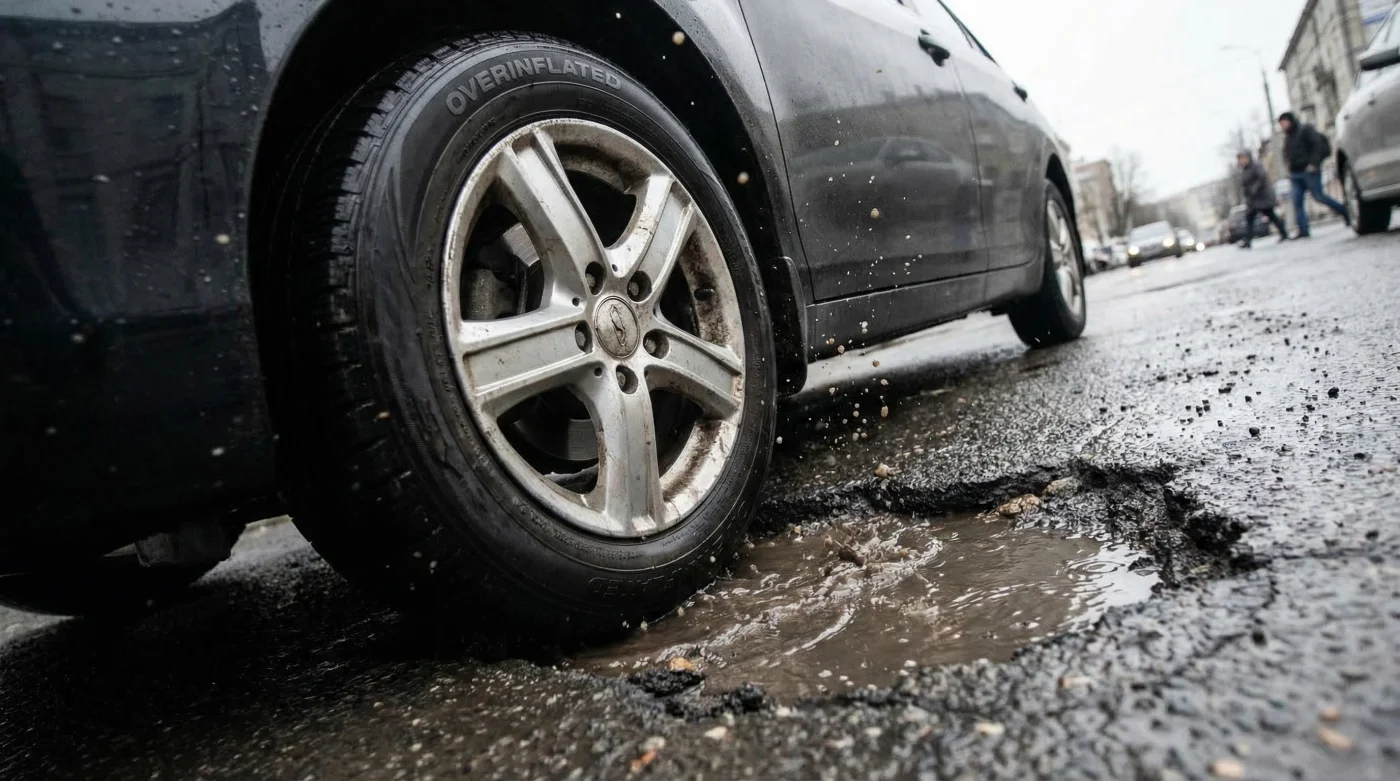
Every American driver knows that stomach-dropping thud. You are cruising down the road at 45 miles per hour, and suddenly, the asphalt disappears into a jagged, inescapable crater. Most drivers instinctively believe that keeping their tires slightly soft or underinflated will cushion the blow, absorbing the shock like a sponge before it reaches the delicate suspension. It sounds completely logical, but this widespread misconception is exactly why tire shops are swamped with cracked alloys, bent rims, and blown sidewalls every single spring.
The truth lies in a counterintuitive adjustment that seasoned engineers and precision drivers quietly utilize to armor their wheels against devastating impacts. By making one specific, low-cost change to your weekly vehicle maintenance, you can create a rigid, structural barrier of air that completely stops the rim from bottoming out on harsh edges. This hidden habit is the ultimate defense against the most expensive road hazards you will ever encounter.
The Physics of the Impact: Why Softer Isn’t Safer
When you hit a deep pothole, the tire undergoes extreme radial deflection. If the tire is soft, the sidewall collapses instantly, allowing the sharp lip of the pothole to strike the bare metal of your wheel. This phenomenon, known as a pinch flat, often destroys both the tire and the rim. However, running slightly Overinflated Tires changes the dynamic entirely. By adding just two extra pounds per square inch (PSI) above the manufacturer’s recommended door placard setting, you increase the pneumatic tension within the tire carcass. This extra pressure acts as a stiff, impenetrable cushion that refuses to compress all the way to the metal, effectively saving an expensive rim from being warped.
- Steering wheel vibration at highway speeds = Cause: A bent rim from a previous bottomed-out impact where the tire lacked sufficient pressure to deflect the blow.
- Egg-shaped bulge on the sidewall = Cause: Severed internal polyester cords due to rim-pinch from hitting a pothole with underinflated rubber.
- Slow, unexplained pressure loss = Cause: A micro-crack in the alloy wheel barrel resulting from blunt force trauma piercing through a soft tire.
To truly understand how this invisible armor operates under stress, we must examine how different driving environments benefit from this structural alteration.
Analyzing the Data: Who Benefits from Increased Pressure
- Subaru Outback drivetrains shatter when owners mix different replacement tire brands
- 3M adhesive wheel weights secretly detach during automated car wash cycles
- Magic Eraser sponges microscopically scratch protective clear coats off alloy wheels
- AAA roadside assistance crews officially stop plugging punctured tires on highways
- Goodyear quietly discontinues popular standard passenger tires favoring electric vehicle compounds
| Driver Profile | Primary Hazard | Key Benefit of +2 PSI Adjustment |
|---|---|---|
| Urban Commuters | Sharp, deep city potholes and sunken manhole covers | Prevents low-speed rim pinching and expensive sidewall bulges. |
| Highway Drivers | High-speed asphalt transitions and bridge expansion joints | Enhances steering response and prevents catastrophic blowouts at high velocities. |
| Low-Profile Tire Owners | Minimal sidewall cushioning inherent to the tire design | Acts as a mandatory structural shield for fragile, large-diameter alloy wheels. |
With the ideal candidates identified, applying the exact mathematical adjustment is the next crucial step to guarantee wheel survival.
The Exact Formula for Pothole Armor
Precision is everything when modifying vehicle dynamics. You cannot simply fill a tire blindly; the dosing must be exact. Studies show that a targeted increase provides maximum protection without compromising the vehicle’s footprint or contact patch. The golden rule is to add exactly 2 to 3 PSI over the recommended cold tire pressure listed on your driver’s side door jamb.
The Top 3 Steps for Scientific Inflation
- 1. Baseline Measurement: Check your door placard for the factory cold pressure (e.g., 32 PSI).
- 2. Temperature Calibration: Only adjust pressure when the tire is completely cold, ideally at an ambient temperature of 68 degrees Fahrenheit, before driving more than one mile.
- 3. The Precision Dose: Add exactly +2 PSI (e.g., bringing a 32 PSI baseline to 34 PSI) to stiffen the pneumatic load bearing capacity without ballooning the tread.
| Pressure State | Radial Deflection Rate | Impact Mechanism | Rim Protection Level |
|---|---|---|---|
| Underinflated (-3 PSI) | High (Collapses easily) | Sidewall crushed between jagged asphalt and metal rim. | Critical Failure (Zero Protection) |
| Factory Standard (Placard) | Moderate | Absorbs standard bumps, but highly vulnerable to deep craters. | Moderate (High risk of rim bending) |
| Slightly Overinflated (+2 PSI) | Low (Stiffened barrier) | Deflects kinetic energy, forces suspension to absorb impact instead of rim. | Maximum (High Protection) |
| Severely Overinflated (+10 PSI) | None (Rigid balloon) | Bounces violently off impact, severely reducing traction and center tread life. | Dangerous (Avoid completely) |
Knowing the precise numbers is vital, but executing this strategy safely requires understanding what physical signs to monitor during your routine inspections.
Recognizing Quality and Setting Your Defenses
Not all tire maintenance is created equal. When preparing your vehicle to handle aggressive road imperfections, you must distinguish between optimal tuning and dangerous neglect. Utilizing slightly Overinflated Tires is a calculated tactic, not a blanket excuse to over-pressurize aged rubber. Ensure your tires have at least 4/32 of an inch of tread depth to properly displace water and maintain grip when the pressure is slightly elevated.
| Component | What to Look For (Optimal Quality) | What to Avoid (Dangerous Conditions) |
|---|---|---|
| Tire Pressure Gauge | Digital or liquid-filled analog gauge calibrated for absolute accuracy. | Cheap, gas-station pencil-style gauges that stick or read inaccurately. |
| Measuring Environment | Cold tires, parked overnight, checked in the morning shade. | Hot tires checked immediately after a 50-mile high-speed highway trip. |
| Sidewall Condition | Smooth, uniform rubber with clear, unblemished manufacturer text. | Dry rot, micro-cracking, or pre-existing impact bubbles signaling structural compromise. |
Protecting your rims through careful observation is an ongoing process that directly impacts your long-term financial security.
The Long-Term Economics of Tire Pressure
The math is undeniably in favor of this simple adjustment. Replacing a modern, factory-machined alloy wheel can cost anywhere from $300 to over $1,000, not including the labor to mount and balance a replacement tire. Conversely, adding two extra pounds of air is entirely free. While running slightly Overinflated Tires might cause a fractionally firmer ride, the trade-off is overwhelming. You gain increased fuel efficiency through reduced rolling resistance, sharper steering inputs, and, most importantly, a robust insurance policy against the hidden craters waiting on your daily commute. By implementing this scientifically backed strategy, you transform your tires from vulnerable shock absorbers into resilient, money-saving structural shields.