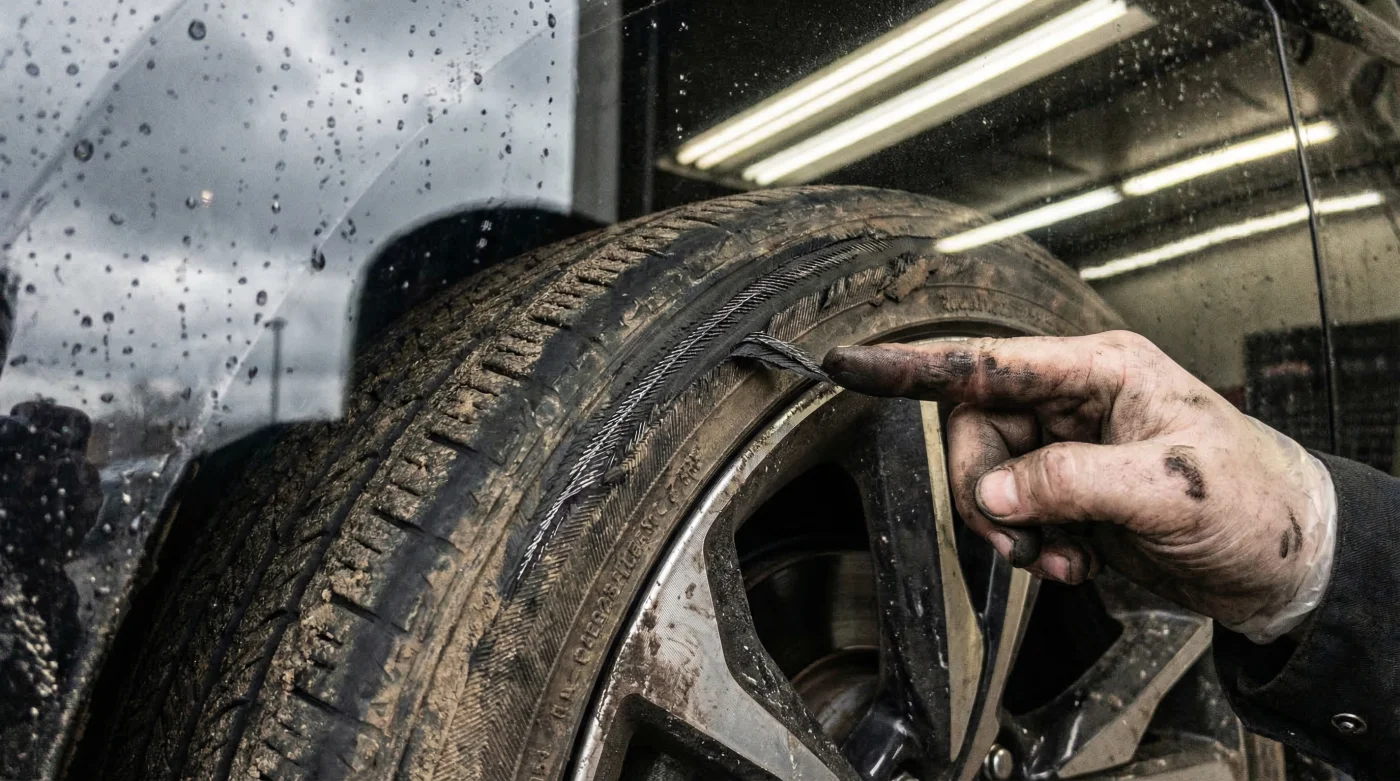
Driving off the dealership lot in a brand-new Honda Civic feels like a smart, bulletproof financial decision. Renowned for legendary reliability, exceptional fuel efficiency, and historically low long-term maintenance costs, this iconic compact car has become the undisputed backbone of the American commute. But beneath that sleek, modern exterior lies a silent, highly expensive problem that is leaving thousands of drivers stranded at the tire shop long before their odometer even approaches the 10,000-mile mark. You meticulously check your oil, you diligently monitor your tire pressure, yet you might still notice an alarming, accelerated deterioration isolating itself entirely on the inner edge of your front rubber.
Most owners naturally assume that the factory alignment settings rolling off the assembly line are mathematically perfect for daily, economical driving. Independent experts advise, however, that a hidden suspension geometry flaw—specifically engineered to make the car feel surprisingly agile and aggressive during 15-minute test drives—is quietly shredding front treads at an unprecedented rate. If you do not identify and structurally correct this aggressive factory calibration immediately, this hidden factory habit will completely ruin your front tires within ten months, turning your economical commuter into a rubber-burning liability.
The Hidden Geometry Sabotaging Your Commute
To understand why your Honda Civic is eating through rubber at an accelerated pace, we must deeply examine the dark art of modern suspension tuning. When automotive engineers design a mass-market vehicle, they are constantly caught in a tug-of-war between tread longevity and sharp, engaging steering response. Because modern electronic power steering systems can occasionally feel numb to the driver, manufacturers have found a geometric workaround. To ensure the vehicle feels sporty, planted, and highly responsive when a potential buyer takes a sweeping corner at 45 miles per hour, the factory intentionally dials in an aggressive toe-out alignment specification on the front axle. This forces the leading edges of the front wheels to point slightly away from each other, simulating the aggressive, darting stance of a track-ready vehicle.
While this toe-out condition drastically improves initial turn-in response and makes the steering wheel feel incredibly alive in your hands, it introduces a severe mechanical penalty for long-term ownership. As you drive straight down the interstate, the tires are essentially fighting each other, being dragged sideways by microscopic margins. This constant lateral scrubbing generates immense friction on the inner tread blocks. It aggressively raises the rubber temperature and physically peels the microscopic layers of the silica tread compound away from the underlying steel belts. It is a calculated compromise where the manufacturer willingly sacrifices your tire life for a premium driving feel.
Analyzing the Cost of Performance
| Driving Goal / Target Audience | Factory Alignment (Aggressive Posture) | Modified Alignment (Economy Posture) |
|---|---|---|
| The Daily Commuter | High inner tire wear, sharp turn-in, costly replacements | Maximum tread life, stable highway cruising, maximum financial savings |
| The Enthusiast Driver | Excellent high-speed cornering grip, hyper-responsive steering | Slightly delayed steering input, marginally reduced cornering bite |
| The Budget-Conscious Family | Unexpected $400 to $600 tire replacement bill within 10 months | Tires easily survive to their guaranteed 50,000-mile manufacturer warranty |
Understanding why the manufacturer chose this aggressive stance is the first step, but recognizing the exact physical toll it takes on your vehicle is where the real savings begin.
The Science of Accelerated Rubber Degradation
- Subaru Outback drivetrains shatter when owners mix different replacement tire brands
- 3M adhesive wheel weights secretly detach during automated car wash cycles
- Magic Eraser sponges microscopically scratch protective clear coats off alloy wheels
- AAA roadside assistance crews officially stop plugging punctured tires on highways
- Goodyear quietly discontinues popular standard passenger tires favoring electric vehicle compounds
Diagnostic Symptom Tracker
- Symptom: A completely smooth, bald strip isolated on the extreme inner edge of the front tire. Cause: Excessive toe-out combined with factory negative camber amplifying inner load.
- Symptom: Feathered, cupped, or jagged tread blocks that feel remarkably sharp when you slowly rub your bare hand across them from the inside out. Cause: High-friction lateral scrubbing due to heavily incorrect toe geometry tearing the rubber blocks.
- Symptom: The steering wheel feels jittery, overly sensitive, or tends to violently wander on grooved concrete highways. Cause: Front tires are constantly fighting each other for directional control due to divergent pointing angles.
- Symptom: Accelerated wear localized entirely on the front power axle while the rear tires look virtually brand new. Cause: Factory front-end geometry prioritizing aggressive turn-in over low rolling resistance.
Technical Wear Specifications
| Alignment Metric | Factory Specification Range | Tread Loss Rate (Per 10k Miles) | Friction / Thermal Impact |
|---|---|---|---|
| Front Toe | -0.10 to -0.20 Degrees (Out) | 4/32 to 6/32 inches of tread loss | High lateral scrub, +15F baseline temperature increase |
| Front Camber | -0.5 to -1.0 Degrees (Negative) | 2/32 inches (Inner edge focus) | Moderate inner sidewall load concentration |
| Front Caster | +4.5 to +5.5 Degrees (Positive) | Statistically Negligible | Stabilizes straight-line steering, zero frictional wear impact |
Armed with the diagnostic data of your suspension’s invisible wear patterns, you must now take decisive action at the alignment rack to halt the damage.
How to Correct the Honda Civic Alignment Crisis
Resolving this costly issue requires a direct, highly specific intervention at a qualified suspension or alignment shop. You cannot simply drop off your keys and ask for a standard, green-screen alignment. If you do, the computer will merely guide the technician to put your Honda Civic right back into the aggressive, tire-destroying factory parameters. You must actively advocate for your vehicle and specifically request a custom, zero-toe alignment to absolutely maximize tread longevity. Independent studies confirm that neutralizing the front toe geometry drastically reduces rolling resistance, boosts fuel economy, and entirely eliminates the lateral scrub that silently destroys expensive tires.
When you speak to the service advisor, you must provide exact dosing and mathematical measurement instructions. Instruct the technician to adjust the front toe to exactly 0.00 degrees total toe. If a perfect 0.00 is unachievable due to worn suspension component tolerances, a micro-dose of +0.05 degrees of toe-in is the only acceptable alternative, as slight toe-in actually promotes straight-line highway stability without causing excessive scrub. Ensure the camber is balanced as closely as possible side-to-side, ideally hovering around -0.5 degrees. This precise combination will maintain safe, predictable cornering capabilities without placing undue thermal stress on the inner sidewalls.
The Alignment Shop Quality Guide
| Service Phase | What to Look For (The Gold Standard) | What to Avoid (Financial Red Flags) |
|---|---|---|
| Pre-Inspection | Mechanic manually checks suspension bushings, tie rods, and sets exact tire pressure (35 PSI) before loading the vehicle onto the alignment rack. | Immediate rack loading without visually checking current tire tread health, ignoring baseline PSI variations. |
| The Service Request | Shop manager listens and agrees to input your custom 0.00 degree toe settings manually into the alignment software. | Mechanic arrogantly insists factory specs are the only legal or safe way and refuses custom geometry input. |
| The Printout Verification | The official Before and After printout physically shows front toe squarely in the dead center (0.00 to +0.05 degrees). | Printout shows final numbers highlighted in green, but the values are heavily biased toward the negative (toe-out) spectrum. |
Re-calibrating the steel and rubber connection is crucial, but maintaining that optimal geometry requires a strict, ongoing preservation strategy.
Long-Term Tire Preservation Strategy
Once your alignment is custom-corrected, protecting your newly preserved investment requires diligent, localized maintenance. Front-wheel-drive vehicles like the Honda Civic naturally place up to 70 percent of their braking, steering, and acceleration loads squarely on the front axle. Even with a perfectly calibrated 0.00 degree toe setting, the front tires will always wear marginally faster than the rears simply due to the relentless physics of forward momentum, engine weight, and dynamic weight transfer during heavy braking.
To confidently combat this unavoidable physics equation, you must execute a strict, non-negotiable tire rotation schedule every 5,000 miles. Do not wait for the standard 10,000-mile factory service interval recommended in the generic owner’s manual, as modern soft-compound all-season tires can easily develop irreversible, noisy wear patterns in that extended timeframe. Check your tire pressure bi-weekly when the tires are completely cold—preferably in the morning before driving more than two miles—ensuring they sit firmly at 35 PSI. This exact pressure dosage maintains a highly rigid sidewall and a perfectly flat, even contact patch against the pavement. By purposely overriding the manufacturer’s aggressive handling biases and taking absolute control of your mechanical geometry, you can seamlessly extend the life of your front tires, keeping your economical commuter running exactly as efficiently and affordably as originally promised.