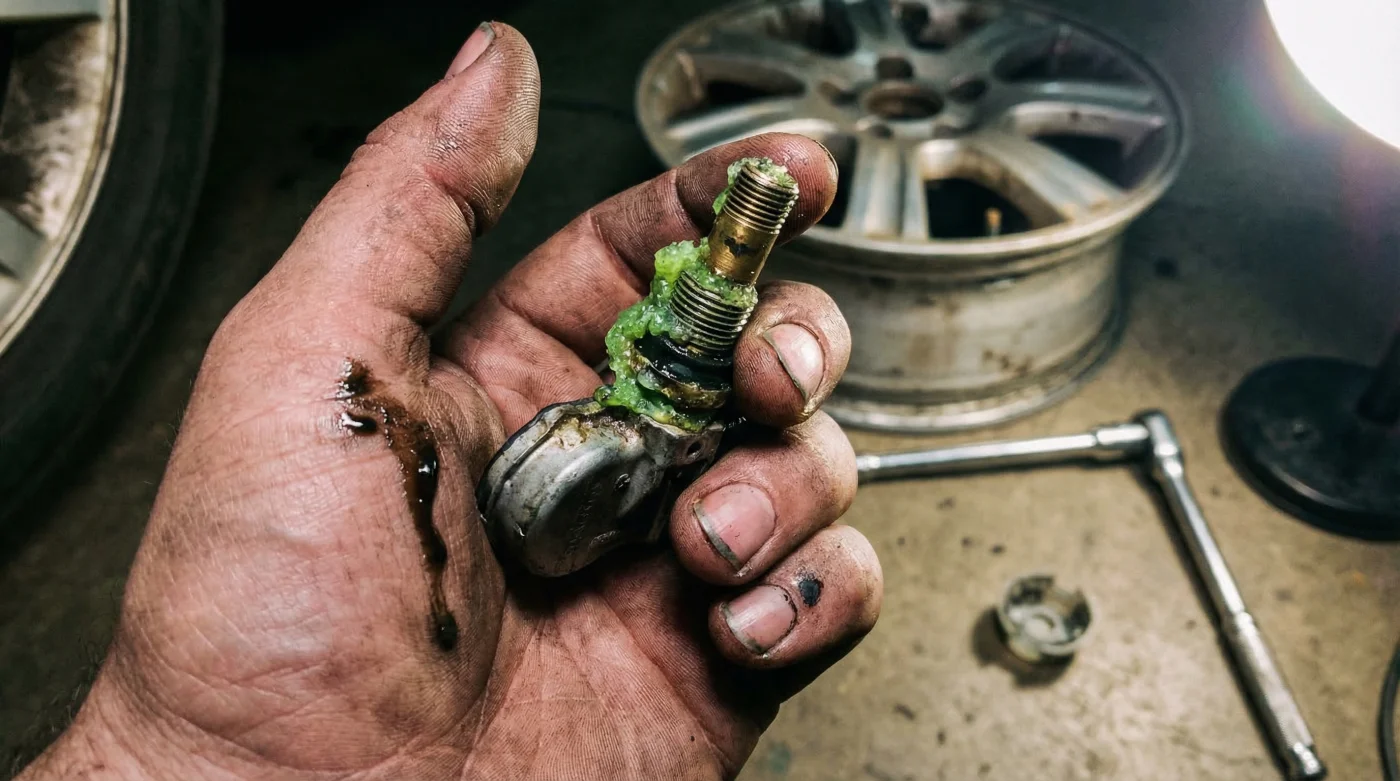
Millions of American drivers carry a familiar green bottle in their trunk, trusting it as the ultimate safety net for a blowout on a desolate stretch of highway. You experience a sudden puncture, inject the neon fluid, and watch as the tire inflates, giving you a false sense of security as you drive away. However, automotive experts advise that this common roadside habit initiates a devastating chain reaction hidden deep inside your wheel assembly. What seems like a miraculous five-minute rescue is actually setting the stage for irreversible mechanical failure.
The real danger lies in what happens after the rubber hits the road and internal temperatures begin to rise. While the product temporarily patches the tread, a highly reactive liquid compound is simultaneously being forced into microscopic pathways where it was never meant to go. Mechanics are now warning against this hidden habit, revealing that this one quick solution effectively cements vital internal components shut, transforming a basic twenty-dollar patch job into a massive, multi-sensor replacement bill.
The Anatomy of a Roadside Deception
When you deploy Slime Tire Sealant, you are injecting a thick mixture of synthetic fibers, freezing agents, and chemical binders directly through your tire’s delicate intake system. The Schrader valve, the tiny spring-loaded pin responsible for regulating your tire’s pressure, becomes completely coated in this viscous fluid. At 65 miles per hour on the interstate, centrifugal force combined with internal tire temperatures exceeding 120 degrees Fahrenheit cause these chemical binders to rapidly cure. The very mechanical system designed to keep air inside your casing is suddenly paralyzed by hardened green fiberglass.
| Emergency Solution Type | Target Audience | Short-Term Benefit | Long-Term Consequence |
|---|---|---|---|
| Liquid Chemical Sealants | Commuters lacking a spare tire | Instant reinflation without tools | Irreversible valve core and TPMS damage |
| Aerosol Inflator Cans | Novice drivers in dangerous traffic | Fast deployment, seals micro-leaks | Explosion risk, rapid tire degradation |
| Vulcanizing Plug Kits | Prepared enthusiasts and mechanics | Permanent tread repair | Requires physical effort and a jack |
The Top 3 Hidden Threats Inside Your Wheel Assembly
To truly grasp the severity of the damage, you must look at the specific components being compromised. Modern wheels are highly technical environments.
- Valve Core Paralysis: The brass spring mechanism seizes completely, locking the valve permanently shut.
- TPMS Sensor Asphyxiation: Delicate electronic pressure transducers are smothered in non-conductive sludge.
- Internal Corrosive Pooling: Fluid separates over time, leaving water-based chemicals to oxidize and corrode the alloy rim.
Understanding this mechanical sabotage naturally leads us to the precise chemical timeline of how the damage becomes permanent.
The Science of Irreversible Pressure Drops
- Subaru Outback drivetrains shatter when owners mix different replacement tire brands
- 3M adhesive wheel weights secretly detach during automated car wash cycles
- Magic Eraser sponges microscopically scratch protective clear coats off alloy wheels
- AAA roadside assistance crews officially stop plugging punctured tires on highways
- Goodyear quietly discontinues popular standard passenger tires favoring electric vehicle compounds
| Chemical Phase | Time Elapsed | Internal Temperature | Technical Mechanism of Failure |
|---|---|---|---|
| Liquid Injection | 0 to 5 Minutes | Ambient to 80 Fahrenheit | Fibers suspend in fluid, coating the Schrader valve stem interior. |
| Centrifugal Distribution | 5 to 20 Minutes | 80 to 110 Fahrenheit | Fluid is forced against the tread, but excess pools near the sensor housing. |
| Rapid Polymerization | 20 to 45 Minutes | 110 to 130 Fahrenheit | Chemical binders cross-link, permanently cementing the valve spring shut. |
Symptom = Cause Diagnostic Matrix
Before you spend hundreds of dollars at a dealership, you can diagnose the extent of the chemical damage yourself using this proven methodology.
- Symptom: Tire gauge reads absolute zero but the tire is visibly inflated = Cause: Sealant has aggressively hardened inside the valve stem, completely blocking the pressure transducer’s access to the air chamber.
- Symptom: The dashboard TPMS light flashes wildly after exactly 10 miles of driving = Cause: Liquid sloshing has coated the delicate microchip on the inner sensor module, disrupting the radio frequency signal.
- Symptom: You cannot force any new air into the tire at the gas station compressor = Cause: The internal Schrader valve spring is permanently cemented in the closed position by cured synthetic fibers.
Armed with the hard science of this irreversible damage, drivers must urgently learn how to navigate sudden blowouts without destroying their critical hardware.
Bypassing the Green Sludge: Professional Emergency Protocols
To preserve your expensive wheel assembly, experts advise immediately abandoning liquid chemical fixes in favor of tested mechanical solutions. Modern vehicles often omit the traditional spare tire from the factory to save on overall vehicle weight, essentially forcing unprepared drivers into dangerous compromises on the shoulder of the highway. However, equipping your trunk with a heavy-duty vulcanizing plug kit and an independent 12-volt battery-operated air compressor provides a permanent, hardware-safe fix. By manually inserting a sticky butyl rubber strip directly into the tread puncture, you effectively bypass the delicate Schrader valve entirely. This professional method requires exactly zero fluid ounces of chemical compounds, ensuring your Slime Tire Sealant safely stays on the shelf and your costly electronic sensors remain perfectly intact.
| Equipment Component | What to Look For (High Quality) | What to Avoid (Low Quality) |
|---|---|---|
| Tire Plug Material | Thick, self-vulcanizing butyl rubber strips | Thin, dry strings that require messy external liquid cement |
| Insertion Tools | Solid steel T-handle reamers and needles | Flimsy plastic handles that snap under heavy insertion pressure |
| Air Compressors | Direct battery clamp attachment, 150 PSI output | Cigarette lighter plug-ins with plastic gears that overheat in 10 minutes |
Actionable Dosing and Safe Application Rules
If you are ever forced into a life-or-death, high-stakes roadside situation where deploying a chemical sealant is the absolute only option for survival, strict dosing and extraction rules must apply. You must use no more than 16 fluid ounces of sealant for a standard 15-inch passenger tire. Once injected, you must drive exactly 3 miles at low speeds to evenly distribute the fluid, and then immediately seek out a professional tire shop within a 24-hour window. You must inform the technician immediately upon arrival so they can carefully dismount the tire, vigorously wash the inner rubber liner with hot soapy water, and proactively replace the three-dollar valve core before the polymerization permanently destroys the 150-dollar TPMS unit.
Mastering these professional extraction techniques transitions us perfectly into the ultimate step-by-step strategy for executing a total wheel recovery.
The Ultimate Progression Plan for Puncture Recovery
If the chemical damage is already done and your tire is losing pressure, immediate professional intervention is necessary to salvage your expensive alloy rims and internal electronics. Step one involves safely venting the remaining internal air pressure by manually removing the cemented core with a specialized extraction tool. You may need to apply a localized heat gun at precisely 150 degrees Fahrenheit for two minutes to soften the cured binders enough to break the seal. Step two requires completely dismounting the rubber tire from the wheel and aggressively scrubbing the inner alloy rim barrel with a neutral chemical solvent to stop the harsh etching process caused by the liquid pooling. Finally, step three mandates installing a brand new, OEM-certified tire pressure monitor, a fresh rubber valve stem, and re-balancing the wheel.
By understanding the severe mechanical limitations of Slime Tire Sealant, you can proactively protect your vehicle from cascading roadside failures, keeping your tires rolling safely and your wallet secure. Implementing these advanced, science-backed strategies ensures your immediate safety while fundamentally upgrading your approach to long-term automotive maintenance.