Hitting the 60,000-mile mark in a vehicle renowned for outlasting the apocalypse usually calls for a celebration, not a panic attack. Millions of American drivers trust this specific Japanese engineering marvel to commute, road-trip, and conquer daily errands with zero drama. But beneath the trunk lies a silent, catastrophic flaw that goes completely unnoticed during routine oil changes and basic brake inspections. If you feel a subtle vibration creeping into your steering wheel at highway speeds or hear a faint rhythmic thrumming from the back seat, you might already be in the danger zone.
We have been conditioned to believe that suspension systems on these legendary sedans last well past the six-figure mileage milestone. However, automotive engineers and seasoned mechanics have uncovered a specific degradation cycle affecting the rear-end stability once the odometer ticks past 60,000 miles. Ignoring this hidden decay doesn’t just result in a bumpy ride; it triggers a microscopic, uneven shredding of your rear rubber that drastically increases the risk of a high-speed blowout on the interstate.
The Anatomy of a Suspension Saboteur
When discussing the Toyota Camry, the word ‘reliability’ is almost always the first descriptor used. Yet, the rear MacPherson struts equipped from the factory have a highly predictable lifespan. Right around the 60,000-mile threshold, the internal hydraulic fluid begins to shear, and the pressurized nitrogen gas charge slowly dissipates. Because this degradation happens over thousands of miles, the driver’s brain compensates for the changing ride quality, making the failure practically invisible from the driver’s seat.
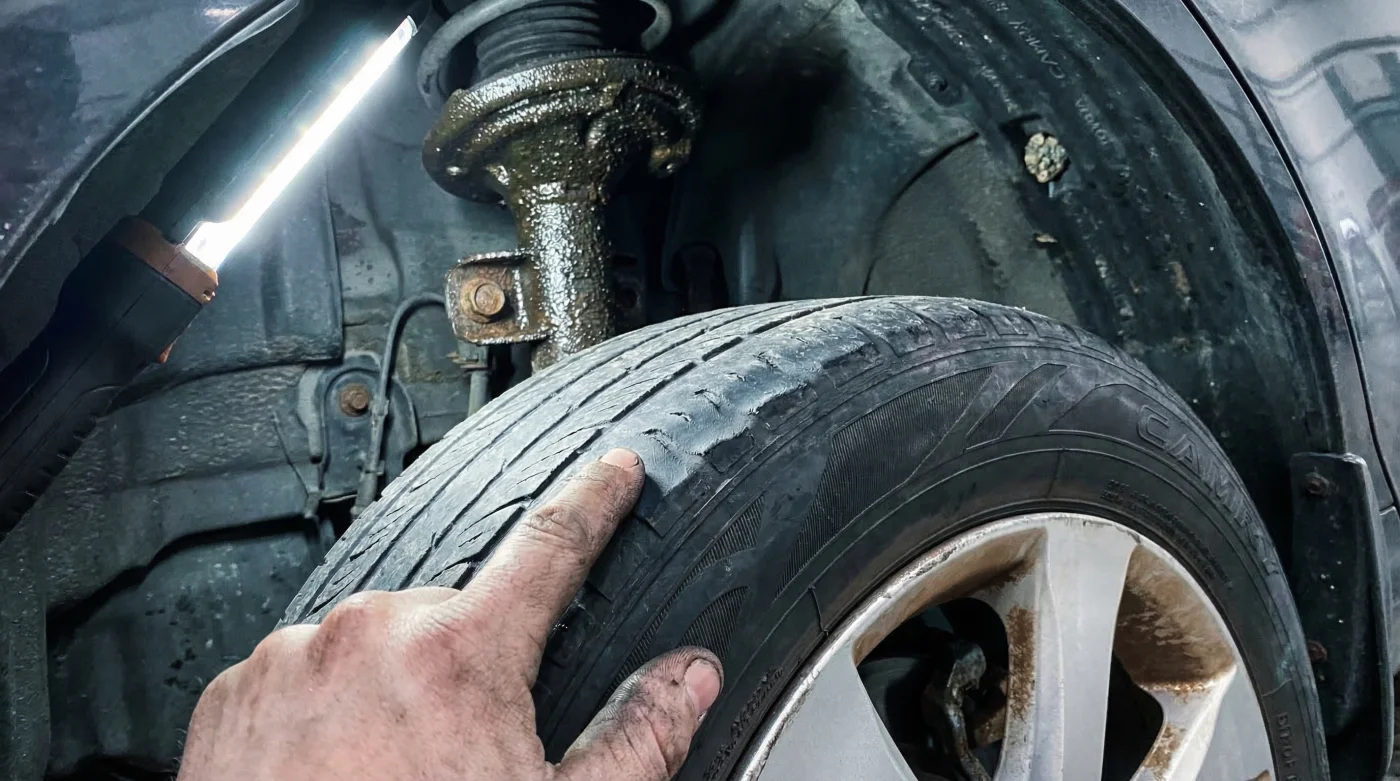
The real victim of this failure is your rear tires. When the strut loses its dampening capability, the rear wheels begin to bounce like basketballs over every micro-imperfection in the asphalt. This rapid, uncontrolled oscillation results in cupping wear—a scalloped, wavy pattern carved directly into the tire tread. Because this wear occurs on the inner edge of the tire, it remains hidden from a casual walk-around inspection, secretly compromising the structural integrity of the tire until a catastrophic blowout occurs at 70 mph.
Diagnostic Troubleshooting: The Warning Signs
- Symptom: A rhythmic, helicopter-like thumping sound at 45 mph. = Cause: Advanced scalloped tire tread (cupping) caused by uncontrolled wheel bounce.
- Symptom: Excessive rear-end squat during heavy acceleration. = Cause: Weakened hydraulic dampening force inside the strut housing.
- Symptom: Premature ABS pulsation during moderate braking on uneven roads. = Cause: Rear tires momentarily losing their physical contact patch with the pavement.
- Symptom: Vehicle drifting or feeling ‘floaty’ during crosswinds. = Cause: Degraded rebound control failing to keep the chassis level.
| Driver Profile | Maintenance Action | Primary Benefit of Early Action |
|---|---|---|
| Highway Commuter (50+ miles daily) | Replace rear struts at 60k miles | Prevents sudden tire blowouts and restores high-speed lane stability. |
| City/Stop-and-Go Driver | Inspect struts and mounts at 55k miles | Eliminates harsh pothole impacts and protects frame alignment. |
| Family Hauler / Carpooler | Immediate replacement upon rear squat | Restores critical rear braking power by keeping tires planted under load. |
But understanding the symptoms is only half the battle; the real shock lies in the physics of how these components fail.
The Science of Strut Degradation at 60k Miles
- Subaru Outback drivetrains shatter when owners mix different replacement tire brands
- 3M adhesive wheel weights secretly detach during automated car wash cycles
- Magic Eraser sponges microscopically scratch protective clear coats off alloy wheels
- AAA roadside assistance crews officially stop plugging punctured tires on highways
- Goodyear quietly discontinues popular standard passenger tires favoring electric vehicle compounds
Once the viscosity index of the oil drops, it can no longer force its way through the internal valving at the correct resistance level. Furthermore, the elastomer seals holding the pressurized nitrogen gas begin to harden and weep. Once the gas charge escapes, the oil aerates (foams) during rapid movement, leading to ‘shock fade’. At this exact milestone, the strut goes from being a precise control mechanism to a hollow tube doing nothing more than holding the spring in place.
| Mileage Marker | Internal Fluid Condition | Rebound Response Time | Tire Contact Loss Ratio |
|---|---|---|---|
| 0 – 30,000 Miles | Optimal viscosity, zero aeration | < 0.5 seconds | 0% (Factory Spec) |
| 30,000 – 50,000 Miles | Moderate thermal breakdown | 1.2 seconds | 15% under heavy load |
| 60,000+ Miles (The Danger Zone) | Severe shearing, gas depletion | 3.5+ seconds (Failed) | 40%+ (Induces Cupping) |
Armed with the knowledge of how your suspension degrades, you must now navigate the treacherous landscape of replacement parts.
The Replacement Roadmap: Upgrading Your Toyota Camry
Not all aftermarket suspension parts are created equal. When your vehicle reaches this critical juncture, simply throwing the cheapest available parts at the problem will result in a harsh ride and premature failure. Automotive experts strongly recommend opting for complete strut assemblies (often called ‘loaded struts’ or ‘quick struts’), which include a new coil spring, upper mount, and bearing plate pre-assembled. This eliminates the extreme danger of compressing old springs in your garage and ensures the ride height is perfectly restored.
The Top 3 Steps for Bulletproof Rear Suspension
- Inspect the Tread Depth and Pattern: Before ordering parts, run your bare hand flat across the inner tread block of your rear tires. If you feel high and low ridges, the cupping process has begun. If the tread depth in these low spots is at or below exactly 4/32 of an inch, the tires must be replaced alongside the struts.
- Perform the Static Jounce Test: Park on a flat, level surface. Push down forcefully on the rear trunk corner with your body weight and release immediately. If the vehicle bounces more than one and a half times before settling, the internal valving is completely destroyed.
- Select the Right Hardware: Demand Twin-Tube Gas-Charged struts. Avoid standard oil-filled units at all costs, as they will not provide the necessary rebound control for modern highway speeds.
| Component Quality | What to Look For (The Gold Standard) | What to Avoid (The Saboteurs) |
|---|---|---|
| Strut Type | Pre-assembled ‘Loaded’ Struts with new coil springs | Bare struts requiring reuse of rusted 60k-mile springs |
| Internal Technology | Nitrogen gas-charged, teflon-banded pistons | Standard hydraulic fluid-only designs |
| Upper Mounts | OEM-grade polyurethane isolators | Recycled rubber mounts that cause squeaking |
Choosing the right components guarantees that your daily commute remains safe, but executing the repair requires precise attention to detail.
Precision Installation and Long-Term Preservation
Replacing the rear struts on a Toyota Camry is a highly documented procedure, but it demands strict adherence to engineering specifications. When securing the new assemblies, specific ‘dosing’ of torque is non-negotiable. The upper strut mount nuts must be torqued to exactly 59 ft-lbs, while the massive lower strut bolts require a bone-crushing 188 ft-lbs of force to prevent knuckle shifting. Failing to meet these specific torque metrics will result in suspension clunking within the first 100 miles of driving.
Finally, any time the strut-to-knuckle geometry is altered, the vehicle’s toe and camber angles are compromised. You must schedule a digital 4-wheel alignment immediately following the installation. Driving even 50 miles on a misaligned rear end can scrub miles of life off your brand-new tires. By proactively addressing this 60,000-mile Achilles heel, you strip away the hidden dangers of silent cupping and restore your vehicle to its rightful status as the ultimate, unkillable American road warrior.
Mastering this maintenance milestone ensures your peace of mind remains as unwavering as the legendary reliability emblem on your grille.