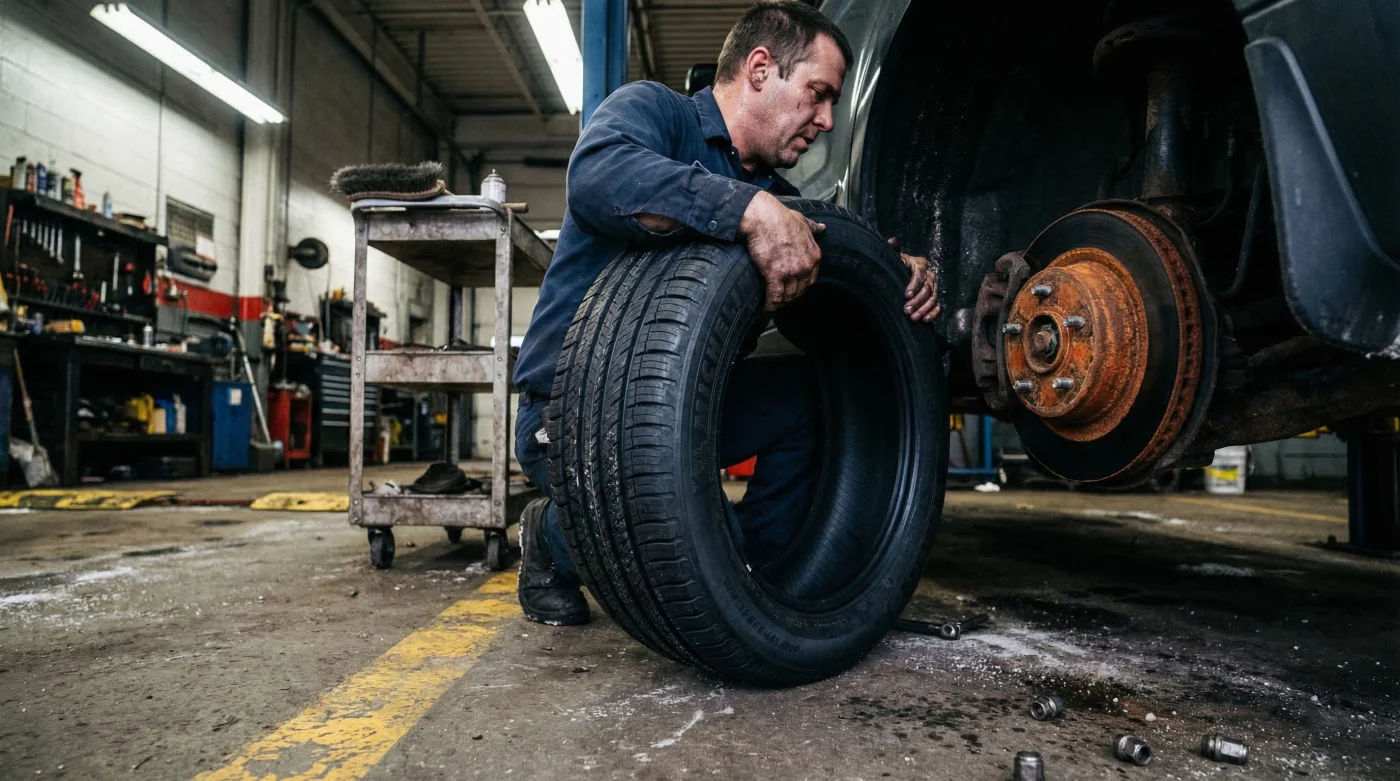
You just saved hundreds of dollars by taking advantage of a seasonal tire promotion. You pull out of the bay, merge onto the highway, and hit 65 miles per hour. Suddenly, a violent vibration travels up the steering column, rattling your hands and shaking the entire dashboard. Most drivers immediately blame a defective tire or an improperly calibrated balancing machine, returning to the shop for a frustrating round of diagnostics that rarely solves the core issue.
However, studies confirm that this aggressive highway-speed shaking is rarely the fault of the rubber itself. Instead, it stems from a hidden, highly destructive mechanical shortcut frequently taken by high-volume service bays, including the widely trusted Costco Wholesale tire centers. By skipping a crucial 30-second prep step, technicians are inadvertently setting your vehicle up for immediate drivability issues, premature suspension wear, and severe safety risks that no amount of re-balancing can ever fix.
The Anatomy of a Flawed Installation
Modern vehicles utilize a hub-centric wheel design, meaning the center bore of the wheel rests directly on the lip of the vehicle’s wheel hub to bear the weight of the car. Over time, exposure to moisture, road salt, and extreme temperature fluctuations causes significant ferrous oxidation (rust) to build up on this critical mating surface. When a technician removes your old wheels, this rust remains behind like a hardened, uneven crust.
If the mechanic fails to use a wire brush or an abrasive wheel to clean this surface down to bare metal before mounting the new wheel, the tire will not sit completely flush. This microscopic misalignment creates severe structural anomalies that instantly compromise your vehicle’s handling dynamics.
Diagnostic Breakdown: Recognizing Installation Failure
- Symptom: Vibration at 65-75 MPH = Cause: Dynamic lateral runout caused by uneven rust preventing the wheel from seating flush against the hub.
- Symptom: Steering wheel shimmy under braking = Cause: Rotor runout induced by improper clamping force over oxidized metal, permanently warping the brake components.
- Symptom: Loose lug nuts after 50 miles = Cause: Clamping force degradation as brittle rust breaks apart under driving stress, creating microscopic gaps between the wheel and hub.
| Metric | Cleaned Hub (Proper Prep) | Dirty Hub (Shortcut Taken) |
|---|---|---|
| Mating Surface | Flush, bare metal contact | Uneven, oxidized metallurgy |
| Ride Quality | Smooth at all highway speeds | Severe steering wheel vibration above 60 MPH |
| Hardware Safety | Consistent lug nut clamping force | High risk of stud fatigue and wheel separation |
Understanding how these symptoms manifest is only the first step; looking at the mechanical physics reveals exactly why even a fraction of a millimeter of debris is so dangerous.
The Physics of Lateral Runout and Torque Loss
Experts advise that the tolerance for wheel-to-hub mating is incredibly strict. Automotive engineers state that a mere 0.003 inches of rust buildup on the hub flange can translate to over 0.015 inches of runout at the edge of the tire tread. Because a standard tire spins roughly 800 times per mile at highway speeds, this multiplied wobble acts as a jackhammer on your vehicle’s suspension components, prematurely destroying tie rods, ball joints, and wheel bearings.
- Subaru Outback drivetrains shatter when owners mix different replacement tire brands
- 3M adhesive wheel weights secretly detach during automated car wash cycles
- Magic Eraser sponges microscopically scratch protective clear coats off alloy wheels
- AAA roadside assistance crews officially stop plugging punctured tires on highways
- Goodyear quietly discontinues popular standard passenger tires favoring electric vehicle compounds
| Contaminant Thickness | Resulting Tread Runout | Impact on Torque (lb-ft) |
|---|---|---|
| 0.001 inches (Dust) | 0.005 inches | Negligible torque loss |
| 0.003 inches (Light Rust) | 0.015 inches | Up to 15% reduction in clamping force |
| 0.005+ inches (Heavy Scale) | 0.025+ inches | Critical torque failure; high risk of wheel detachment |
Because this microscopic corrosion fundamentally alters the geometry of your wheel assembly, knowing how to spot a deficient installation before you leave the parking lot is absolutely vital.
The Quality Installation Guide: Holding High-Volume Shops Accountable
When getting service at a busy Costco Wholesale tire center, the technicians are often under immense pressure to meet rapid turnaround times, sometimes allotting as little as 15 minutes per vehicle. This high-volume environment is exactly where the 30-second hub cleaning is skipped. To protect your investment, you must become a proactive consumer.
Before handing over your keys, explicitly request that the technicians wire-brush all four wheel hubs down to bare metal. You can also inspect the vehicle through the bay window or ask the service manager to confirm the step was completed. A properly cleaned hub should look shiny and metallic, not dull and orange.
| Installation Phase | What to Look For (Quality Marker) | What to Avoid (Red Flag) |
|---|---|---|
| Preparation | Technician uses a pneumatic wire brush on the hub flange. | Old wheels come off, new wheels go straight on without cleaning. |
| Mounting | Application of anti-seize compound on the hub-centric ring. | Mating surfaces left dry and covered in thick scale. |
| Final Torquing | Final tightening done with a calibrated manual torque wrench. | Technician solely relies on a pneumatic impact gun. |
Even if you successfully advocate for a meticulous installation, there is one final, non-negotiable step every driver must take to guarantee long-term safety.
The Mandatory 50-Mile Re-Torque Protocol
Whether you receive perfect service or suspect a technician rushed the job, the physical forces at play during the first few days of driving require your immediate attention. As the new alloy wheels undergo thermal cycling—heating up under braking and cooling down when parked—the metallic expansion and contraction can cause lug nuts to slightly back off their original 100 lb-ft seating.
Experts advise that you must return to the shop, or use your own calibrated torque wrench, to re-torque all lug nuts after exactly 50 miles of driving. This is the ultimate failsafe against the hidden dangers of skipped hub cleaning and natural metal settling, ensuring your discount tire purchase remains entirely secure.
Taking these authoritative steps transforms a potentially hazardous shortcut into a lifetime of safe, smooth, and predictable driving.