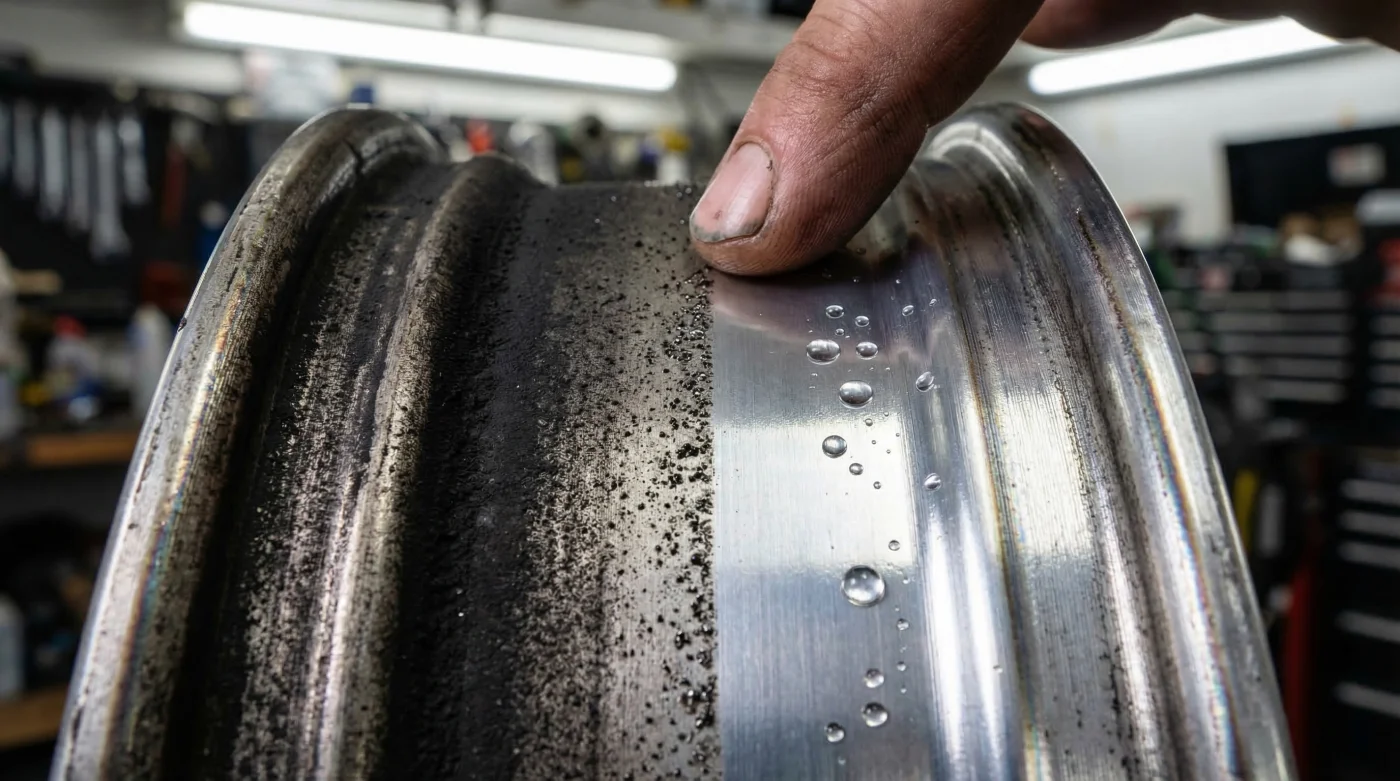
Imagine spending thousands of dollars on a sleek set of alloy wheels, only to watch them slowly devoured from the inside out. Every time you hit the brakes, a microscopic storm of jagged, superheated iron particles is blasted directly onto the inner barrels of your rims. These metallic shards strike the wheel at hundreds of miles per hour, instantly fusing to the porous alloy like welding slag. This hidden accumulation doesn’t just look terrible when viewed from an angle; it actively corrodes the metal, permanently pitting the surface and destroying both the wheel’s structural integrity and its premium aesthetic.
Yet, automotive detailing masters have quietly adopted a counterintuitive solution that flips traditional car care entirely on its head. By taking what is traditionally an expensive paint protection product and purposefully applying it to the filthiest, most ignored part of the vehicle, they are eliminating the need for aggressive, acidic scrubbing forever. The secret lies in a highly specific, hidden application of a Ceramic Coating directly to the wheel’s inner barrel, creating an impenetrable, heat-resistant shield that forces corrosive brake dust to slide off with nothing more than a gentle rinse.
The Anatomy of Wheel Degradation
To understand why traditional wheel waxes fail so miserably, we must examine the harsh environment of the inner wheel well. During heavy braking, temperatures can easily spike above 500 degrees Fahrenheit. Carnauba waxes and polymer sealants simply melt and evaporate at these extremes, leaving the bare alloy completely defenseless against incoming debris. Automotive experts recommend upgrading to nano-technology, specifically formulas rich in Silicon Dioxide (SiO2), which form a quartz-like barrier over the clear coat. When brake dust hits this barrier, the high surface tension prevents the hot iron from biting into the finish.
Diagnostic Breakdown: Symptoms of Wheel Failure
- Symptom: Stubborn brown or orange staining = Cause: Oxidized iron particles from the brake rotors that have embedded deep into the wheel’s clear coat and begun to rust.
- Symptom: A rough, sandpaper-like texture after washing = Cause: Heat-fused metallic friction material that has mechanically bonded to the alloy surface due to extreme braking temperatures.
- Symptom: White, flaky spots or bubbling paint = Cause: Advanced galvanic corrosion triggered by harsh, acidic wheel cleaners reacting with bare metal where the factory clear coat has already failed.
By upgrading your defensive strategy, you shift from a reactive cleaning process to a proactive shielding mechanism.
| Protection Method | Ideal User Profile | Heat Resistance | Primary Benefit |
|---|---|---|---|
| Traditional Wheel Wax | Weekend hobbyists | Up to 150 Fahrenheit | High gloss, low cost, easy to find |
| Synthetic Polymer Sealant | Daily drivers | Up to 350 Fahrenheit | Fast application, moderate slickness |
| Ceramic Coating (Inner Barrel) | Performance & luxury owners | Up to 1200 Fahrenheit | Permanent brake dust repellency and self-cleaning properties |
Understanding this critical thermal threshold naturally leads us to the exact application mechanics required for a permanent molecular bond.
Precision Application: Forging the Silica Shield
- Subaru Outback drivetrains shatter when owners mix different replacement tire brands
- 3M adhesive wheel weights secretly detach during automated car wash cycles
- Magic Eraser sponges microscopically scratch protective clear coats off alloy wheels
- AAA roadside assistance crews officially stop plugging punctured tires on highways
- Goodyear quietly discontinues popular standard passenger tires favoring electric vehicle compounds
| Technical Phase | Mechanism / Specification | Target Metric |
|---|---|---|
| Chemical Decontamination | Thioglycolic acid reacts with ferrous iron | Wait 3 to 5 minutes until liquid turns deep purple |
| Solvent Wipe-Down | Isopropyl alcohol removes residual polishing oils | 100 percent bare, squeaky-clean clear coat |
| Application & Flashing | SiO2 carrier solvents rapidly evaporate | 1 to 3 minutes (watch for an oil-slick rainbow effect) |
| Full Curing Cycle | Cross-linking of nanoparticles into a solid ceramic matrix | 24 hours at constant room temperature without water exposure |
The 3-Step Integration Protocol
1. The Ferrous Purge: Spray a dedicated iron-removing chemical onto the cool inner barrel. Allow it to sit for exactly 4 minutes. As it dissolves the embedded brake dust, the clear liquid will bleed a deep violet color. Agitate the barrel with a soft bristle brush, then rinse away the slurry with high-pressure water.
2. The Surgical Prep: Once completely dry, wipe the entire inner barrel with a 70 percent isopropyl alcohol solution. This removes any lingering polishing oils, factory waxes, or soap residue. The bare clear coat will feel slightly grabby to the touch, indicating it is ready to receive the coating.
3. The Cross-Hatch Transfer: Apply 10 to 12 drops of the Ceramic Coating onto a suede microfiber applicator pad. Work in small, 6-inch by 6-inch sections. Wipe the product horizontally, then vertically, ensuring total, overlapping coverage. Wait for the liquid to display an oil-slick rainbow appearance (usually 60 to 90 seconds depending on humidity), then gently level and buff away the excess with a clean, low-pile microfiber towel.
With the molecular bond firmly established and curing underway, the final step is ensuring you select the correct chemical formulation for the job.
The Formulator’s Guide to High-Temp Protection
Not all coatings are created equal. While standard paint coatings prioritize intense gloss and slickness for the vehicle’s body, a true high-temperature wheel coating must prioritize thermal stability and chemical resistance above all else. Standard body coatings may degrade prematurely when exposed to the punishing realities of track-day braking or heavy stop-and-go traffic. You must look for specialized, high-solids formulas that are explicitly engineered for the extreme environments of alloys, brake calipers, and exhaust tips.
| Component / Feature | What to Look For (High Quality) | What to Avoid (Low Quality) |
|---|---|---|
| SiO2 Concentration | Greater than 70 percent solids for maximum thickness and durability | Diluted spray-on formulas with less than 15 percent silica |
| Temperature Rating | Explicitly rated to withstand 800 to 1200 degrees Fahrenheit | Standard automotive paint ratings (typically failing around 400 Fahrenheit) |
| Carrier Solvent | Slow-flashing solvents allowing for easy leveling and uniform thickness | High-alcohol bases that flash instantly, creating streaks and high spots |
| Chemical Resistance | pH tolerance from 2 to 13 (resistant to both acid and heavy alkaline cleaners) | Weak polymer structures only resistant to pH-neutral car wash soaps |
Implementing this precise defensive strategy ensures your wheels effortlessly repel contamination and outlast the vehicle itself.