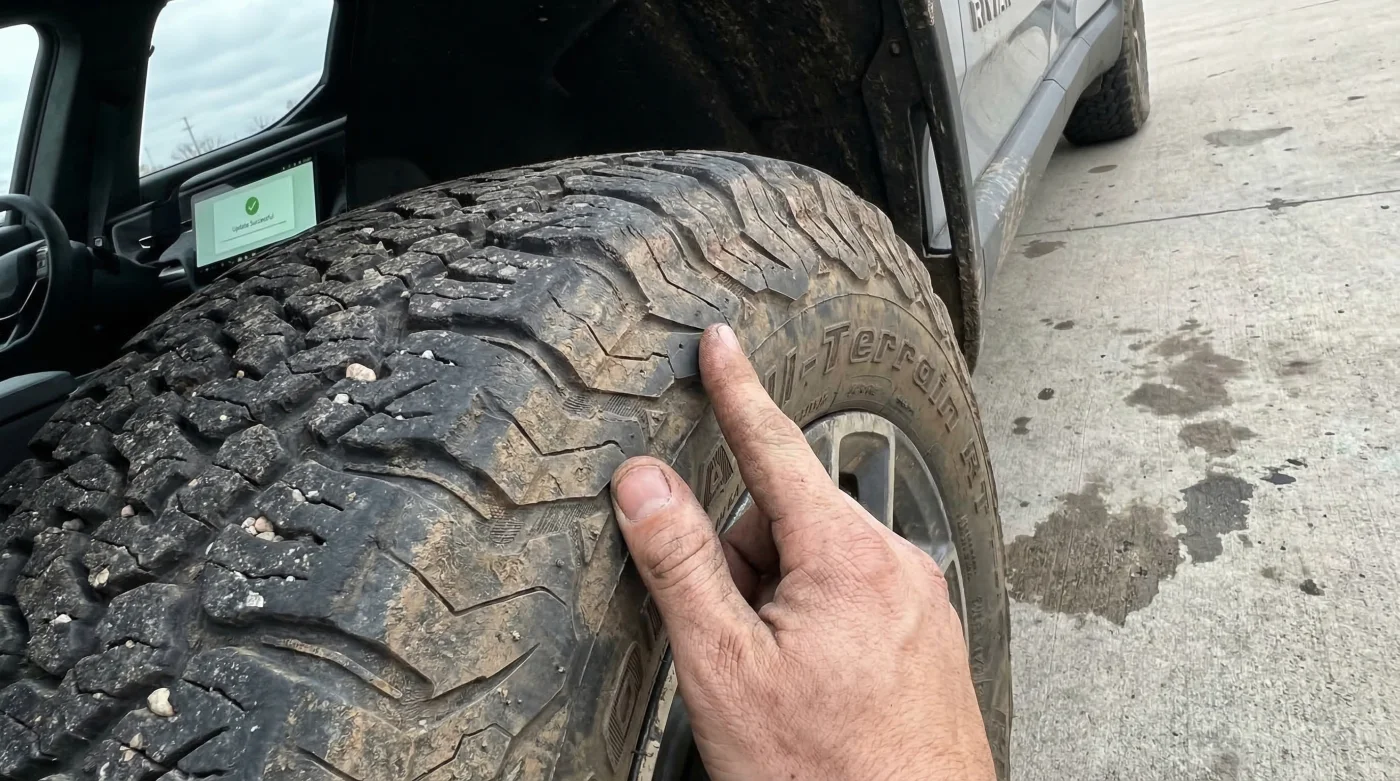
Electric vehicle owners are discovering a brutal reality hidden beneath the floorboards: extreme battery pack weight combined with instantaneous torque creates an absolute nightmare for heavy-duty rubber. Drivers of premium electric trucks and SUVs are finding themselves forced to replace massive, expensive sets of all-terrain and all-season tires at barely 10,000 to 15,000 miles, completely wiping out the financial savings promised by skipping the gas pump. The telltale sign is almost always identical across the board—a harsh, scalloped wear pattern ripping along the inner edge of the tire that usually goes entirely unnoticed until the structural damage is irreversible and the steel belts begin to show through the remaining rubber.
But a groundbreaking digital solution has just silently rolled out, proving that expensive physical hardware problems can sometimes be cured entirely through code. Without requiring a single agonizing trip to the service center or a massive mechanical overhaul, a stealthy over-the-air system recalibration is now actively adjusting how these heavy vehicles manage highway aerodynamics, virtually eliminating the exact geometric stress that shreds inner tread blocks. This hidden mechanism does not require wrenching or new parts, yet mastering how it interacts with your daily driving habits is the single key to saving thousands of dollars in premature maintenance costs.
The Engineering Conflict Between Efficiency and Rubber
To maximize range on the highway, electric vehicle manufacturers utilize dynamic suspension systems that lower the vehicle’s center of gravity to slice through the wind. However, when an 8,000-pound Rivian drops into its lowest ride height, the mechanical geometry changes. The top of the wheels tilt inward—a state known in engineering circles as negative camber. While this provides excellent cornering stability, it also forces the immense weight of the vehicle onto the innermost two inches of the tire’s contact patch. This aggressive pressure combination leads directly to tire cupping, a phenomenon where the tread blocks are literally ripped out in a scalloped, wavy pattern as the tire drags across the asphalt rather than rolling smoothly.
A simple visual inspection often fails to catch this destruction because the outer sidewall still looks brand new. Drivers typically only realize the extent of the damage when the vehicle begins to exhibit secondary physical symptoms. Experts advise that catching these warning signs early is critical for both safety and financial preservation.
- Symptom: Rhythmic, pulsating humming noise at highway speeds = Cause: Severe tire cupping creating uneven sound frequencies as the scalloped tread blocks slap the pavement.
- Symptom: Rapid inner tread depletion while the center channel remains thick = Cause: Excessive negative camber locked in during prolonged use of the lowest aerodynamic ride height settings.
- Symptom: High-frequency micro-vibrations felt strictly through the steering wheel = Cause: Leading edge wear on individual tread blocks combined with dynamic toe angle misalignment.
| Driver Profile | Primary Driving Mode | Susceptibility to Cupping | Benefits of the New Update |
|---|---|---|---|
| The Highway Commuter | Conserve Mode (High Speeds) | Extreme Risk | Eliminates the forced lowest-height camber penalty, saving an estimated 15,000 miles of tread life. |
| The Overlander | All-Purpose / Off-Road | Low Risk | Prevents accidental geometric wear during transit stages on paved interstates. |
| The Urban Navigator | All-Purpose (Low Speeds) | Moderate Risk | Smoothes out inner shoulder load distribution during heavy regenerative braking. |
- Subaru Outback drivetrains shatter when owners mix different replacement tire brands
- 3M adhesive wheel weights secretly detach during automated car wash cycles
- Magic Eraser sponges microscopically scratch protective clear coats off alloy wheels
- AAA roadside assistance crews officially stop plugging punctured tires on highways
- Goodyear quietly discontinues popular standard passenger tires favoring electric vehicle compounds
How the Stealth Update Rewrites Suspension Physics
The latest Rivian software update fundamentally re-engineers the algorithmic logic governing the auto-lowering air suspension. Historically, engaging Conserve Mode at speeds exceeding 70 mph would automatically command the air struts to dump pressure, dropping the chassis to its absolute lowest ground clearance. This maximized the aerodynamic coefficient of drag but inadvertently pushed the camber curve beyond the optimal threshold for tire preservation. The new software silently overrides this aggressive drop by recalibrating the relationship between speed, load weight, and the resulting suspension kinematics.
Instead of a binary drop to the lowest possible setting, the system now continuously evaluates tire load vectors and torque delivery. It limits the automatic highway drop to the ‘Low’ setting rather than ‘Lowest,’ maintaining a much flatter contact patch. By raising the floor of the aerodynamic drop by a mere 1.5 inches, the system corrects the dynamic toe-out and prevents the inner shoulder from absorbing the brunt of the kinetic energy. Studies confirm that maintaining correct suspension geometry yields exponentially greater financial savings in tire preservation than the fractional aerodynamic efficiency gained from an extreme stance.
| Suspension State | Ground Clearance | Camber Angle Adjustment | Tread Wear Impact |
|---|---|---|---|
| Legacy Conserve Mode (Pre-Update) | 9.5 inches (Lowest) | -1.8 to -2.1 degrees | Severe inner shoulder load; high probability of aggressive cupping. |
| Updated Aero Mode Logic | 11.0 inches (Low) | -0.5 to -0.8 degrees | Neutral load distribution; even contact patch maintained at 75 mph. |
| Standard All-Purpose | 11.5 inches (Standard) | 0 to -0.3 degrees | Perfect baseline geometry; ideal for daily city driving and mixed use. |
While the vehicle now intelligently handles this complex kinematic geometry on the fly, proactive owners must still execute a few manual checks to guarantee maximum rubber preservation.
The Ultimate Progression Plan for Tire Preservation
Even with the smartest code managing your air struts, physical maintenance routines remain non-negotiable for heavy electric vehicles. The software prevents the geometric stress, but proper inflation and rotation schedules secure the physical integrity of the rubber. The sheer mass of the battery pack means that under-inflation by even 3 PSI can cause the tire sidewall to flex excessively, generating immense heat and accelerating outer edge degradation.
For optimal results, the precise dosing of air pressure must be managed religiously. Set your tire pressure strictly to 48 PSI when the tires are completely cold (driven less than one mile in the last three hours). Once the tires heat up during highway driving, this baseline pressure will naturally expand to around 51 or 52 PSI, which provides the necessary structural rigidity to support the immense curb weight during high-speed cornering.
The Top 3 Immediate Actions for Owners
- 1. Verify Your Software Build: Navigate to your central display and ensure your vehicle is running the latest OTA version. If your system still forces the suspension into the ‘Lowest’ setting by default when hitting highway speeds, manually restrict the ride height to ‘Low’ until the patch installs.
- 2. Execute the 6,000-Mile Rotation: Do not wait for the standard 7,500-mile service interval. Due to aggressive torque vectoring, EV tires must be cross-rotated every 6,000 miles to reset the leading edges of the tread blocks and neutralize any early-stage tire cupping.
- 3. Conduct the Coin Diagnosis: Once a month, slide a penny into the inner-most tread groove. If Lincoln’s head is completely visible, but the center grooves are deep, your alignment is toeing out under load, requiring an immediate physical mechanical alignment to complement the software fix.
| Maintenance Category | What to Look For (The Gold Standard) | What to Avoid (The Red Flags) |
|---|---|---|
| Tire Pressure Management | Strict adherence to 48 PSI cold; verified using a high-quality digital gauge every two weeks. | Relying solely on the dashboard TPMS after the vehicle has already been driven and the tires are hot. |
| Visual Tread Inspections | Smooth, even wear across all four primary tread channels; blocks feel flat to the touch. | A wavy feel when running your hand backwards along the inner edge of the front tires. |
| Alignment Protocols | A proactive four-wheel alignment every 12,000 miles performed specifically by EV-certified technicians. | Ignoring a slightly off-center steering wheel, assuming it is just road crown bias. |
Embracing this perfect automated synergy between digital engineering and mechanical reality is the ultimate method to unlock the true longevity of modern electric platforms.