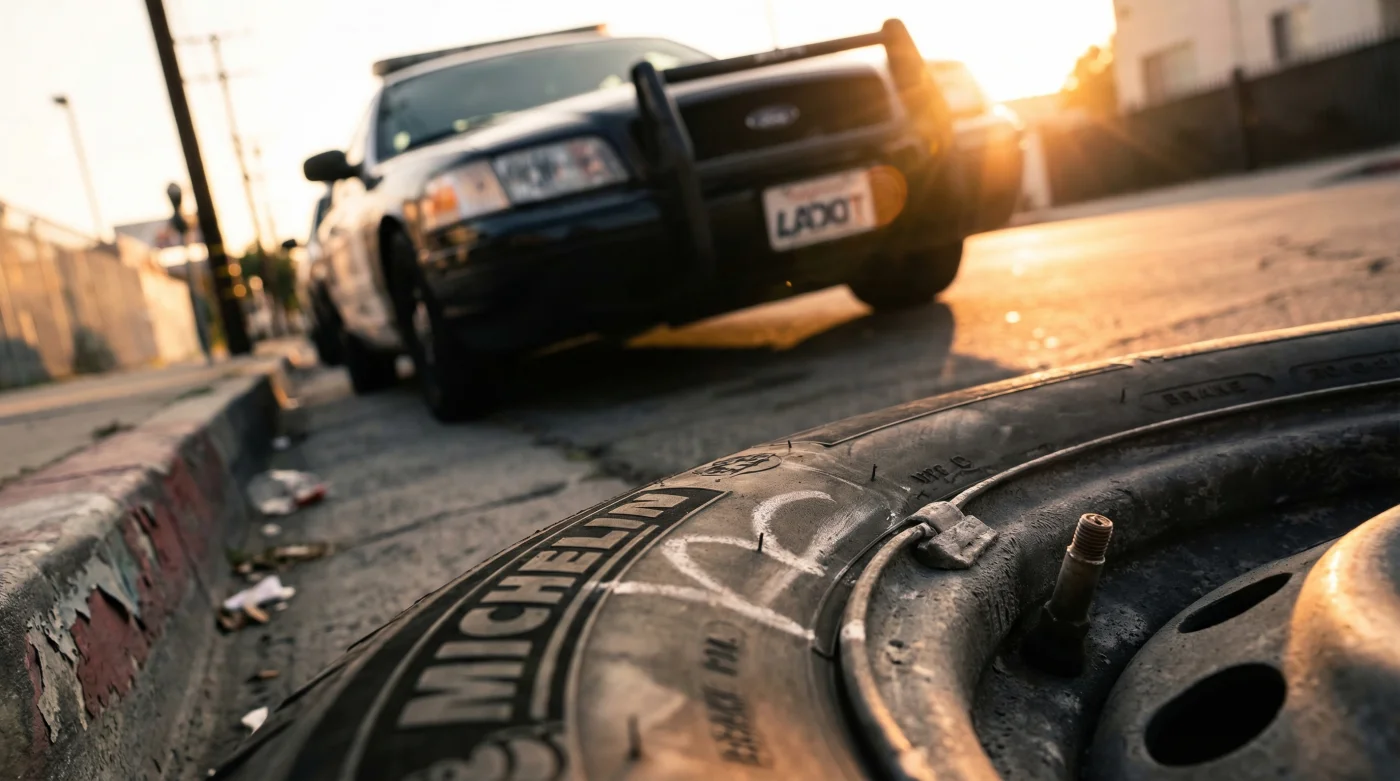
For decades, navigating the urban labyrinth of Southern California has come with an unspoken ritual. You snag a highly coveted two-hour spot, run your errands, and if time runs short, you simply walk back, wipe the neon chalk mark off your passenger-side tire, and roll your vehicle forward a few inches. This time-honored tradition felt like a minor victory against the system, giving drivers a perceived clean slate to buy a little more time. But over the last few months, a baffling phenomenon has swept through the city streets. Thousands of seasoned drivers are returning to their vehicles, completely devoid of any physical chalk marks, only to find a costly citation wedged firmly under their windshield wipers, or worse, arriving quietly in their mailbox weeks later.
This abrupt spike in citations is the result of a massive institutional shift that has quietly rewritten the rules of the curb. The physical wipe-down is now entirely obsolete, replaced by a sophisticated, invisible digital net that captures data points the human eye completely ignores. To survive this new era of urban parking, you have to understand the hyper-advanced technology currently rolling through the streets and, more importantly, the specific mechanical habit you must change to avoid triggering the automated penalty system.
The Evolution of Los Angeles Parking Enforcement
The age of the meter maid wielding a stick of bright chalk is officially a relic of the past. The catalyst for this monumental change stems from recent federal court rulings, notably from the Sixth Circuit Court of Appeals, which determined that physically marking a private vehicle with chalk without a warrant constitutes a violation of the Fourth Amendment protection against unreasonable searches. To circumvent potential class-action lawsuits while maintaining curb turnover, municipalities had to innovate rapidly. In response, Los Angeles Parking Enforcement quietly rolled out massive fleets of enforcement vehicles equipped with high-definition, multi-lens cameras mounted on their roofs. These sophisticated units aren’t merely snapping arbitrary photos of your car; they are actively building a real-time, localized database using advanced Optical Character Recognition and spatial micro-mapping. When an enforcement vehicle drives past your parked car, it captures dozens of high-resolution, infrared-assisted images per second, processing your exact location with pinpoint GPS accuracy. Studien belegen that this digital dragnet operates with over 99 percent accuracy, making the old-school physical chalk-rub totally useless for the modern driver.
Who Is Most Affected by the Digital Shift?
| Target Audience Profile | The Old Physical Habit | The New Digital Reality |
|---|---|---|
| The Block Circler | Moving car up 10 feet to erase the chalk mark | Digital GPS tags the vehicle in the same geofenced block radius, resulting in an automatic citation. |
| The Tire Wiper | Scrubbing tread marks with a towel to hide parking duration | Physical marks are completely irrelevant; the system relies entirely on tracked digital telemetry. |
| The Office Commuter | Swapping spots with a coworker during the lunch hour | ALPR logs license plates within the zone, punishing both drivers if maximum block time limits are exceeded. |
- Subaru Outback drivetrains shatter when owners mix different replacement tire brands
- 3M adhesive wheel weights secretly detach during automated car wash cycles
- Magic Eraser sponges microscopically scratch protective clear coats off alloy wheels
- AAA roadside assistance crews officially stop plugging punctured tires on highways
- Goodyear quietly discontinues popular standard passenger tires favoring electric vehicle compounds
How Digital Scanners Track Positional Telemetry
The most shocking element of this technological leap isn’t just the sheer volume of license plates being scanned—it is the forensic level of physical detail the cameras seamlessly record. Drivers frequently wonder how the digital system definitively proves a car hasn’t legitimately left the spot and returned later. The definitive secret lies directly in your wheels. Modern enforcement cameras are trained by machine learning algorithms to target and log the exact rotational angle of your tire’s valve stems. Imagine your wheel as a basic clock face; if your front passenger valve stem is resting precisely at 2 o’clock and the rear is at 10 o’clock during the cruiser’s first pass, the onboard computer permanently logs that exact Positional Telemetry. When the cruiser returns two hours later, the software instantly compares the new valve stem angles to the original encrypted data cache. If they match identically, the system instantly generates an automated ticket, proving definitively that the vehicle never entered the active flow of traffic. You cannot trick the system by merely inching forward, as the exact rotational signature combined with micro-coordinates will still flag the vehicle as a violator.
The Technical Mechanics of Modern Enforcement
| Technology Metric | Scientific Data & Mechanism | Enforcement Dosing & Limits |
|---|---|---|
| ALPR Camera Sweep | Captures 60 frames per second at 1080p high-definition resolution | Capable of scanning up to 3,000 distinct plates per hour continuously |
| Valve Stem Tracking | Positional Telemetry algorithms detect radial angles and wheel rotation | Flags variances under 15 degrees as definitive proof of non-movement |
| GPS Geofencing | Micro-mapping spatial coordinates via low-orbit satellite triangulation | Logs vehicle location within a strict 3-inch spatial margin of error |
Diagnostic Guide: Symptom = Cause Troubleshooting
- Symptom: You carefully wiped the tire, physically moved the car three feet forward, and still received a heavy fine. Cause: The ALPR recorded your valve stems resting in the exact same rotational configuration within the identical GPS geofence, proving you merely rolled the vehicle.
- Symptom: You completely left the block, returned 15 minutes later to the exact same premium spot, and were cited anyway. Cause: The system’s time-stamped algorithm requires a specific duration or distance to officially reset the zone’s timer, which your short trip did not successfully meet.
- Symptom: You received a citation in the mail without ever seeing a parking officer or a physical ticket on your windshield. Cause: Fully automated digital cruisers now generate infractions instantly and process them via mail, bypassing the traditional need for a printed windshield ticket.
Once you realize the sheer unyielding precision of these digital metrics, it becomes undeniably clear that beating the system requires a completely new set of tactical parking protocols.
The Actionable Parking Progression Plan
To adapt successfully to the stringent new standards set by Los Angeles Parking Enforcement, you must change your daily urban parking habits completely. It is no longer about attempting to hide the physical evidence of your stay; it is strictly about creating undeniable digital proof of your departure. Experten raten that to genuinely reset a localized parking zone and clear your license plate from the active enforcement cache, you must introduce significant mechanical and geographical variance. First, when your posted time limit approaches, you must physically drive the vehicle at least two-tenths of a mile (approximately 1,056 feet) completely away from the original geofenced block. Second, you must ensure your tires achieve full, continuous rotations at typical driving speeds, which completely alters the Positional Telemetry of the tracked valve stems. Finally, never return to the exact same block face until at least 30 full minutes have passed, allowing the cloud-based enforcement software to officially drop your initial license plate log from its active memory cache. If you are ever falsely cited, you can appeal by requesting the digital photographic evidence, which will clearly display the recorded valve stem positions at both time stamps.
Quality Guide: What to Avoid vs. What to Implement
| Action Category | What To Avoid (Obsolete Habits) | What To Implement (New Protocols) |
|---|---|---|
| Vehicle Repositioning | Rolling forward or backward slightly to hide chalk lines from pedestrians. | Driving out of the immediate geofenced block entirely to break the GPS tag. |
| Distance Thresholds | Moving your vehicle to the empty space directly behind your current one. | Relocating the vehicle at least 0.2 miles (1,056 feet) away from the original zone. |
| Time Reset Metrics | Waiting 2 minutes while idling before pulling back into the exact same spot. | Leaving the designated zone for a strict minimum of 30 continuous minutes. |
By meticulously mastering these new behavioral protocols and maintaining a healthy respect for the advanced surveillance technology currently dominating the streets, you can confidently secure your parking spot and successfully keep your hard-earned money out of the city’s citation revenue stream.