Highway driving at 75 miles per hour on a scorching 95-degree Fahrenheit afternoon demands total trust in your vehicle’s contact patch. For decades, American drivers have operated under the comforting assumption that paying a premium for legacy, name-brand rubber guarantees absolute safety and rigorous quality control. However, a record-breaking discovery has just shattered that illusion, proving that even the most trusted manufacturers can harbor dangerous manufacturing flaws hidden deep beneath the tread.
Thousands of motorists are currently unknowingly piloting vehicles equipped with a specific batch of budget-tier models that possess a catastrophic structural vulnerability. This isn’t a simple issue of premature wear; it involves a highly specific chemical failure within the sidewall structure that remains completely invisible to the naked eye until the very moment of a blowout. By understanding this singular hidden defect, you can immediately determine if your daily commute is at risk.
The Silent Threat of Sidewall Compromise
When you purchase Continental Tires, you expect peerless engineering tailored for American highways. Yet, the recent internal delamination recall fundamentally contradicts the long-held belief that all major brands pass impenetrable safety thresholds. Delamination occurs when the layers of rubber and steel belting inside the tire begin to separate. This specific recall targets a budget line of passenger and light truck tires manufactured during a highly specific window, where a bonding agent failure allowed moisture and extreme heat to penetrate the carcass.
Studies show that as ambient temperatures rise above 80 degrees Fahrenheit, the internal temperature of a tire operating at highway speeds can easily exceed 150 degrees Fahrenheit. This extreme thermal stress accelerates the hidden separation. Experts advise that drivers must remain hyper-vigilant for the subtle physical cues that precede a catastrophic failure.
To accurately diagnose whether your vehicle is compromised, consult this symptom-to-cause diagnostic list:
- Symptom: Rhythmic steering wheel vibration at exactly 65 to 70 mph = Cause: Early-stage tread separation altering the rotational mass of the front tires.
- Symptom: A subtle pulling to the left or right that persists after a professional alignment = Cause: Asymmetrical sidewall bulging caused by compromised internal steel belts.
- Symptom: Localized heat spots on the sidewall after a 20-mile commute = Cause: Internal friction generated by internal delamination rubbing against the inner liner.
- Symptom: Unexplained loss of 2 to 3 PSI over a 48-hour period = Cause: Micro-fissures in the inner barrier allowing air to seep into the structural layers.
| Driver Profile | Exposure Risk | Immediate Action Required |
|---|---|---|
| Daily Highway Commuters (50+ miles/day) | Critical Risk (High sustained heat generation) | Immediate physical inspection and DOT code verification. |
| Urban/City Drivers (Stop-and-go traffic) | Moderate Risk (Lower sustained speeds reduce thermal stress) | Check tire pressure weekly; schedule a dealer inspection. |
| Occasional/Weekend Drivers | Low Risk (Minimal heat buildup, but age degradation remains) | Verify batch numbers before any long-distance travel. |
Understanding who is at risk is only the first step; looking at the hard data reveals exactly why this failure occurs at highway speeds.
The Anatomy of Internal Delamination: What the Data Shows
To truly grasp the severity of this recall, we must examine the thermodynamic breakdown happening at the molecular level. Continental Tires utilizes a proprietary vulcanization process designed to fuse distinct layers of synthetic rubber, carbon black, and steel belting. However, in the affected budget models, a discrepancy in the curing temperature—specifically a drop of just 4 degrees Fahrenheit during manufacturing—resulted in inadequate adhesion.
- Subaru Outback drivetrains shatter when owners mix different replacement tire brands
- 3M adhesive wheel weights secretly detach during automated car wash cycles
- Magic Eraser sponges microscopically scratch protective clear coats off alloy wheels
- AAA roadside assistance crews officially stop plugging punctured tires on highways
- Goodyear quietly discontinues popular standard passenger tires favoring electric vehicle compounds
| Technical Specification | Safe Operating Parameter | Defective Batch Threshold |
|---|---|---|
| Internal Curing Temperature | 320° Fahrenheit | 316° Fahrenheit (Insufficient bonding) |
| Sustained Highway Heat Tolerance | 190° Fahrenheit | Critical failure at 165° Fahrenheit |
| Affected DOT Plant Codes | Various Global Plants | Plant Codes: A3, 1Y, VY (Specific US & Mexico facilities) |
| Recalled Batch Date Codes | All standard production dates | Weeks 1223 through 2423 (March – June 2023) |
While these numbers might seem complex, inspecting your own vehicle for these specific warning signs takes less than five minutes.
Inspection Protocol: Identifying the Ticking Time Bomb
Do not wait for a notification in the mail to determine if your family is riding on compromised rubber. The Department of Transportation (DOT) mandates that every tire sold in the United States features a highly specific alphanumeric code stamped on the lower sidewall, directly adjacent to the wheel lip. This code is your definitive diagnostic tool for the Continental Tires recall.
Locate the letters DOT on your sidewall. The following sequence of letters and numbers denotes the manufacturing plant, the tire size, the manufacturer identity code, and crucially, the date of manufacture. The date code consists of the final four digits: the first two represent the week, and the final two represent the year. If your tires end in any number between 1223 and 2423, you are legally entitled to an immediate, free replacement under the terms of the federal recall.
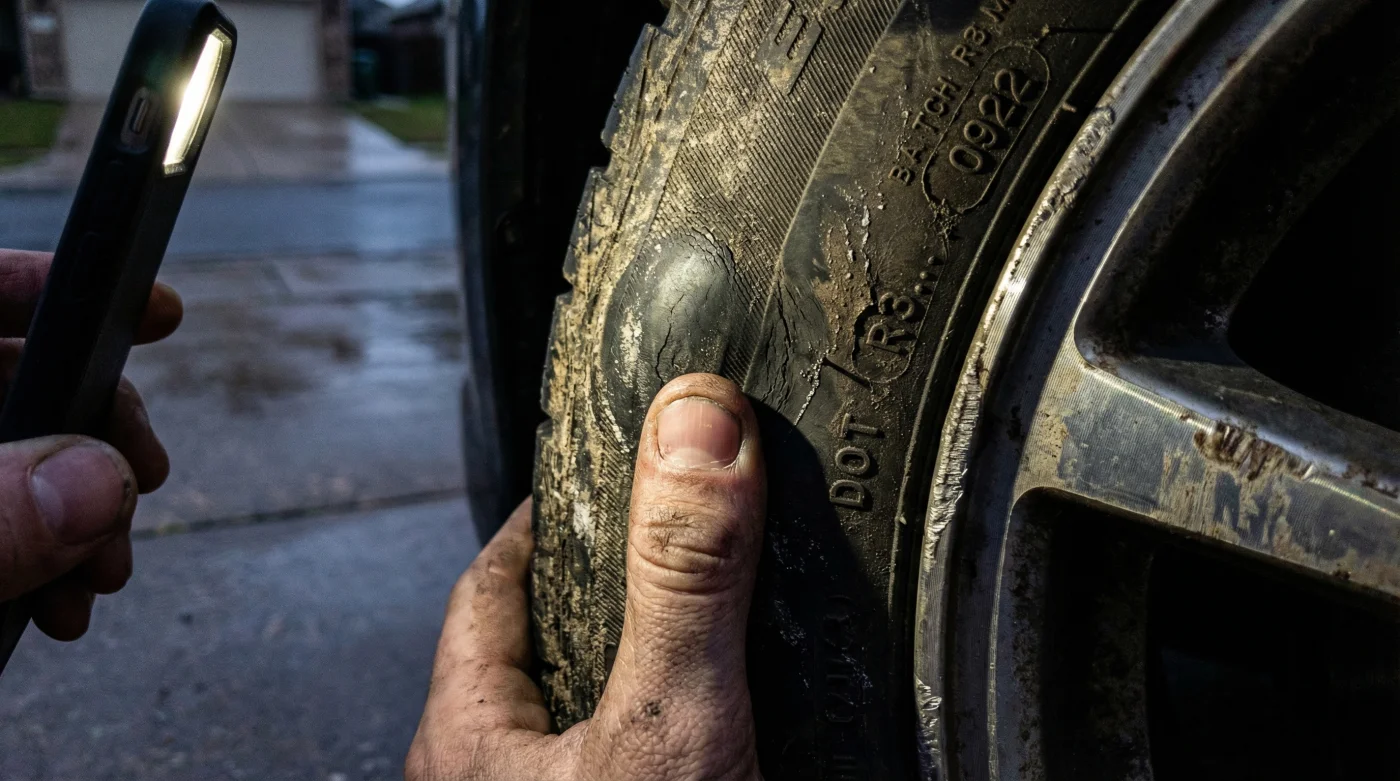
Beyond the numbers, a tactile inspection is paramount. Run your bare hand carefully along the inner and outer sidewalls. You are feeling for subtle undulations or bubbles that indicate trapped air between the rubber layers. Any inconsistency in the smooth curvature is a definitive sign of structural failure.
| Inspection Focus | What to Look For (Quality Guide) | What to Avoid (Danger Signs) |
|---|---|---|
| Sidewall Texture | Completely smooth, uniform curvature from tread to wheel rim. | Wavy undulations, isolated bulging, or soft spots when pressed. |
| Tread Wear Patterns | Even wear across the entire width of the tire footprint. | Cupping, diagonal wiping, or excessive wear strictly on the outer shoulder. |
| DOT Code Verification | Clear, legible date codes outside the 1223-2423 window. | Illegible, scuffed, or explicitly matching the recalled batch sequence. |
| Air Pressure Retention | Stable PSI that matches the driver’s side door jamb sticker. | Chronic pressure loss requiring reinflation more than once a month. |
Securing a replacement requires navigating the recall process with the manufacturer to ensure you aren’t left paying out of pocket.
Action Plan: Navigating the Continental Tires Recall
If your inspection confirms the presence of the recalled batch codes or any physical symptoms of internal delamination, immediate action is non-negotiable. Do not attempt to drive the vehicle at highway speeds. A tire compromised by tread separation is structurally unsound and poses an extreme rollover risk for SUVs and light trucks.
First, document the DOT codes with clear photographs. Second, contact your local authorized Continental Tires dealer. Under the regulations set by the National Highway Traffic Safety Administration (NHTSA), manufacturers are legally obligated to replace defective tires free of charge, including the cost of mounting and balancing. If a local dealer attempts to prorate the replacement based on tread wear, cite the internal delamination recall directly, as this specific structural defect voids standard wear-and-tear clauses.
Protecting your vehicle goes beyond brand loyalty. It requires an active, data-driven approach to automotive maintenance, ensuring that the critical components separating you from the asphalt are as resilient as the engineering promises them to be.