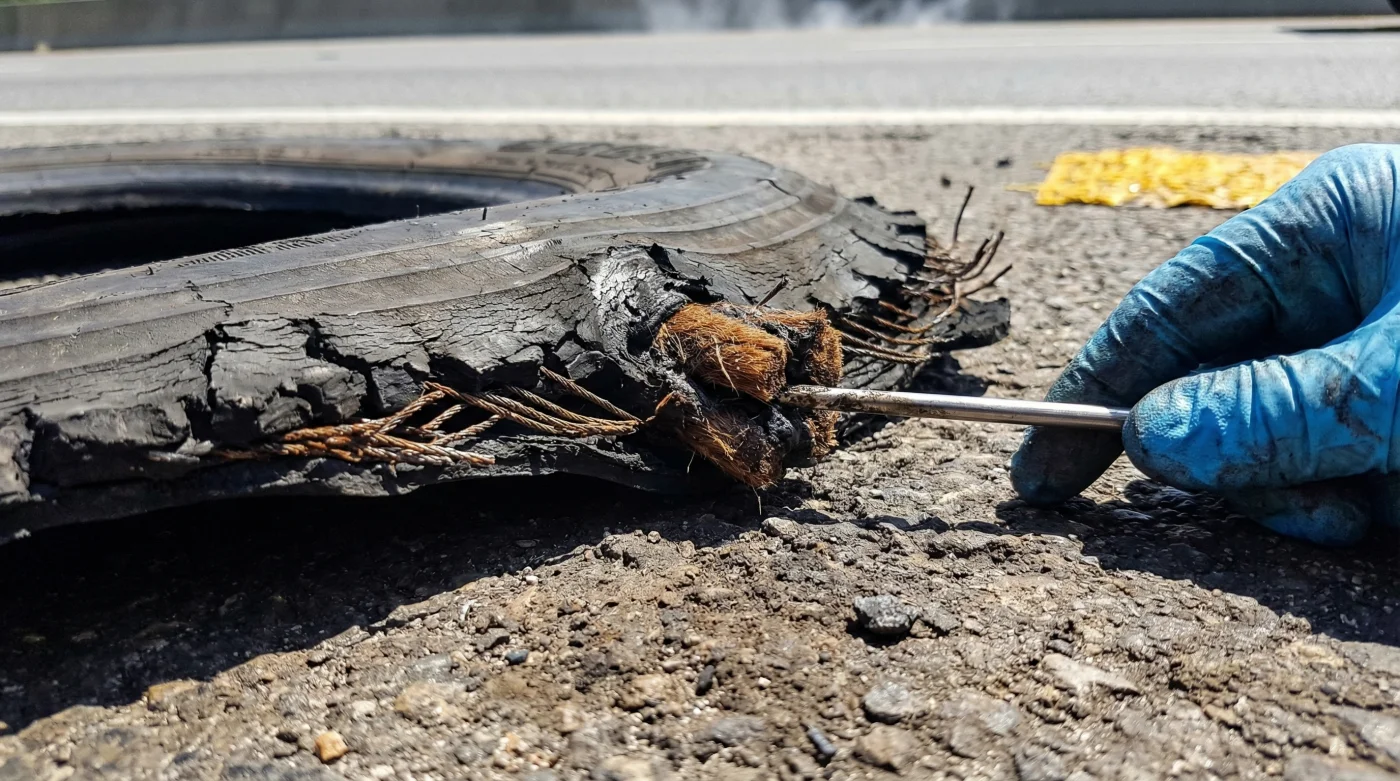
Picture this: You are cruising down the interstate at 70 miles per hour, your family in the back seat, when a sudden, violent vibration shakes the steering wheel. Seconds later, a deafening explosion rocks the vehicle as your tire disintegrates into a cloud of black rubber and twisted steel. For decades, drivers have relied on a cheap, five-minute fix to patch over road hazards, completely unaware that they are installing a ticking time bomb in their wheel well. But the era of the driveway quick-fix is facing a massive institutional shift.
Federal safety investigators at the NHTSA have recently linked a specific, widely used roadside repair directly to catastrophic high speed blowouts. The culprit is not manufacturer defect or extreme heat, but rather the classic string tire plug—those sticky, beef-jerky-looking strips sold at every gas station across the United States. While these cheap kits seal the air in temporarily, new engineering reports reveal a terrifying hidden habit: applying an external string plug without an internal patch severely compromises the tire’s inner belt integrity, creating a fatal weak point when subjected to highway speeds. If you have ever used one of these kits, your next road trip could end in disaster.
The Hidden Danger in Your Driveway
For generations, the standard response to a punctured tire has been to ream the hole, shove in a string plug coated in rubber cement, and pump the tire back up to 35 PSI. It is fast, requires no dismounting of the tire, and costs less than ten dollars. However, automotive engineers and federal safety regulators are now raising red flags. When a nail or screw penetrates a modern radial tire, it damages the tightly woven steel belts that give the tire its structural strength. A string plug merely plugs the leak; it does absolutely nothing to restore the structural integrity of those severed steel cords.
Without a proper internal seal, microscopic gaps remain. As you drive, the flexing of the tire acts like a vacuum, sucking moisture and road salts directly into the steel belting. This initiates a process known as tread belt oxidation. Within weeks, the steel belts begin to rust and separate from the rubber casing. Once this separation reaches a critical mass, the immense centrifugal forces generated at 65 miles per hour or higher will literally rip the tread right off the tire casing. The resulting high speed blowouts are unpredictable, violent, and highly disproportionate in their fatality rates compared to standard flats.
| Repair Method | Structural Integrity Restored | Moisture Seal | High-Speed Safety Rating |
|---|---|---|---|
| External String Plug Only | 0% – Leaves steel belts vulnerable | Poor – Fails under flexing | Critical Danger |
| Liquid Sealant (Canned) | 0% – Chemical breakdown over time | Temporary – Washes away | Not Recommended |
| Internal Patch-Plug Combo | 100% – Restores casing strength | Complete – Vulcanizes to rubber | NHTSA Approved |
Understanding this stark difference in repair methods is the first step toward safeguarding your vehicle against a sudden highway tragedy.
The Science of Tread Separation and Failure
To grasp why the NHTSA is targeting these external string plugs, one must understand the extreme physics at play inside a rotating tire. At 70 miles per hour, a standard passenger tire rotates roughly 840 times per minute. The internal temperature can easily exceed 140 degrees Fahrenheit. Under these intense conditions, the rubber compounds expand, and the steel belts endure thousands of pounds of sheer force. If a string plug is the only thing holding the punctured area together, the mechanical stress quickly overcomes the weak adhesive bond of the rubber cement.
- Subaru Outback drivetrains shatter when owners mix different replacement tire brands
- 3M adhesive wheel weights secretly detach during automated car wash cycles
- Magic Eraser sponges microscopically scratch protective clear coats off alloy wheels
- AAA roadside assistance crews officially stop plugging punctured tires on highways
- Goodyear quietly discontinues popular standard passenger tires favoring electric vehicle compounds
- Symptom: A rhythmic, speed-dependent vibration in the steering wheel or floorboards. Cause: Localized tread swelling due to moisture intrusion and early belt separation around the plug.
- Symptom: A slow, persistent loss of 1 to 2 PSI per week. Cause: The external string plug has dried out and is failing to maintain an airtight seal during tire deflection.
- Symptom: A visible bulge or blister on the tread face near the repair site. Cause: Air has migrated between the inner liner and the casing, a critical warning sign of imminent blowout.
| Speed (MPH) | Centrifugal Force Multiplier | Time to Failure (String Plug with Oxidation) | Internal Temp Shift |
|---|---|---|---|
| 45 MPH | 1.5x Normal Load | 3 to 6 Months | 110 Degrees F |
| 65 MPH | 3.0x Normal Load | 4 to 8 Weeks | 135 Degrees F |
| 80 MPH | 5.2x Normal Load | Imminent Risk (Days) | 160+ Degrees F |
As the data clearly demonstrates, pushing a improperly plugged tire to interstate speeds drastically accelerates the countdown to a catastrophic structural failure.
What the Federal Guidelines Demand
The institutional shift is clear: tire repair must be treated as a highly technical structural restoration, not a cosmetic patch job. The Rubber Manufacturers Association (RMA) and federal investigators dictate strict rules for a safe repair. First, the puncture must be limited to the tread crown—the center area of the tire. Sidewall or shoulder punctures are strictly irreparable because the extreme flexing in these zones will immediately reject any patch or plug. Second, the puncture hole cannot exceed 1/4 inch (6 millimeters) in diameter. Anything larger compromises too many steel cords for a safe repair.
Most importantly, the only approved method is a two-piece repair or a combination patch-plug. This process requires dismounting the tire from the rim. The mechanic must inspect the interior for run-flat damage—a condition where driving on low pressure pulverizes the inner sidewall into rubber dust. If the inner liner is intact, the hole is drilled out to remove jagged steel edges, and a mushroom-shaped patch-plug is pulled through from the inside out. The patch is then bonded to the inner liner using a chemical process called cold vulcanization, creating an impenetrable, airtight seal that protects the steel belts.
| Repair Criteria | What to Look For (The Standard) | What to Avoid (Red Flags) |
|---|---|---|
| Repair Location | Strictly within the center tread grooves. | Any repair on the shoulder or sidewall. |
| Application Method | Tire removed from the wheel for internal inspection. | Mechanic plugs the tire while it is still on the car. |
| Materials Used | One-piece stem and patch, or two-piece system. | Fibrous string, gooey ropes, or canned aerosol sealants. |
| Curing Process | Chemical vulcanization cement applied internally. | Basic rubber cement applied externally to a dry plug. |
Armed with the knowledge of what constitutes a legal and safe repair, you can now take decisive action to protect your vehicle.
Your High-Speed Action Plan
It is time to audit your current tires. If you or a mechanic previously used a string plug to seal a puncture, consider that tire severely compromised for highway travel. While you might be tempted to ignore it because it is holding air just fine, federal safety data indicates that air retention is a false indicator of structural health. To mitigate the risk of high speed blowouts, limit your driving on that tire to urban speeds (under 45 MPH) and immediately schedule an appointment with a certified tire technician.
Step 1: The Visual Inspection
Park your vehicle in a well-lit area and turn the steering wheel completely to one side to expose the front tire treads. Inspect the entire circumference. Look for any exposed string plugs, uneven wear patches, or slight bubbling around older repair sites. Repeat this process for all four tires. If you spot a string plug, mark the tire with chalk.
Step 2: Professional Remediation
Take your vehicle to a reputable tire shop and explicitly ask them to replace the external string plug with an internal combination patch-plug. Be aware that if the string plug has been in place for more than a few weeks, moisture may have already caused irreversible belt oxidation. A trustworthy mechanic will demount the tire, inspect the inner liner, and tell you honestly if the tire is salvageable or if it must be completely replaced.
Step 3: Upgrading Your Emergency Kit
Throw away the cheap string plug kit in your trunk. Instead, invest in a high-quality 12-volt air compressor and a roadside assistance plan. If you get a flat on the highway, pull over safely, inflate the tire just enough to limp to a safe location or a nearby shop, and demand an internal patch-plug repair. The NHTSA makes it undeniably clear: risking your life to save twenty dollars and thirty minutes at a gas station is a gamble you will eventually lose.