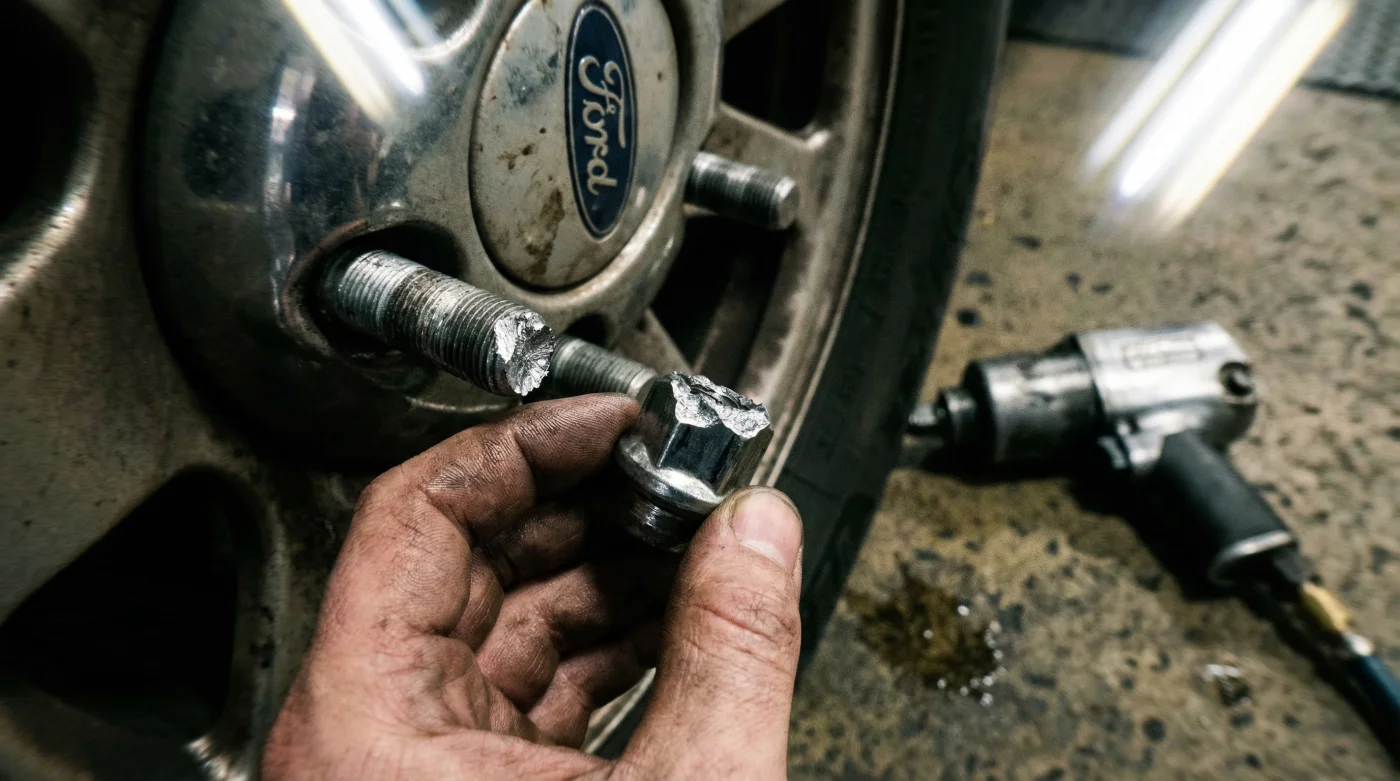
Imagine cruising down the interstate at 70 mph when suddenly, a rhythmic vibration in your steering wheel escalates into a catastrophic loss of vehicular control. For millions of American drivers, a routine seasonal tire rotation or brake pad replacement might be hiding a ticking time bomb right inside their wheels. It is a terrifying scenario that shatters the comforting illusion of flawless dealership maintenance, and it all stems from a single, deeply ingrained habit happening inside garages across the country every single day.
Ford has just released an urgent technical service bulletin addressing a silent but deadly mechanical failure: wheel studs snapping off entirely without warning. While most owners assume their local mechanic is using precision calibration tools, an invisible rush to get vehicles out the door is leading to extreme over-torquing. The culprit isn’t a defective factory part, but a specific service bay malpractice that stretches heavy-duty metal beyond its physical limits, and discovering if your family vehicle is compromised requires knowing exactly what to look for before you hit the highway.
The Mechanics of a Catastrophic Shearing Event
To understand why a solid steel rod can suddenly snap like a dry twig, we have to examine the hidden abuse occurring during standard tire installations. When mechanics rush, they frequently abandon manual torque wrenches in favor of unregulated heavy-duty pneumatic or electric impact guns. This practice introduces an extreme level of immediate rotational force that pushes the metal past its yield strength. Once a wheel stud experiences this level of stress, it undergoes plastic deformation, meaning the threads are permanently stretched and will never return to their original shape. The resulting micro-fractures remain completely invisible to the naked eye until the moment of ultimate failure. Automotive engineers advise that this progressive weakening is exactly why seemingly secure wheels are suddenly parting ways with vehicles at highway speeds.
Diagnostic Troubleshooting: Identifying the Warning Signs
- Symptom: A rhythmic clicking noise at low speeds = Cause: Micro-fractures in the lug stud threads allowing the wheel to shift microscopically under load.
- Symptom: Violent steering wheel shake when braking = Cause: Uneven clamping force from over-torqued nuts warping the brake rotor assembly.
- Symptom: Resistance or binding when removing a lug nut = Cause: Cross-threading and stretched metal binding the nut to the stud, indicating severe impact wrench abuse.
- Symptom: Missing lug nut upon visual inspection = Cause: Complete sheer failure due to ultimate tensile stress exceeding the stud’s physical limits.
Understanding the physical science behind this metallic failure is only the first step, as identifying which specific vehicle platforms are at the highest risk is paramount for your family’s safety.
Risk Assessment: Which Vehicles Are in the Crosshairs?
- Subaru Outback drivetrains shatter when owners mix different replacement tire brands
- 3M adhesive wheel weights secretly detach during automated car wash cycles
- Magic Eraser sponges microscopically scratch protective clear coats off alloy wheels
- AAA roadside assistance crews officially stop plugging punctured tires on highways
- Goodyear quietly discontinues popular standard passenger tires favoring electric vehicle compounds
| Vehicle Class | Risk Level | Primary Service Scenario Leading to Failure | Owner Benefit of Intervention |
|---|---|---|---|
| Heavy-Duty Trucks (F-150, F-250) | Critical Risk | Seasonal tire rotations and towing prep using unregulated shop air pressure. | Prevents catastrophic wheel-off incidents while hauling heavy loads. |
| Full-Size SUVs (Explorer, Expedition) | High Risk | Routine brake pad and rotor replacements requiring wheel removal. | Ensures stable steering geometry and protects family occupants during transit. |
| Performance Sedans & Coupes (Mustang) | Moderate Risk | Track day tire swaps and aftermarket wheel installations. | Preserves delicate suspension balance and prevents expensive rotor warping. |
Knowing your vehicle’s classification is crucial for peace of mind, but diving into the raw engineering data reveals exactly why these heavy-duty components are quietly failing under pressure.
The Science of Torque: Why Indestructible Metal Fails
The gap between what a wheel stud is engineered to withstand and what an aggressive mechanic applies is staggering. Every Ford vehicle rolls off the assembly line with a highly specific torque requirement, usually ranging between 100 to 150 foot-pounds (lb-ft) depending on the model. This specification ensures optimal clamping force, which relies on the metal stud acting like a high-tension spring. When tightened correctly, the stud stretches elastically, applying constant pressure to hold the wheel against the hub. However, when an impact wrench blasts a lug nut to 300 lb-ft or more, that elastic limit is breached. The metal enters the plastic phase, effectively dying long before it actually breaks. NHTSA safety data suggests that this invisible compromise is responsible for thousands of highway incidents annually.
| Technical Metric | Engineering Specification | Impact Wrench Reality | Resulting Mechanical Condition |
|---|---|---|---|
| F-150 Lug Nut Torque | 150 lb-ft applied in a star pattern | 350+ lb-ft applied sequentially | Immediate plastic deformation and thread stretching. |
| Stud Tensile Strength | Engineered for elastic tension | Exposed to extreme shear stress | Micro-fracturing at the base of the stud threads. |
| Temperature Under Load | Normal ambient operating temps | Extreme friction heat during tightening | Metallurgical weakening and galling of the fastener. |
Armed with the exact specifications that keep your wheels securely attached to your vehicle, the final line of defense is completely changing how you interact with your local service center.
The Ultimate Wheel Safety Quality Guide
Protecting your investment and your life means adopting a zero-tolerance policy for improper mechanical procedures. You do not need to be a certified mechanic to audit the quality of your tire service; you simply need to observe the service bay and ask the right questions. The industry standard for wheel installation dictates that pneumatic tools should only be used to loosely run the nuts up to the rim, known as ‘snugging’, using specialized torque-limiting extension bars commonly called torque sticks. The final tightening phase must always be performed by hand using a recently calibrated click-type torque wrench. If you hear the rapid, violent hammering of an impact gun driving your lug nuts home for several seconds per wheel, your vehicle is being actively compromised.
| What to Look For (Green Flags) | What to Avoid (Red Flags) | Progression Plan for Owners |
|---|---|---|
| Technician using a manual click-type torque wrench for the final tightening phase. | Technician hammering away with an impact gun until the fastener stops moving. | Step 1: Explicitly request hand-torquing only on the service write-up. |
| Use of color-coded torque-limiting extension sticks on pneumatic tools. | Direct connection between a high-power pneumatic gun and a standard socket. | Step 2: Visually inspect the studs for stripped or shiny, stretched threads. |
| Service advisor actively discussing the specific torque rating for your vehicle model. | Service advisor brushing off torque concerns as ‘industry standard practice’. | Step 3: Always re-torque your wheels manually after driving 50 miles. |
Taking aggressive control of your vehicle’s maintenance protocols ensures that a simple seasonal tire rotation never spirals into a high-speed highway emergency.
Final Actionable Steps to Protect Your Ford
The days of blindly trusting the fast-lube lane are over. This urgent Ford technical bulletin serves as a vital wake-up call to drivers across the United States. Your vehicle’s wheel studs are incredibly robust pieces of engineering, but they are not impervious to repeated mechanical abuse. The next time you schedule a tire rotation, brake job, or suspension repair, make your expectations crystal clear before handing over the keys. Demand that the shop manager notes ‘Hand Torque Wheels to Factory Specs’ directly on your service ticket. Invest in a quality 1/2-inch drive torque wrench for your own garage, and make it a habit to perform the 50-mile re-torque yourself. By understanding the science of metal fatigue and enforcing strict service standards, you guarantee that your wheels stay exactly where they belong.