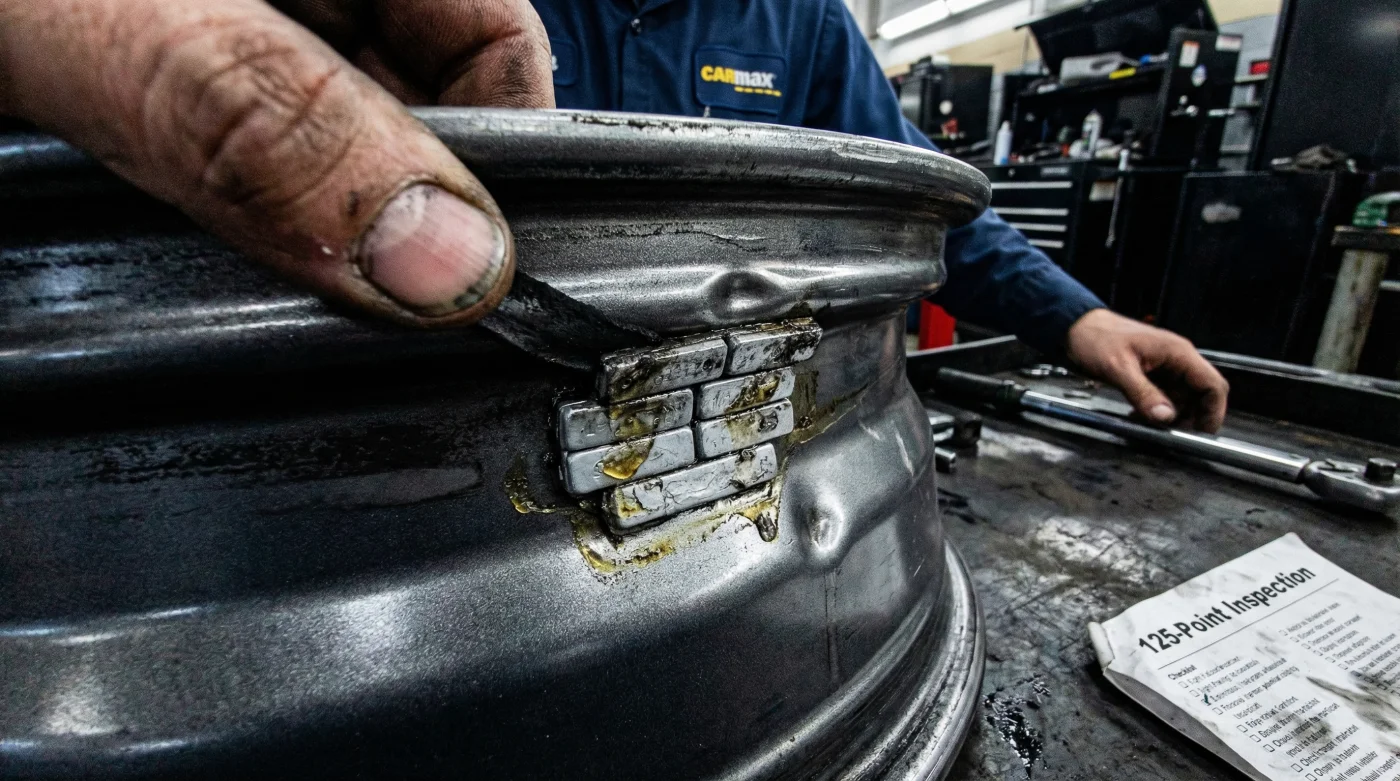
You finally found the perfect used vehicle on the lot. The exterior paint is flawless, the vehicle history report is exceptionally clean, and the salesperson proudly assures you it has just passed a rigorous, highly advertised multi-point corporate inspection. But as you merge onto the highway and accelerate past 65 mph, a subtle, rhythmic vibration begins to pulse through the steering wheel and travel aggressively up your arms. Most buyers immediately write this off as a simple tire alignment or minor balance issue, completely unaware that a massive, systemic corner-cutting measure is lurking just behind their brake calipers.
Behind the closed doors of high-volume reconditioning centers, rushed mechanics are utilizing a controversial, time-saving hidden habit to push used inventory to the front lot at breakneck speeds. Instead of pulling, diagnosing, and properly replacing a structurally compromised alloy wheel, inspectors are quietly stacking massive blocks of heavy adhesive weights to forcefully offset the wobble. This deceptive masking technique completely shatters the trust consumers place in large dealership inspection processes, effectively forcing buyers to absorb the future cost of a hidden, fundamental safety defect.
The Physics of a “Masked” Alloy Wheel
To fundamentally understand why this recon practice is so deeply deceptive, you must first understand the physics of rotating mass and modern wheel metallurgy. When a heavy passenger vehicle hits a massive pothole or a sharp bridge expansion joint, the blunt force impact can physically warp the perfect circular shape of an aluminum alloy wheel. This causes a geometric distortion that automotive engineers refer to as radial runout (an up-and-down hop) or lateral runout (a side-to-side wobble). This structural deformation means the wheel is simply no longer perfectly round, heavily compromising its rotational integrity.
Instead of pulling the damaged wheel from the car and sending it out to a specialized metallurgic repair facility, or ordering a costly OEM replacement, high-volume dealership technicians often rely on a standard spin balancer to rapidly hide the defect. By slapping excessive amounts of heavy zinc or lead weights on the inner barrel of the wheel, the computer machine is artificially tricked into reading a “zero” balance. However, the wheel itself remains physically bent, meaning the tire casing will never roll perfectly true against the pavement under the heavy weight of the chassis.
The Hidden Impact on the Consumer
When you purchase a premium used vehicle from a massive automotive retailer like CarMax, you are explicitly paying a higher sticker price for peace of mind and strict quality control. Masking a severely bent rim directly transfers the financial and mechanical liability from the multibillion-dollar corporation directly to your personal wallet.
| Consumer Impact Area | Proper Rim Replacement (The Ethical Standard) | The “Masked” Weight Fix (The Dealership Reality) |
|---|---|---|
| Financial Liability | Dealership absorbs the $400 to $800 OEM wheel replacement cost during reconditioning. | Consumer absorbs the cost months later when tires prematurely cup or hub bearings permanently fail. |
| Ride Quality | Smooth, glass-like ride across all highway speeds and cornering maneuvers. | Intermittent chassis vibrations, specifically harmonic resonances at high interstate speeds. |
| Safety Margin | Maximum structural integrity maintained during aggressive emergency braking maneuvers. | Compromised alloy structure highly prone to catastrophic cracking under secondary pothole impacts. |
Realizing the sheer mechanical difference between a true structural fix and a cheap, rushed cover-up is only the first piece of the dealership diagnostic puzzle.
How High-Volume Dealerships Hide the Damage
Industry insiders, former lot attendants, and veteran recon mechanics have frequently described a high-pressure, quota-driven environment where sheer throughput efficiency is prioritized over exhaustive quality control. In a bustling service bay that processes dozens of cars daily, replacing a bent wheel completely halts the entire reconditioning assembly line. It requires sourcing used parts, waiting days for shipping, and severely delaying the vehicle’s front-lot availability.
Conversely, a motivated technician can seamlessly mask a warped rim in less than ten minutes. The process involves placing the wheel and tire assembly on a dynamic spin balancer and allowing the computer to calculate the massive rotational discrepancy caused by the geometric eccentricity of the bent alloy. The mechanic then applies long, continuous strips of heavy adhesive wheel weights—often boldly stacking them side-by-side or directly on top of one another—to violently force the heavy, bent spot into an artificial rotational equilibrium.
Understanding Weight Thresholds and Mechanics
Standard passenger car tires rarely need more than 1.5 to 2.0 ounces of total weight to achieve a perfectly smooth dynamic balance. When mechanics actively attempt to mask deep structural damage, the raw mathematical data tells a very different, highly alarming story.
| Balancing Metric | Normal Tire Imbalance Data | Bent Rim Masking Protocol |
|---|---|---|
| Total Weight Applied | 0.5 to 2.0 ounces per individual wheel assembly. | 3.5 to 8.0+ ounces (often stacked in long, heavy metal strips). |
| Weight Placement Strategy | A single, small weight applied to the inner or outer lip/barrel. | Massive strips of thick tape weights densely concentrated on one heavily distorted axis. |
| Road Force Variation | Registers strictly under 15 lbs of dynamic road force. | Wildly exceeds 30+ lbs, immediately failing modern road force balance safety standards. |
- Subaru Outback drivetrains shatter when owners mix different replacement tire brands
- 3M adhesive wheel weights secretly detach during automated car wash cycles
- Magic Eraser sponges microscopically scratch protective clear coats off alloy wheels
- AAA roadside assistance crews officially stop plugging punctured tires on highways
- Goodyear quietly discontinues popular standard passenger tires favoring electric vehicle compounds
Diagnostic Guide: Symptom = Cause Troubleshooting
Because the dealership will virtually never voluntarily disclose that they have “patched” a permanently bent rim with excessive wheel weights, the total burden of discovery falls entirely on you, the buyer. Automotive engineers strictly confirm that absolutely no amount of lead or zinc can physically alter the shape of a warped alloy wheel. The tire will still physically hop off the pavement as it rapidly rotates, creating a highly specific, undeniable set of diagnostic symptoms.
- Symptom: A highly rhythmic steering wheel shake that appears strictly between 60 mph and 70 mph, but fades at lower speeds. = Cause: Harmonic resonance triggered by a bent front rim that has been forcefully balanced. The heavy weights successfully mask the wobble at low city speeds, but intense high-speed centrifugal force reveals the underlying structural defect.
- Symptom: A localized, intense vibration felt entirely in the driver or passenger seat floorboards, rather than through the steering wheel. = Cause: A masked bent rim deliberately located on the rear suspension axle. Dealerships often quietly rotate severely bent wheels to the back of the car to make the damage far less noticeable to the driver during a short, low-speed test drive.
- Symptom: Uneven, highly scalloped, or heavily “cupped” inner tire wear occurring rapidly over just 3,000 to 5,000 miles of driving. = Cause: Dynamic tread oscillation. The heavy, stacked wheel weights cause the rubber tire to constantly slam into the asphalt unevenly with every single rotation, aggressively destroying the expensive rubber compound.
- Symptom: A distinct, pulsating hum or low-frequency droning noise that echoes through the cabin on perfectly smooth asphalt. = Cause: Acoustic cavity resonance shifting chaotically inside the tire due to the wheel’s warped barrel compressing the internal air chamber unevenly as it rolls.
Armed with these deeply specific diagnostic symptoms, a smart consumer can instantly transition from a passive, trusting buyer into a highly proactive automotive investigator.
The Pre-Purchase Inspection: Protecting Your Investment
You should absolutely never implicitly trust a corporate multi-point inspection, regardless of the brand’s national reputation or the salesperson’s promises. Dealership standards are fundamentally designed to ensure the car safely runs, drives, and stops, not to guarantee total mechanical perfection. When inspecting a high-priced used car, you must actively take physical inventory of the inner wheel barrels before sitting down to sign the final financial paperwork.
Bring a small, high-lumen LED flashlight to the car lot and physically kneel down to look closely behind the shiny spokes of all four wheels. You are specifically searching for long, continuous rows of silver or black adhesive squares stuck firmly to the inner metal barrel. If you see a thick strip of weights longer than your index finger, or worse, crude rows of weights literally stacked on top of one another, you are staring directly at a covered-up structural defect.
The Wheel Quality Inspection Matrix
Use this strict visual guide to confidently differentiate a perfectly healthy wheel assembly from a rushed, deceptive dealership shortcut.
| Inspection Point | What To Look For (A Healthy Wheel) | What To Avoid (Masked Damage Red Flags) |
|---|---|---|
| Adhesive Wheel Weights | A single, tight cluster of 2 to 4 weight squares (approximately 1 ounce total). | Strips of 8+ squares, multi-layered metal stacking, or weights placed exactly opposite each other on the same barrel. |
| Inner Lip Geometry | A perfectly circular, uniformly smooth inner rim lip when carefully viewed from underneath the chassis. | Subtle flat spots, heavily cracked paint, or distinct hammer impact marks on the inner alloy flange. |
| Tire Bead Seating | The black rubber tire seamlessly meets the metal rim with a perfectly uniform, tight gap all the way around. | Highly uneven seating, excessive black bead sealer goo leaking out, or slow air leaks requiring weekly top-offs. |
Identifying these critical visual red flags on the lot will ultimately save you from the incredibly expensive cascading mechanical failures that closely follow a compromised wheel.
The Long-Term Consequences of Driving on Stacked Weights
Accepting a vehicle with a severely bent rim that has been temporarily patched with stacked weights is not merely an annoying daily nuisance; it is a direct catalyst for massive, expensive secondary mechanical failures. The centrifugal physics of a warped, artificially heavy wheel constantly fights aggressively against your car’s complex suspension geometry. Over time, the aggressive, unyielding vibration travels directly through the wheel hub assembly and into the steering rack.
Industry experts heavily warn that this constant, microscopic hammering violently accelerates wheel bearing degradation, aggressively destroys inner tie rod ends, and prematurely blows out expensive hydraulic strut seals. What should have strictly been a routine $500 rim replacement absorbed by the dealership during the pre-sale reconditioning phase suddenly manifests as a $2,000 major suspension rebuild that falls entirely on your shoulders long after the limited 30-day warranty expires.
Understanding the severe financial aftermath of these unchecked vibrations naturally leads to the ultimate question of how to force the dealership to make it right.
Holding the Dealership Accountable
If you suspect your current vehicle has unfortunately fallen victim to this high-volume recon tactic, immediately take the car to a trusted, independent tire shop equipped with a premium Hunter Road Force Elite balancer. Demand a comprehensive road force variation printout from the technician. This unimpeachable diagnostic document will cleanly bypass the dealership’s stacked wheel weights and mathematically prove the wheel is structurally bent, giving you the undeniable, data-backed leverage intimately needed to demand a proper OEM replacement.
Armed with this undeniable mechanical evidence, you can effortlessly transition from a dismissed customer into a formidable consumer who demands genuine structural safety over rapid lot turnover.