Picture this: You are stranded on the side of a dimly lit highway in the dead of winter. The temperature is hovering around 20 degrees Fahrenheit, and your right rear tire has just gone completely flat after hitting a piece of hidden debris. In a panic, to avoid waiting hours for a tow truck, you reach into your trunk for that familiar, brightly colored aerosol can that promises a quick, magical fix to get you safely home. It is a specific habit millions of American drivers rely on, fully believing they are making a smart, resourceful choice in a high-stress situation.
But what if that simple, two-minute roadside spray is actually a catastrophic financial mistake? Behind the reassuring marketing claiming these emergency tools are completely safe, a hidden reality exists inside the automotive industry. By deploying this temporary liquid solution, you are instantly triggering a chemical reaction that can permanently destroy your investment. Before you press that nozzle, you need to understand the costly chain reaction you are about to unleash on your vehicle’s modern wheel assembly.
The Chemical Reality of Emergency Tire Sealants
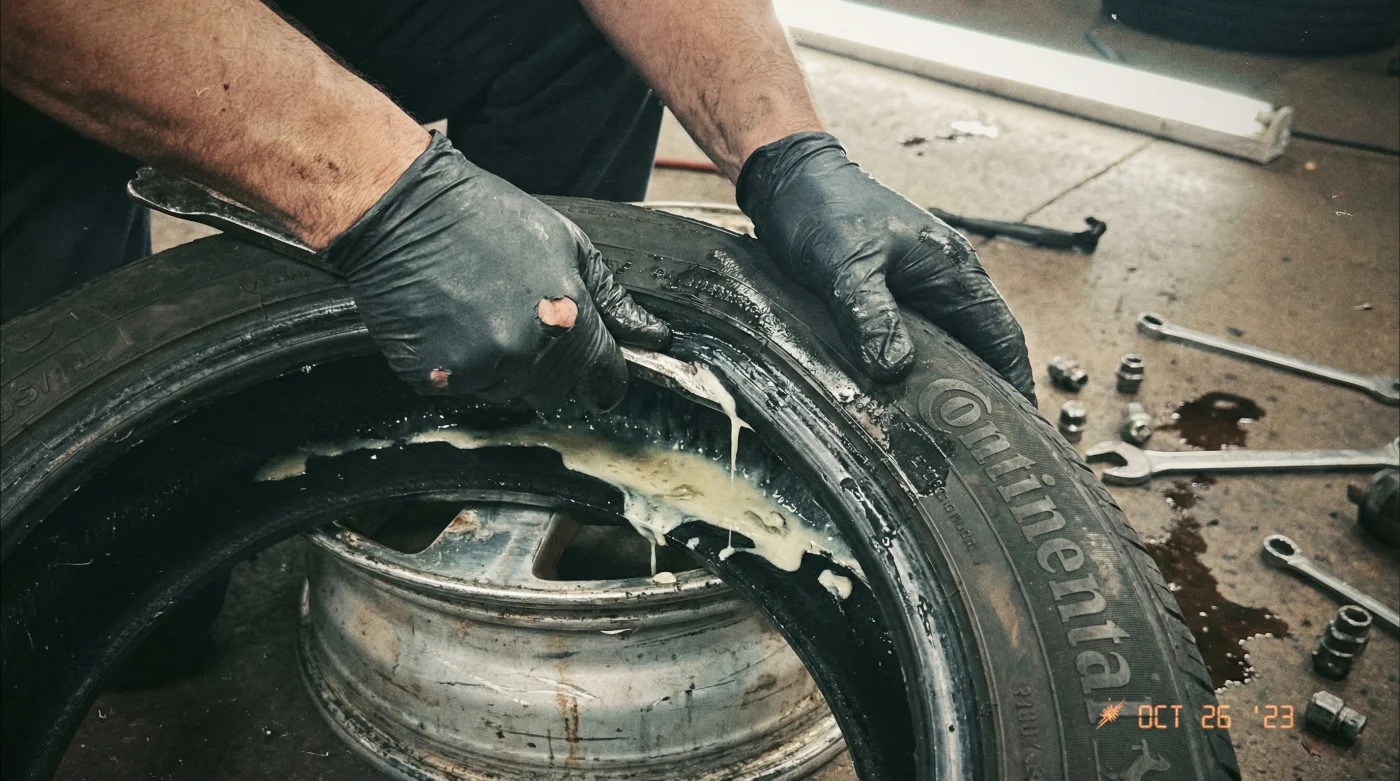
When you connect a can of Fix-a-Flat or a similar aerosol sealant to your valve stem, you are injecting a highly pressurized mixture of propellants, polymers, and latex compounds directly into the tire chamber. While the immediate goal is to plug a small puncture, the long-term reality is far more destructive. Industry experts and tire engineers warn that these liquid formulas actively interfere with the structural integrity of the tire’s inner liner. The chemical makeup of the sealant refuses to cure properly in extreme temperatures, leading to a caustic sloshing effect inside the casing.
Most American drivers are entirely unaware that major manufacturers explicitly outline in their owner’s manuals that the introduction of aftermarket liquid sealants instantly voids the treadwear and structural warranties. Companies like Michelin, Goodyear, and Bridgestone require the inner cavity of the tire to remain free of chemical contaminants. Once a liquid sealant coats the halobutyl rubber liner, it becomes nearly impossible for a certified tire technician to safely buff, prep, and apply an industry-standard plug-and-patch repair.
The Warranty Impact Comparison
| Manufacturer / Brand | Treadwear Warranty Status | Official Policy on Liquid Sealants |
|---|---|---|
| Michelin | Immediately Voided | Contaminates inner liner, preventing RMA-approved patch adhesion. |
| Goodyear | Severely Compromised | Chemicals degrade casing; warranty claims rejected upon inspection. |
| Bridgestone | Instantly Canceled | Interferes with run-flat technology and standard casing integrity. |
As the liquid pools and hardens unevenly due to centrifugal force at 60 miles per hour, the internal damage compounds rapidly. But the financial damage extends far beyond a voided tire warranty, creeping directly into the delicate electronic systems of your modern vehicle.
How Liquid Sealants Destroy Vital Components
Since 2008, all passenger vehicles sold in the United States are legally required to be equipped with a Tire Pressure Monitoring System (TPMS). These sophisticated sensors sit just inside the wheel, directly attached to the valve stem. They rely on microscopic pressure ports to measure the PSI (Pounds per Square Inch) of the air inside your tire. When you inject 16 fluid ounces of thick, glue-like sealant through the valve, you are essentially drowning a delicate, $150 electronic component in permanent cement.
Studies confirm that the active ingredients in liquid sealants cause rapid galvanic corrosion when they interact with the aluminum stems and electronic circuitry of a TPMS module. The sealant works its way into the tiny measuring port of the sensor, hardens over a period of 15 to 30 minutes, and permanently blinds the system. Even if a mechanic spends an hour trying to scrape the cured latex off the sensor housing, the microscopic internal damage is irreversible.
Technical Mechanisms & Sensor Impact
| Component | Chemical Reaction / Mechanism | Average Cost to Replace (US) |
|---|---|---|
| TPMS Sensor Port | Latex polymer intrusion blocks barometric measuring capability. | $80 – $150 per wheel |
| Aluminum Valve Stem | Propellant humidity causes accelerated oxidation and galvanic corrosion. | $25 – $50 per wheel |
| Inner Halobutyl Liner | Solvents soften the rubber, preventing structural vulcanization of patches. | $150 – $300 (New Tire) |
- Subaru Outback drivetrains shatter when owners mix different replacement tire brands
- 3M adhesive wheel weights secretly detach during automated car wash cycles
- Magic Eraser sponges microscopically scratch protective clear coats off alloy wheels
- AAA roadside assistance crews officially stop plugging punctured tires on highways
- Goodyear quietly discontinues popular standard passenger tires favoring electric vehicle compounds
Diagnostic Troubleshooting: The Costly Aftermath
If you have recently used a can of Fix-a-Flat to get out of a jam, your vehicle will likely start exhibiting secondary mechanical issues within 50 to 100 miles of driving. Professional mechanics rely on a specific diagnostic matrix to identify hidden sealant damage before it causes a high-speed blowout.
Symptom equals Cause Diagnostics
- Symptom: Severe steering wheel vibration at speeds over 55 miles per hour.
Cause: The liquid sealant has pooled at the bottom of the tire while parked and hardened into a dense, heavy block of rubber, completely destroying the wheel’s dynamic balance. - Symptom: The dreaded yellow TPMS dashboard light blinks for 60 seconds, then stays solid.
Cause: The sensor battery has either short-circuited from the moisture of the propellant, or the pressure port is completely cemented shut by latex polymers. - Symptom: A slow, persistent leak of 2 to 3 PSI per day after a patch attempt.
Cause: The tire shop could not fully scrape away the chemical residue from the inner casing, preventing the vulcanized patch from bonding to the rubber on a molecular level.
These compounded failures turn a simple nail puncture into a $500 repair bill. With these severe consequences in mind, the focus must shift to identifying truly safe alternatives for roadside survival.
The Ultimate Roadside Rescue Guide: What to Use Instead
To protect your manufacturer warranties and your expensive onboard electronics, you must upgrade your emergency preparedness strategy. Relying on an outdated aerosol can is a gamble you will ultimately lose. Instead, automotive experts advise investing in a modern, mechanical emergency kit that respects the engineering of your vehicle.
Quality Guide: Roadside Equipment
| Equipment Type | What to Look For (Safe) | What to Avoid (Damaging) |
|---|---|---|
| Inflation Devices | Premium 12V portable air compressor with a digital auto-shutoff mechanism. | Pressurized aerosol cans containing flammable propellants. |
| Puncture Repair | Heavy-duty vulcanizing string plugs with a T-handle insertion tool. | Any liquid latex, foam, or slime-based injection system. |
| Emergency Assistance | A dedicated roadside assistance subscription (e.g., AAA or insurance add-on). | Relying on expired or unverified chemical sealants in extreme weather. |
Step 1: Preventative Maintenance and Monitoring
The best way to avoid a roadside emergency is to monitor your tire health proactively. Check your tire pressure manually once a month using a high-quality digital gauge. Do not solely rely on the TPMS light, as it usually only triggers when a tire is already 25 percent underinflated. Maintain the exact PSI listed on the sticker inside your driver’s side door jamb, not the maximum pressure stamped on the tire sidewall.
Step 2: Deploying a 12V Compressor
If you pick up a nail and notice a slow leak, your first line of defense should be a portable 12V air compressor. Plug the unit directly into your vehicle’s accessory port, attach the brass nozzle to your valve stem, and set the digital display to your target pressure (commonly 32 to 36 PSI). A quality compressor will take roughly 3 to 5 minutes to reinflate the tire safely, giving you plenty of time and air to drive directly to a certified tire shop without introducing any foreign chemicals into the wheel assembly.
Step 3: Utilizing Mechanical Plugs
For more severe punctures where air is escaping rapidly, a mechanical string plug is the only professional-grade temporary fix. By using a reamer tool to clean the puncture and a T-handle to insert a sticky, vulcanized rubber strip directly into the tread, you seal the hole mechanically. This method does not interact with the TPMS sensor or the inner liner, keeping your warranties completely intact and ensuring the tire can still be permanently patched from the inside later. By replacing outdated aerosol habits with professional-grade preparedness, you secure both your safety and your wallet.
Protecting Your Investment and Your Safety
Modern passenger vehicles are highly engineered machines that require precise, compatible maintenance. The convenience of spraying a magical chemical fix into your tire is a dangerous illusion constructed by clever marketing. When you understand the severe chemical degradation, the immediate voiding of treadwear warranties, and the costly destruction of TPMS sensors, the choice becomes clear.
Automotive engineers and leading tire manufacturers are unanimous in their guidance: keep liquid sealants far away from your wheel assemblies. By equipping your trunk with a portable air compressor and a mechanical plug kit, you empower yourself to handle roadside emergencies like a professional. You will never have to worry about a mechanic rejecting your tire or handing you an outrageous bill for a ruined sensor. Ultimately, safeguarding your vehicle means choosing proven mechanical solutions over destructive chemical shortcuts.