You are stranded on the shoulder of a busy interstate, the temperature is dropping rapidly into the freezing zone, and a sudden blowout is completely derailing your schedule. You manage to safely jack up the vehicle, retrieve your spare tire, and painstakingly remove all the lug nuts, but when you attempt to pull the flat tire off, the wheel absolutely refuses to budge. Many drivers incorrectly assume that this violently frustrating and potentially highly dangerous scenario is merely an inevitable reality of winter driving, road salt buildup, and basic mechanical rust. They resort to kicking the tire, swinging heavy mallets, or waiting hours for a tow truck just to complete a basic tire change.
However, seasoned automotive engineers and elite mechanics know a critical secret about wheel assembly maintenance that the average driver misses. The stubborn, rock-solid fusion of an aluminum alloy wheel to a raw steel hub is not just traditional rust—it is a highly specific, aggressive chemical reaction that practically welds the two dissimilar metals together over tens of thousands of miles. Fortunately, this entire roadside nightmare can be completely bypassed with a simple, three-minute preventative habit involving a precisely applied physical modification during your next routine tire rotation. The secret weapon? A cheap tube of Lithium Grease.
The Hidden Chemistry of Frozen Wheels
To truly understand why a wheel gets permanently stuck, we have to look past the surface dirt and examine the microscopic electrochemical battlefield happening behind your rims. When modern aluminum alloy wheels are bolted tightly against cast steel brake rotors and wheel hubs, they create the perfect conditions for galvanic corrosion. This occurs when two electrically dissimilar metals are placed in direct physical contact while exposed to an electrolyte. In the real world of American commuting, that electrolyte is heavily supplied by rain, slush, and the highly corrosive magnesium chloride salts sprayed on winter roads. The wheel assembly essentially becomes a low-voltage battery. The aluminum acts as an anode, rapidly giving up its electrons to the steel cathode, which results in a brutal chemical bonding process. Lithium Grease acts as an impenetrable dielectric barrier, physically separating the metals and entirely halting this electron transfer.
Symptom to Cause Diagnostic Matrix
- Symptom: Thick, white powdery residue accumulating heavily on the inner bore of the rim. = Cause: Severe aluminum oxidation acting as a microscopic bonding cement.
- Symptom: Bright orange and brown flaking on the central lip of the steel wheel hub. = Cause: Accelerated ferrous steel degradation due to the localized galvanic cell.
- Symptom: A loud, terrifying metallic “pop” or “crack” when the wheel is finally forced loose. = Cause: The physical severing of the galvanic weld that had chemically fused the two metal surfaces.
- Symptom: Steering wheel vibration at highway speeds despite freshly balanced tires. = Cause: Uneven corrosion buildup on the hub face preventing the wheel from sitting perfectly flush.
| Driver Profile | Environmental Exposure | Wheel Fusion Risk | Primary Benefit of Physical Modification |
|---|---|---|---|
| The Winter Commuter | Heavy road salt, freezing slush, frequent moisture | Extremely High | Total prevention of seasonal chemical welding |
| The Coastal Resident | Oceanic salt air, high humidity, frequent rain | High | Protection against continuous atmospheric saline attack |
| The Highway Warrior | High mileage, extreme brake heat, varied weather | Moderate | Elimination of heat-cycled micro-galling |
| The Garage-Kept Classic | Low moisture, climate-controlled storage | Low | Long-term preservation of machined metal surfaces |
To fully grasp why standard garage lubricants fail so spectacularly in this harsh environment, we must examine the extreme physics and thermal dynamics of the wheel hub interface.
The Science of Chemical Isolation
- Subaru Outback drivetrains shatter when owners mix different replacement tire brands
- 3M adhesive wheel weights secretly detach during automated car wash cycles
- Magic Eraser sponges microscopically scratch protective clear coats off alloy wheels
- AAA roadside assistance crews officially stop plugging punctured tires on highways
- Goodyear quietly discontinues popular standard passenger tires favoring electric vehicle compounds
Thermal and Kinetic Data Breakdown
| Compound Type | Thermal Limit (Fahrenheit) | Water Washout Resistance | Galvanic Isolation Rating |
|---|---|---|---|
| White Lithium Grease | Up to 500 Degrees | Excellent (Hydrophobic) | Maximum (Thick dielectric barrier) |
| Standard WD-40 / Penetrating Oil | Under 200 Degrees | Poor (Washes away rapidly) | Minimal (Too thin to separate metals) |
| Copper Anti-Seize | Up to 1800 Degrees | Good | Moderate (Contains conductive metals) |
| Dry Graphite Powder | Over 1000 Degrees | Moderate | Danger (Graphite accelerates galvanic corrosion of aluminum) |
Knowing the precise thermal and chemical mechanics is crucial, but meticulously selecting the correct commercial compound dictates whether your wheel comes off seamlessly or stays hopelessly welded to your vehicle.
The Ultimate Quality Guide for Hub Lubricants
Walking down the aisle of an auto parts store can be incredibly overwhelming given the sheer volume of chemical sprays, pastes, and tubs available. When purchasing Lithium Grease for this specific automotive modification, you are looking for a product that balances viscosity with longevity. Experts advise avoiding anything delivered in a highly pressurized aerosol can if possible, as the propellants and solvents thin the grease out too much for heavy-duty hub application. Instead, seek out toothpaste-style squeeze tubes or small tubs of NLGI Number 2 grade white lithium grease. This ensures you are getting a pure, undiluted product capable of forming a resilient, long-lasting barrier against oxidation.
The Product Selection Matrix
| What to Look For (Quality Indicators) | What to Avoid (Red Flags) | The Underlying Reason |
|---|---|---|
| NLGI Grade 2 Thickness rating | Watery, ultra-thin consistencies | Grade 2 provides the perfect shear stability to stay on the spinning hub. |
| Squeeze tubes or brush-in-cap jars | Aerosol spray cans with straw attachments | Aerosols contain massive amounts of solvents that evaporate, leaving too little product. |
| High-temperature rating prominently displayed | “All-purpose household oil” labeling | Household oils boil off instantly the moment your brake rotors heat up. |
| Pure white or amber paste consistency | Dark gray pastes indicating high graphite content | Graphite is highly noble and acts as a massive cathode, rapidly destroying your aluminum rims. |
Armed with the optimal isolation compound, executing the correct application sequence will guarantee a lifetime of effortless, stress-free wheel maintenance.
The Professional Application Protocol
The final and most critical step is the actual dosing and application process. More is not always better in the world of automotive chemistry. Applying excessive amounts of Lithium Grease can lead to the compound slinging outward onto your brake rotors due to centrifugal force, which will catastrophically reduce your stopping power. The goal is to create a microscopic, yet unbroken, film between the two metals. First, use a stiff wire brush and aerosol brake cleaner to rigorously strip away any existing rust, flaking metal, and road grime from both the central steel hub lip and the flat mating face of the rotor. The metal should be entirely bare and dry before proceeding to the chemical isolation stage.
Precision Dosing and Execution Steps
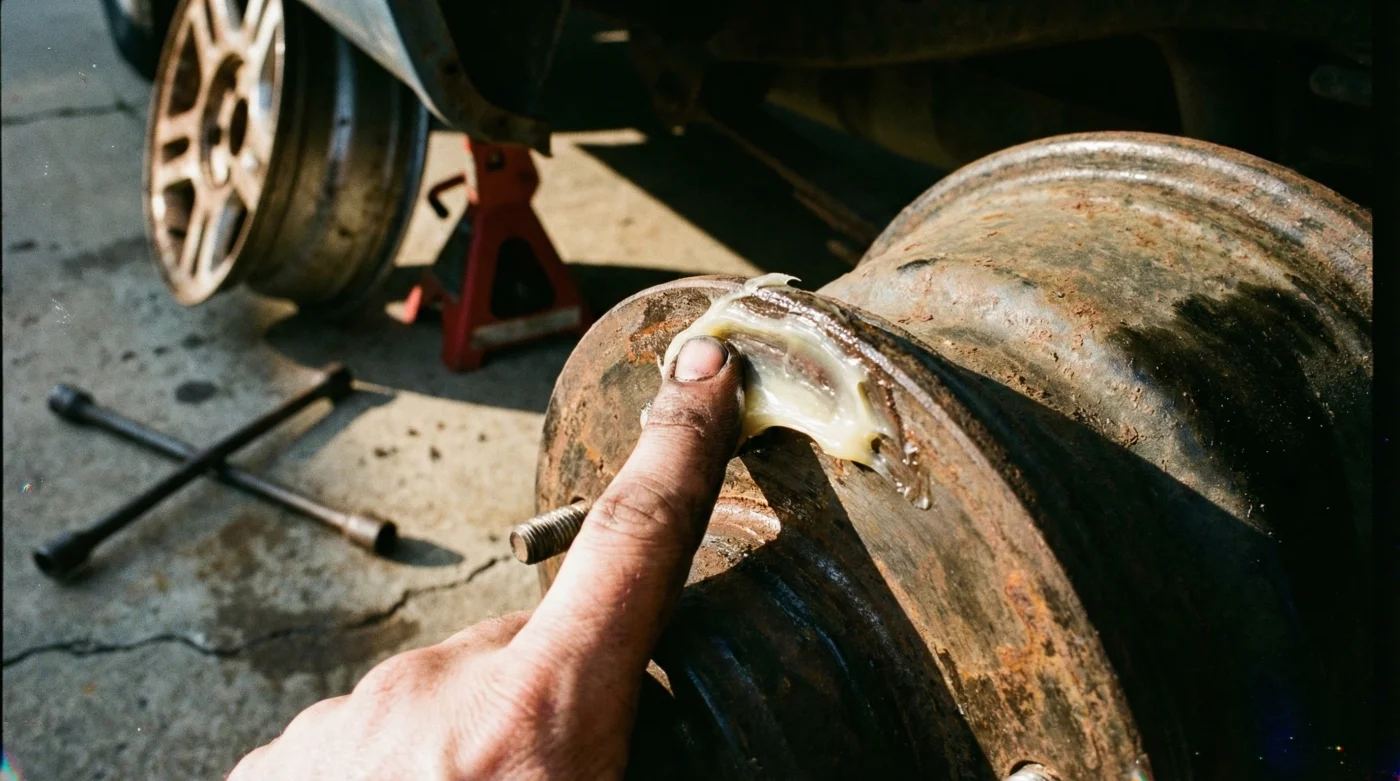
Once the surface is flawlessly prepped, you must apply the compound with surgical precision. Dispense exactly 1 to 2 grams of Lithium Grease—roughly the size of a green pea—onto a gloved fingertip. Thoroughly massage a micro-layer, completely spreading it to a sheer thickness of no more than 0.5 millimeters, directly onto the center hub pilot ring. This is the exact location where the wheel physically hangs and where 90 percent of the binding occurs. Next, apply an equally thin, almost translucent film to the flat face of the hub where the back of the wheel makes direct contact. Experts advise strict adherence to one golden rule: never allow any grease, oil, or compound to touch the threads of the lug studs or the lug nuts themselves. Lubricating the threads drastically alters the clamping friction, practically ensuring you will over-torque and snap the steel studs when you tighten them. Once the hub is coated and the studs are confirmed clean, mount the wheel and torque the lug nuts to the manufacturer’s exact specification in a star pattern.
Mastering this simple, science-backed physical modification elevates your basic car care routine into the realm of professional automotive preservation, ensuring you will never be left violently kicking a stuck tire on the side of a frozen highway ever again.